Get Full Government Meeting Transcripts, Videos, & Alerts Forever!
Get email alerts on the Debt And Bonds topic
No spam. Unsubscribe anytime.
Will County hears bond refunding gains and three borrowing scenarios; no bond action taken
Summary
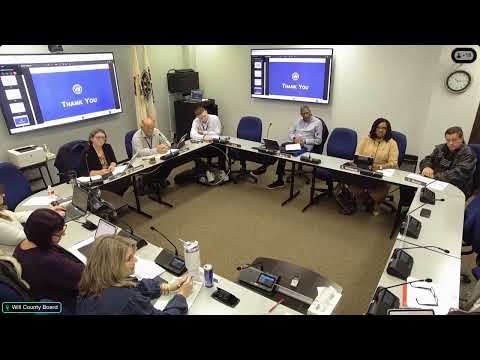
Anthony Miceli of Spear Financial told the Will County Capital Committee on Nov. 4 that October refundings and a tender of taxable 2020 bonds produced about $5.74 million in immediate debt-service savings and left the county with about $291 million in par outstanding after the Nov. 15 payment.
Anthony Miceli, a managing director at Spear Financial, told the Will County Capital Committee on Nov. 4 that the county closed two refunding series on Oct. 15, 2025 and used a tender process and advance refunding on a portion of 2020 taxable bonds to capture interest-rate-driven savings.
Miceli said the 2025 refunding and tender produced about $5.74 million in additional debt-service savings and that, measured against the county’s multi-year refunding program, total savings since 2020 exceed $24.3 million. “It was a really successful transaction,” Miceli told the committee.
After the upcoming Nov. 15 payment, Miceli said total par outstanding across general-obligation and alternate-revenue series stands at just over $291 million; about $180 million of that par is callable with the first call dates in 2029 and the last in 2035. He showed a debt-service schedule that projects roughly $30 million in total debt service in 2026 that declines in later years as older series mature.
Miceli noted the county’s high credit ratings — Moody’s Aa1 and Standard & Poor’s AA+ — and summarized risks that could place downward pressure on ratings, including substantial drawdowns of available reserves, reductions in pension funding, or large and unexpected increases in debt and liabilities. He estimated the market impact of a one-notch downgrade can be roughly on the order of 10 basis points on borrowing costs, but emphasized market conditions vary.
To illustrate capacity, Miceli presented three sample borrowing scenarios (assumptions: 20-year terms, tax-exempt general-obligation alternate-revenue source bonds and interest-rate conditions as of Oct. 2025):
• Scenario 1 (single 2027 issuance): an illustrative par of about $103.995 million (roughly $114 million in estimated proceeds after premium and expenses), sized to keep annual debt service near a $25 million target; Miceli noted that under some years this scenario slightly exceeds the target by about $300,000.
• Scenario 2 (staged 2027 and 2030 issuances): an illustrative combined par of roughly $131.4 million with estimated proceeds near $143 million by staging issuance to take advantage of declining existing debt-service in later years.
• Scenario 3 (three-part issuance through 2030): an illustrative combined par of roughly $142.8 million with estimated proceeds near $151 million achieved by pushing more issuance into later years as capacity opens.
Miceli cautioned there is no single correct timing; he also reminded the committee that for tax-exempt bond proceeds the county must reasonably expect to spend the funds within three years of closing. He concluded the presentation by noting the options are illustrative and that actual issuance sizing should follow identification of project scope and capital spending plans.
Board members asked clarifying questions and debated strategy. Board member Ballot said he was “a little bit confused” and asked whether the presentation signaled an intention to borrow; Miceli and staff said the slides showed what could be done, not a directive to issue debt. Several members urged a separate finance-committee discussion to align capital plans with borrowing options. Other members raised concerns about using bonds to address parking alone and pressed for prioritization of courthouse and justice-related building needs. No new bonds or formal borrowing authorizations were approved at the meeting.
Committee staff and members requested follow-up information, including a historical figure for the original courthouse borrowing and additional detail tying specific capital projects to the illustrative financing scenarios.