Get Full Government Meeting Transcripts, Videos, & Alerts Forever!
Get email alerts on the Collective Bargaining topic
No spam. Unsubscribe anytime.
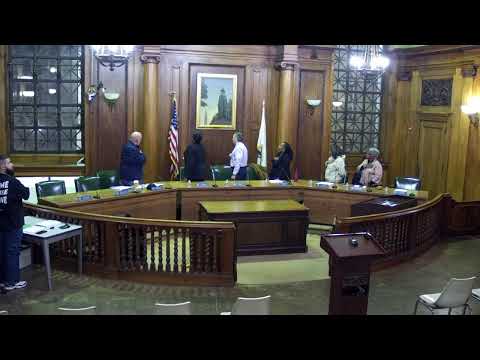
Springfield School Committee votes to enter executive session to discuss successor contract negotiations
Summary
School Committee member Collins moved that the Springfield School Committee enter executive session under Massachusetts General Laws Chapter 30A, Section 21(a)(3) to discuss strategy for successor collective-bargaining negotiations; the motion passed on a roll-call vote.
School Committee member Collins moved that the Springfield School Committee enter executive session under Massachusetts General Laws Chapter 30A, Section 21(a)(3) “to discuss strategy with respect with respect to collective bargaining as an open meeting may have a detrimental effect on the school committee’s position,” naming successor contract negotiations with: United Food and Commercial Workers Union Local 1459 on behalf of Springfield School substitute teachers; United Food and Commercial Workers Union Local 1459 on behalf of Springfield School security guards; Springfield Public Health nurses, Professional and Health Care Division, United Food and Commercial Workers Union Local 1459; and the Technical Employees Association, MTA/NEA, successor contract negotiations. The motion was seconded by Committee member Hurst.
Clerk Cook conducted a roll-call vote. Committee members Collins, Gresham, Hurst, Monroe Naylor and Mayor Sarno were recorded as voting yes; Committee member Gonzales and Attorney Murphy were recorded absent. The chair declared the motion passed and said the committee would return to open session after the executive session.
The motion invoked M.G.L. c. 30A, § 21(a)(3), the statute that allows a public body to meet in executive session to discuss strategy with respect to collective bargaining when an open meeting would have a detrimental effect on the public body's negotiating position. The record in the meeting lists four distinct bargaining units named in the motion; no contract terms, dollar amounts or further negotiation positions were discussed on the public record before the executive session.
No other formal actions or votes on contracts were taken in open session. The committee recessed to executive session as stated and provided no additional timetable for return to open session during the recorded remarks.