Get Full Government Meeting Transcripts, Videos, & Alerts Forever!
Get email alerts on the Pipeline Safety topic
No spam. Unsubscribe anytime.
Railroad Commission details pipeline damage‑prevention process, common violations and trends
Summary
Miles Kirk, manager for pipeline safety support at the Railroad Commission of Texas, described the agency's damage‑prevention workflow, the most frequent chapter 18 violations and new tools for documenting potential noncompliance before damage occurs.
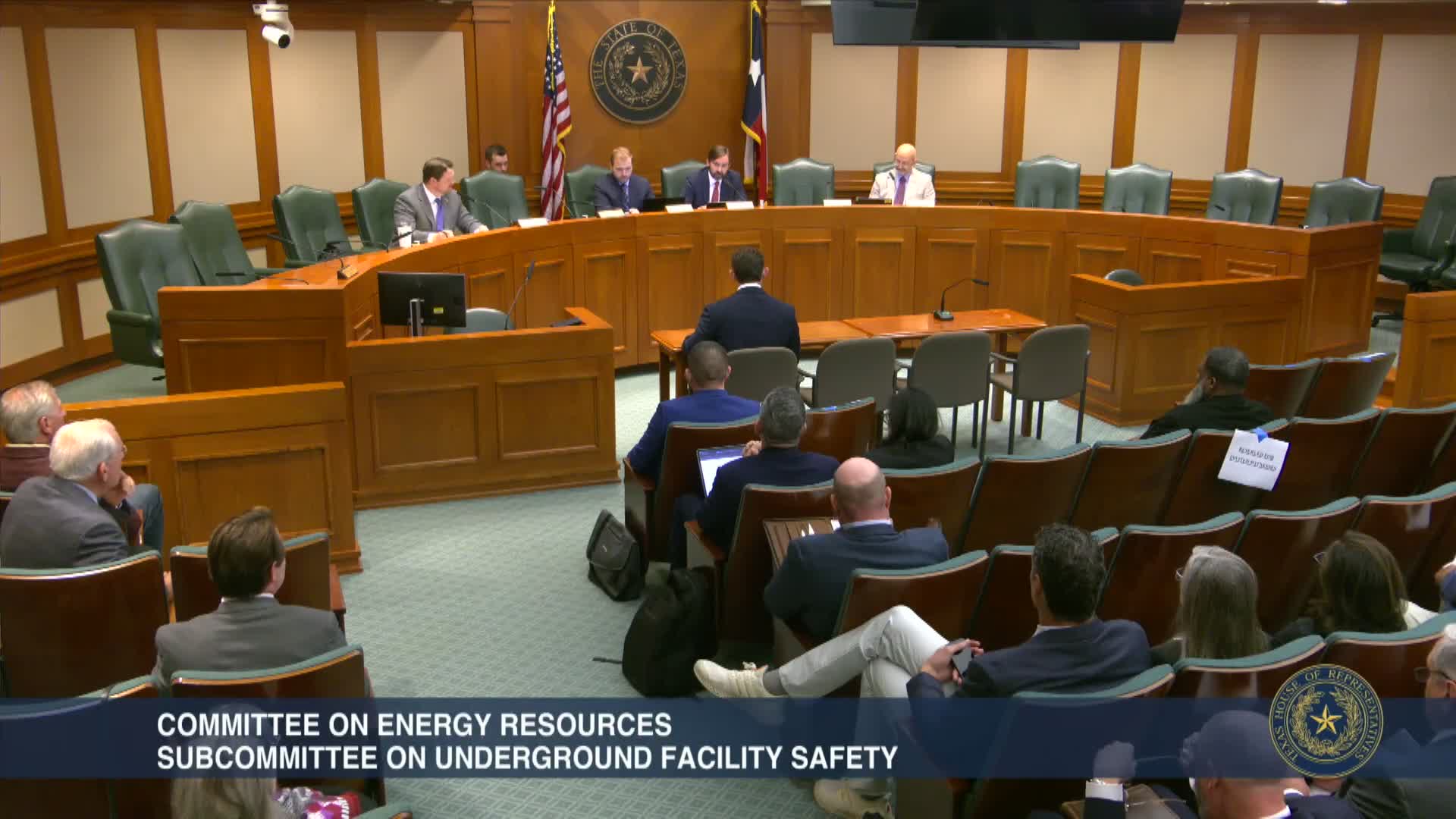
Miles Kirk, manager for pipeline safety support at the Railroad Commission of Texas, told the House subcommittee the Commission's damage‑prevention unit reviews Texas Damage Reporting Forms and enforces chapter 18 when locatable incidents occur.
Kirk described the typical process: after an operator or excavator files a TDRF within 30 days of an incident, a compliance analyst reviews the report, determines any chapter 18 violations and issues a docket to the noncompliant party. Penalties increase if a docket remains unpaid (10% after 45 days, 20% after 75 days) and unresolved matters are referred to the agency legal team after 105 days.
Kirk listed frequent violations by chapter: 18.3 (no locate ticket in place); 18.4 (excavator did not wait the required 48 hours); 18.8(a) (line locator failed to mark accurately); 18.10(b) (failure to dig with care in the tolerance zone); and 18.11(b) (no TDRF within 30 days or no dig‑up ticket within one hour of a damage). He explained the tolerance zone formula (18 inches plus half the pipe's nominal diameter) and acceptable soft‑dig methods inside that zone (hand tools, hydrovac, air‑knife).
Kirk described the "no damage noncompliance report," an administrative tool the Commission can accept when an operator discovers potentially noncompliant excavation before actual damage occurs. The tool lets the commission document the event and notify the party that a future damage by the same actor would likely result in a violation.
On statistics, Kirk said calendar‑year 2024 recorded just over 11,000 damages and a statewide rate of about 2.7 damages per 1,000 locates. He said root‑cause analysis shows "no notification" is the single largest cause at roughly 44%, with tolerance‑zone clearance failures at 24%, locator error at 16% and unlocatable facilities at about 5%.
Kirk answered member questions about "unlocatable" facilities by describing common reasons (for example, lines without tracer wire that locators cannot detect electronically). He closed by offering the Commission's compliance and investigation resources for future subcommittee work.