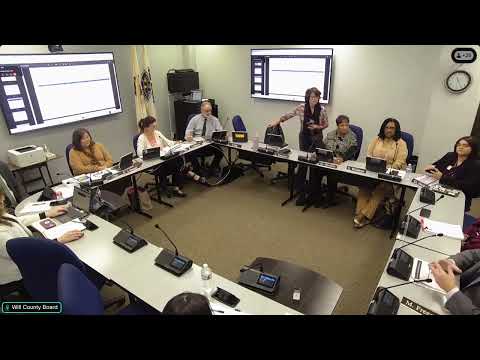
Will County reports $5.7 million in savings from 2025 refunding bonds, outlines future borrowing scenarios
Loading...
Summary
County financial advisers told the finance committee the Oct. 15, 2025 refunding of multiple bond series produced roughly $5.7 million in near-term savings and contributed to combined historical savings of about $24.3 million when paired with a 2020 advance refunding; staff also presented long-range debt capacity and three issuance scenarios.
Will County financial advisers reported to the Finance Committee that the county's 2025A and 2025B refunding bonds, closed Oct. 15, produced about $5,700,000 in savings and were executed without extending the county's overall debt-service footprint.
Anthony Masali of Spear Financial, the county's bond adviser, told the committee the 2025 transactions included a partial tender of 2020 bonds and an advanced refunding. "As a result of all of those, we were able to save through the issuance of the 25 a and 25 b bonds, just over, $5,700,000," Masali said. He added that the 2020 refunding had previously generated roughly $20.5 million in savings; combined with the 2025 work, total savings from the two periods are about $24,300,116.
Masali explained the mechanics and limitations of the tender process used on the 2020 bonds, noting that market participants differ in willingness to sell: "There's certain holders that are very willing to sell the bonds back, and certain holders that, for 1 reason or another don't wanna show a loss on their books."
The presentation summarized the county's outstanding par at roughly $291 million and noted about $181 million of that par is callable. Advisers said the largest portion of operating debt is supported by a mixed pledge of RTA sales tax, general sales tax and landfill host fees; one bond series (02/2021) is pledged to RNG facility revenues.
Spear Financial also reviewed credit metrics. The county holds high investment-grade ratings from Moody's (Aa1) and S&P (AA+). Masali cited Moody's guidance that material drawdowns in reserves (fund balance under 30% of revenues) could pressure the rating; he said the county's current fund balance is roughly 50 percent of revenues.
Looking ahead, the advisers presented three illustrative borrowing scenarios intended to keep annual county debt service near a $25 million self-imposed planning level while addressing capital needs: a single 2027 issuance that would yield roughly $104 million of new borrowing capacity; a two-part issuance (2027 and 2030) that could support about $131 million; and a three-part issuance staggered across 2027, 2029 and 2030 that could produce about $142.8 million of issuance capacity. The advisers emphasized these scenarios are analytical exercises, not recommendations.
Committee members asked timing and program questions during the presentation, including call dates for legacy bonds (Masali confirmed the 2020 bonds have a callable date of Nov. 15, 2030) and the schedule for realizing refunds in the county budget. County staff also explained that the RNG facility revenues currently cover that series' debt service and do not materially alter operating-debt obligations.
The presentation and the committee's discussion focused on debt-management options, market timing, and the trade-offs between issuing once versus staggering issuances to limit interest carry during periods when existing debt drops off. Masali and staff repeatedly stressed the analysis assumes current market rates and that capital-project timing and legal limits on tax-exempt spending should guide any issuance schedule.
Ending: Committee members asked staff to provide additional historical bond payoff schedules and coupon totals for recent years; advisers and staff said they would deliver follow-up materials to the committee.