
Staff weighs two Milwaukee Street designs as Voigt Farm development advances; residents push for medians and bike safety
Get AI-powered insights, summaries, and transcripts
Subscribe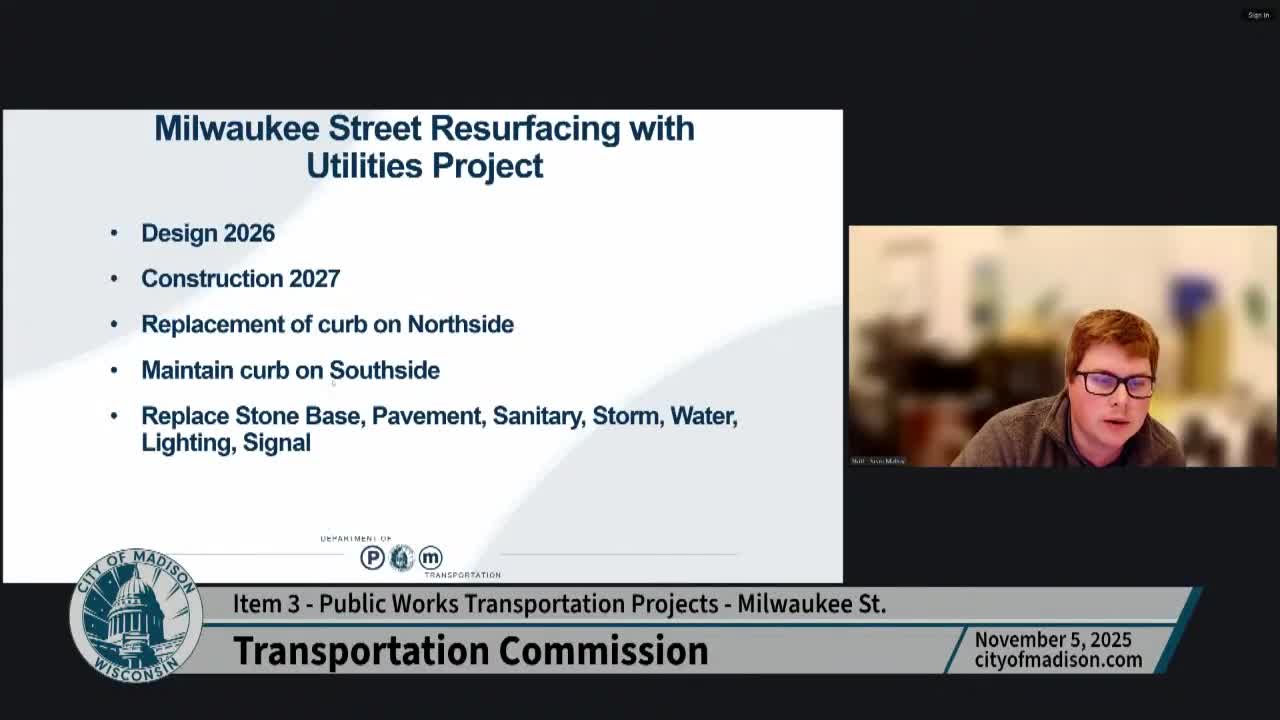
Summary
Engineering staff presented two cross‑section options for Milwaukee Street — a twiddle/two‑way left‑turn lane with a north‑side path versus a four‑lane divided section — and commissioners and neighbors pushed for a median or other measures that favor pedestrians, cyclists and long‑standing small businesses over expanded vehicular capacity.
City staff brought preliminary design alternatives for the Milwaukee Street resurfacing and utilities project to the Transportation Commission on Nov. 5 as the Voigt Farm development approaches construction. The designs respond to competing guidance: a prior neighborhood special area plan recommended a four‑lane divided cross‑section, while the Madison Complete Green Streets Guide lists Milwaukee as a community connector that should include protected bike facilities and context‑sensitive design.
Staff reported 2024 traffic counts of about 13,000–14,000 average daily trips on segments of Milwaukee Street. Using trip‑generation estimates for the Voigt Farm project and an allowance for mode shift, staff estimated roughly 5,500 additional vehicle trips tied to the development; that projection pushes projected ADT near or slightly above the Complete Green Streets threshold staff uses to evaluate cross‑section options.
Two alternatives described: a) a two‑way left‑turn lane (“twiddle”) with a north‑side multiuse path, 11‑ft bus‑capable lanes, and parking bays on the development side; and b) a four‑lane divided cross‑section with medians and parking on the north side. Staff noted constrained geometry on curve approaches that make center bus lanes costly in places.
Public commenters and several commissioners urged a hybrid approach that resists adding motor vehicle capacity. Grant Foster and others recommended retaining a median and carving space for a more generous refuge at pedestrian crossings; Foster suggested using some recovered travel‑lane width to create a planted median and wider pedestrian refuges while still accommodating left‑turn bays at key intersections. Nicholas Davies, a resident, warned that adding lane capacity risks inducing traffic and argued for pedestrian refuges and a safer, connected bike facility instead.
Sean (project staff) said the project is at the start of design (2026 design, 2027 construction target) and that staff will refine geometry, evaluate medians and examine where protected bike facilities or side paths will fit. Commissioners asked staff to carry forward a median‑oriented design and to evaluate curb changes, sight lines, and small‑business parking impacts through the Safe Streets Madison prioritization process. Sean said some of the north‑side multiuse path work is expected to be built by the Voigt Farm development, which affects the project’s footprint and cost.
What’s next: staff will refine a hybrid option that emphasizes pedestrian refuges and continuous bike connections, examine on‑street parking impacts for existing businesses, and return with a recommended cross section after more detailed design.