Wooster council debates seven proposed TIFs; leaves ordinances on second reading
Loading...
Summary
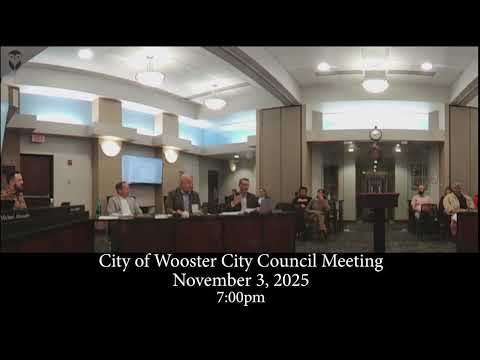
Wooster City Council members spent the Nov. 3 meeting debating seven proposed tax increment financing ordinances (Ordinances 2025-16 through 2025-22) that would redirect newly created tax revenues toward infrastructure projects; the council left the measures on second reading after extended public comment and staff explanations.
Wooster City Council members spent the majority of their Nov. 3 meeting discussing a package of seven proposed tax increment financing (TIF) ordinances covering multiple parcels (Ordinances 2025-16 through 2025-22). The clerk read the seven ordinances at the start of the discussion; the measures would declare targeted improvements a public purpose under Ohio law (ORC 5709.40(b)) and establish the collection and deposit of service payments to pay for infrastructure related to new development.
The public comment period included three speakers who focused on the TIF package. Ted Hill, a resident of 735 Bell Avenue, urged caution and said the city should “use the TIFs very sparingly, very carefully,” warning of hidden costs for the school district. Another resident and multiple council members asked whether the TIFs would lock money into specific projects if a developer did not proceed and whether the school district could lose revenue while still pursuing levies.
Jonathan, the city’s director of administration, walked council through how the proposed TIFs would operate under ORC 5709.40(b). He said the ordinances are structured as parcel/area TIFs intended to fund infrastructure (streetscape, access, multi‑use trails, roundabouts and similar items) that make development possible; the administration described TIFs as an investment intended to produce a larger tax base over time. Administration cited prior local examples, including a parcel TIF used to reconstruct Long Road and an earlier Oak Hill TIF (previously described to council at about $8.6 million) to show how infrastructure financed by a TIF can enable development and later return revenues to taxing districts once projects are completed.
Council members and the public pressed for specifics. Questions included how long redirected revenues could be held, whether funds must be returned if unused, and the effect on school finances. Administration said the model before council redirects up to 75% of newly created tax revenues for a period up to 10 years under the cited ORC section and that, if funds are not used for qualifying infrastructure, monies are remitted back to the affected taxing districts. Administration also noted that pro forma estimates vary by project and that income‑tax sharing thresholds (for new payroll) influence how much income tax revenue may be available for sharing in addition to property‑tax increments.
Several council members voiced concern that approving seven new TIF areas at once could create the appearance of overuse and might reduce short‑term school receipts at a time when the district is seeking local support for facilities levies. Others argued the TIFs would accelerate infrastructure projects listed in the city’s comprehensive plan, potentially increasing the tax base and easing the long‑term levy burden. Administration said the package is intended to be a tool to unlock targeted redevelopment and that each TIF would include pro forma estimates to show expected impacts on school and county revenues.
After extended discussion and questions of staff, the council agreed to a blanket action to leave Ordinances 2025-16 through 2025-22 on second reading; no final ordinance votes were taken Nov. 3. The city administration said it will continue to engage affected partners and produce the detailed pro forma and tax‑incentive review documentation that will be used in subsequent budget and review processes.
What happens next: the seven ordinances remain on second reading and will return to the council for further consideration at future meetings; administration said each TIF would also be reviewed in the annual tax incentive review process and tracked in the budget.