
Teacher-parent urges Burleson ISD to expand training, supports for neurodivergent students
Get AI-powered insights, summaries, and transcripts
Subscribe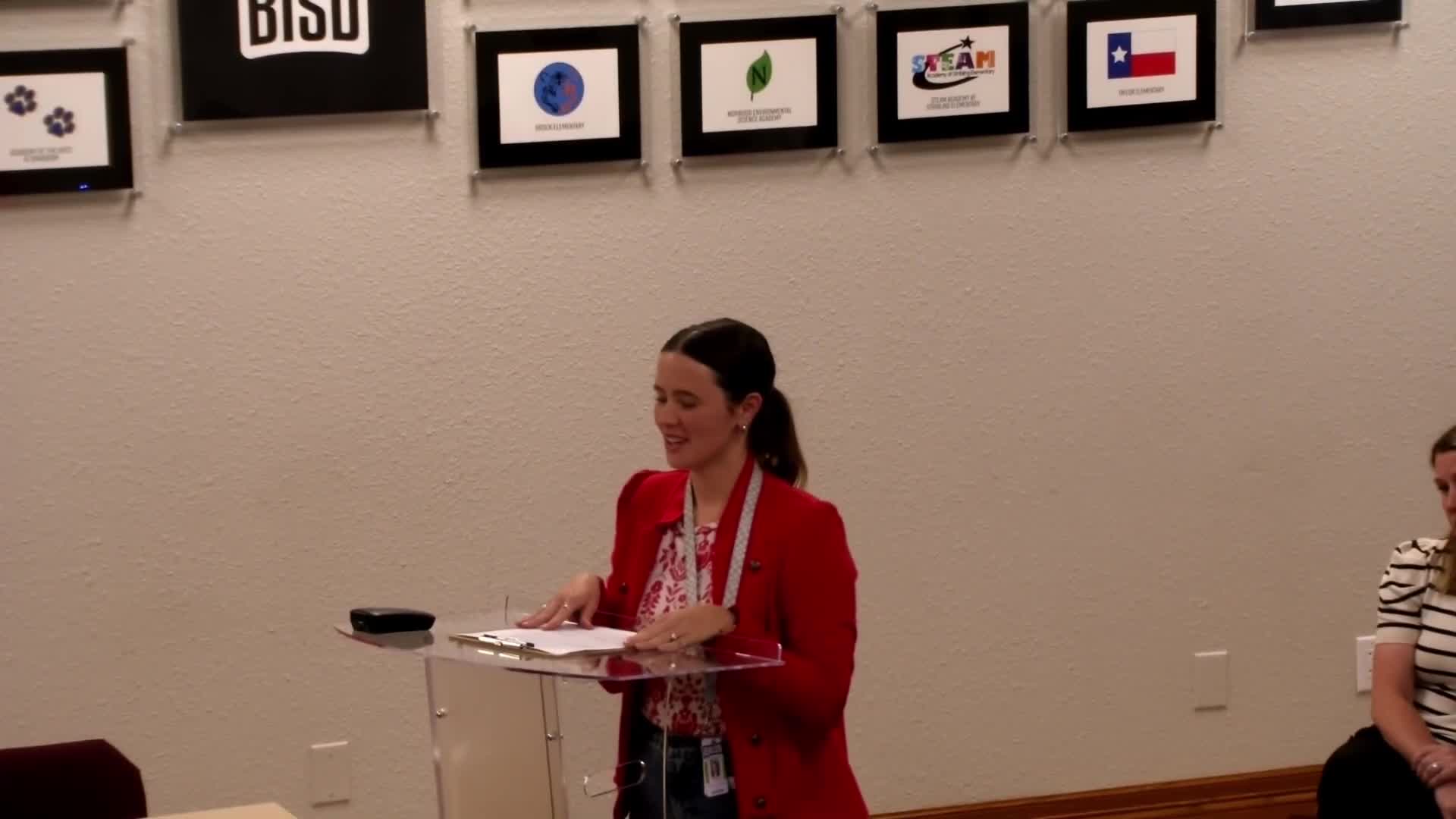
Summary
Samantha Steinbart, a district teacher and parent, told the board she is asking the district to partner with families and provide meaningful training and supports for students with ADHD and autism, citing state prevalence data and concerns about inconsistent special education implementation.
Samantha Steinbart, a Burleson ISD teacher and parent, addressed the board during the public-comment period on Oct. 27 to urge the district to increase training and supports for neurodivergent students, particularly those with attention-deficit/hyperactivity disorder and autism.
Steinbart said she has been an educator for 10 years and described her mission as promoting academic growth while prioritizing "human growth." She asked the board to work with teachers and families to better understand students whose behaviors stem from neurodivergence, saying current teacher training is limited to packets of accommodations provided each August and does not explain the underlying "why" of behaviors. She argued that without better understanding, students are at risk of being mischaracterized by peers and adults.
Citing public data, Steinbart said about 14 percent of Texas students have ADHD (up from about 8.6 percent 10 years earlier) and that Texas's estimated autism rate is about 1 in 28, higher than the national estimate she quoted. She referenced a University of Texas at Austin report that found many districts are noncompliant with IDEA mandates, and said staffing shortages and funding constraints make it harder to serve growing special education needs.
Steinbart urged the district to invest in educator training that explains why behaviors occur and how adults can identify and remove barriers to learning. She said teachers in the district are willing to participate in training and that such work benefits both students and classroom instruction.
Her remarks were delivered as public comment; the board did not take action on the request during the meeting.