Get Full Government Meeting Transcripts, Videos, & Alerts Forever!
Get email alerts on the Public Rights Of Way Enforcement topic
No spam. Unsubscribe anytime.
Committee backs ban on commercial auto repairs in Baltimore City public rights-of-way
Summary
A Baltimore City Council committee voted to recommend passage of Council Bill 25-0095, a measure that would prohibit commercial, nonemergency motor-vehicle repairs on city streets and sidewalks and create civil penalties for violations.
A Baltimore City Council committee voted to recommend passage of Council Bill 25-0095, a measure that would prohibit commercial, nonemergency motor-vehicle repairs on city streets and sidewalks and create civil penalties for violations.
Councilman Mark Parker, the bill sponsor, told the Land Use and Transportation Committee the legislation responds to complaints from neighborhood groups about “disruptive and potentially dangerous commercial auto repair practices happening in city streets.” Parker said the measure is intended to address a gap in the city code that has limited enforcement against unlicensed, mobile repair operations. “This bill is intended to prohibit the dangerous and improper activity of commercial auto repair services, on city streets and sidewalks,” Parker said.
Why it matters: Committee members and agency staff said mobile commercial repair operations can create traffic and parking disruptions and environmental hazards — for example, oil and other contaminants left in the public right-of-way — and can circumvent zoning and permitting requirements that apply to fixed repair shops. The committee heard that the bill is designed to protect public rights-of-way used by buses, pedestrians and other road users while leaving intact an exemption for emergency roadside assistance and for residents working on their own vehicles on or adjacent to their property.
Agency positions: The Law Department approved the bill for form and legal sufficiency, and the Baltimore City Parking Authority said it was “favorable” because limiting noncompliant uses should improve parking availability. The Office of Equity and Civil Rights said it found no inequity in the bill’s intent and that curbing mobile repairs could have positive health and safety effects and better enforce zoning rules.
Enforcement questions and process: The Department of Transportation (DOT) and Baltimore Police Department (BPD) expressed support but flagged operational questions. DOT said it currently relies largely on Transportation Enforcement Officers for parking matters and that the department has 10 special enforcement officers who work on right-of-way code enforcement; those officers, DOT said, could be tasked with enforcing the proposed prohibition. DOT representative Luciano Diaz said the measure would give the agency “another tool in our arsenal” and that higher fines would make enforcement more justifiable given limited staff.
Committee members pressed DOT and other agencies for details about how citations would be issued in the field, how officers would identify repeat violators, and how residents would request enforcement through 311. The Law Department outlined the citation process in the code, including that a citation is a prepayable civil citation that a person can challenge in district court and that refusing to provide identification when requested may itself be a separate violation under the code. DOT and BPD representatives said they would follow existing citation procedures and coordinate on enforcement, but acknowledged that additional staffing and operational protocols may be needed to sustain proactive enforcement.
Penalties and amendment: After DOT review, the sponsor offered an amendment that raised penalty levels for commercial operators. The amendment sets a civil penalty of $250 for a first offense and $350 for subsequent offenses for a motor vehicle repair service making repairs in the public right-of-way. Committee discussion also referenced existing penalty ranges in other sections of the code (for example, $25–$100 for some right-of-way violations and Montgomery County examples) and noted practical questions about how officers determine whether a citation is a first or repeat offense in the field.
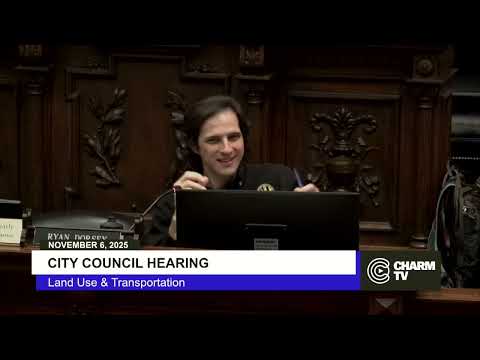
Outcome and next steps: The committee approved two amendments and voted to recommend Council Bill 25-0095, as amended, favorably to the full City Council; Chair Ryan Dorsey recorded his aye vote. The committee forwarded the bill to the council meeting scheduled for Monday, Nov. 10, for further consideration. Agencies requested follow-up at second reader to clarify operational protocols, citation processes and the role and dispatch mechanisms for special enforcement officers.
Community input and context: Parker credited the Greektown Neighborhood Association and Brewers Hill Neighborhood Association for raising the issue. Committee members said the problem is widespread across the city, not confined to one district, and may include both contractors operating repeatedly in public rights-of-way and repair shops that extend operations into adjoining streets or alleys.
What the bill does not do: The legislation, as explained by the sponsor, does not prevent residents from working on their own vehicles on private property, does not restrict emergency roadside assistance, and does not regulate repair activity that occurs wholly on private property.