Get Full Government Meeting Transcripts, Videos, & Alerts Forever!
Get email alerts on the Overdose Response topic
No spam. Unsubscribe anytime.
Council committee votes to advance resolution urging naloxone placement alongside AEDs in public buildings
Summary
The Public Health and Environment Committee voted 5–0 to advance Resolution 25-0005R, which urges implementation of state law to place naloxone with AEDs in designated public buildings. The committee also agreed to form a working group to identify interim local sites for naloxone placement ahead of statewide distribution.
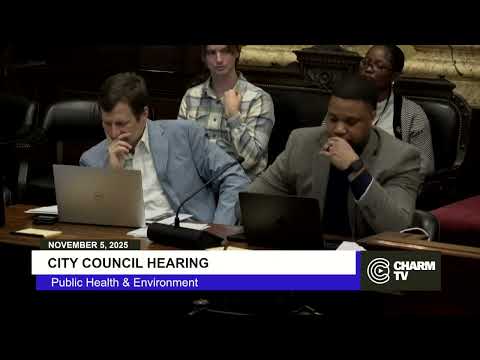
Baltimore City Councilwoman Felicia Porter, chair of the Public Health and Environment Committee, presided over a committee vote that advanced Resolution 25-0005R seeking the co-location of naloxone with automated external defibrillators (AEDs) in designated public buildings.
Councilman Mark Conway, sponsor of the resolution, said the city must move faster to ensure naloxone is available at “those brief moments before someone succumbs to opioids,” and pressed agencies for updated implementation plans. Julia Roche, legislative affairs director at the Baltimore City Health Department, summarized state law requiring the placement of naloxone alongside AEDs in specified public gathering spaces and said the program is to be funded through state opioid restitution funds.
Nina Themlas, director of government relations for Mayor Scott, reported a pilot naloxone box recently installed at the Penn North Metro station and said usage data from that pilot will inform future placements. Committee members asked whether naloxone is currently accessible at City Hall and other listed sites; agency representatives said distribution under the state program had not yet reached every local AED and that some placements remain pending statewide implementation.
To avoid delay, Chair Porter and members agreed to form a committee working group — including the Mayor’s Office of Government Relations, the Health Department and other relevant agencies — to identify priority local locations where naloxone could be placed immediately ahead of full statewide distribution. Conway committed to provide a list of proposed locations by the end of the week; the committee aims to reach placement decisions within roughly a month of receiving that list.
A roll-call vote on the resolution was made by motion of Councilman Conway and seconded by Councilwoman Odette Ramos. Porter, Conway, Mark Parker, Ramos and Councilman Torrance voted yes; two members were absent. The motion passed and the resolution will proceed to second reader at the full council meeting on Nov. 10.
The committee characterized the action as an interim step to accelerate local access while continuing coordination with the state office charged with statewide distribution. Officials said procurement and distribution schedules are controlled by the state program and will guide the final placement process.