
Planning commission weighs eliminating parking minimums in major code rewrite
Get AI-powered insights, summaries, and transcripts
Subscribe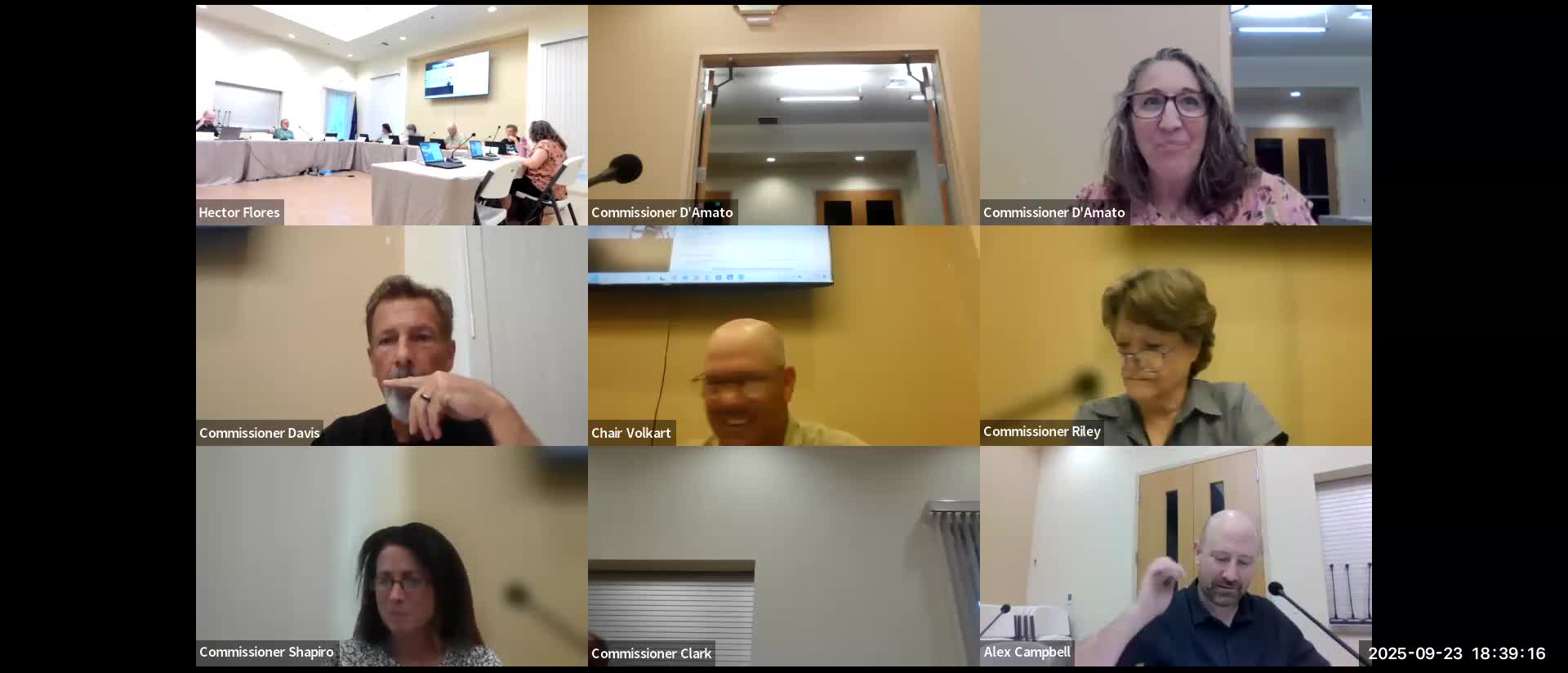
Summary
Staff presented proposed parking development code amendments that would remove parking minimums to comply with Oregon Administrative Rules; commissioners spent extensive time on implications for short‑term rentals, residential care homes, bike parking, EV readiness and ADA access.
Talent Planning Commission reviewed proposed amendments to the city’s parking development code (CNA-2025-002) at its Sept. 23 meeting, as staff described options required by Oregon Administrative Rules and recommended eliminating parking minimums citywide.
Staff member Alex said the state rules offer two primary approaches: remove parking minimums citywide or eliminate them only within a half‑mile of a high‑frequency transit corridor, and that either path would likely require measures such as unbundling parking from leases or establishing parking districts. "It seemed to me to follow what I think 90 plus percent of jurisdictions have are doing in Oregon is it's far easier to just eliminate the minimums and, and be done with it," Alex said.
The proposal on the table would remove minimum off‑street parking requirements and retain or clarify maximums and lot design standards. Staff described required bike‑parking minimums under state rules and proposed that bicycle parking requirements remain enforceable even where off‑street auto parking is not required. Staff also proposed EV‑readiness requirements for new commercial and multiunit developments, and design standards for large parking lots (defined as more than a half acre) including a tree canopy target intended to reach about 40% coverage within 15 years.
Commissioners asked detailed questions about consequences for short‑term rentals (STRs), residential care homes, and enforcement. One commissioner cautioned, "I do wanna put a pin into that issue with STRs because I would hate for us to inadvertently be opening up STRs, at least on the parking front." Alex said the simpler citywide elimination of minimums would likely remove existing STR parking requirements (currently 2 spaces per unit up to five), whereas the more complex half‑mile option might allow the city to retain such rules outside the transit buffer.
On residential care homes, Alex told the commission that state guidance lists residential care as a use the city must exempt from parking minimums under the alternative compliance paths; the draft retains maximums for those uses and staff adjusted rounding in calculations so some maximums increase modestly. "Residential care is one of the categories that we have to exempt no matter which way we go," Alex said. Commissioners and commenters representing disability services flagged operational needs for vans, staff parking and access to shopping, urging close review of how the change would affect residents and caregivers.
The commission discussed shared (joint) parking language; staff said the state materials use the term "shared parking" and will confirm wording for consistency. On bicycle parking, staff noted the code ties bike‑parking minimums to other metrics in places and will ensure requirements meet the state standard; commissioners asked staff to confirm what constitutes one bicycle parking space (a secure two‑point lockable facility).
Staff also proposed clarifications for ADA access: if a development provides any on‑site parking, required accessible spaces must be on‑site; if no on‑site parking is provided, accessible parking must be located on the shortest accessible route and no more than 200 feet from an accessible entrance. Commissioners asked staff to reconcile any city language with federal ADA obligations and to return with that comparison.
The commission did not take a formal vote on the parking amendments and directed staff to return with clarified code language, answers on STR licensing vs. land‑use authority, confirmation of OAR citations and definitions (including the high‑frequency transit map), and additional detail on bike‑parking and EV‑readiness standards ahead of the public hearing.
Ending: Staff said the parking amendments and related code edits will be posted for public hearing and that commissioners should expect a return packet with refined code language and supporting analysis.