Get Full Government Meeting Transcripts, Videos, & Alerts Forever!
Get email alerts on the Local Governance topic
No spam. Unsubscribe anytime.
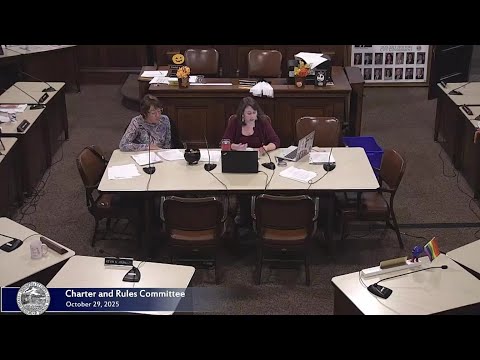
Holyoke Charter & Rules committee narrows Public Service committee role, advances several procedural rule changes
Summary
The Charter and Rules Committee voted to limit the Public Service Committee’s formal jurisdiction to appointments and confirmations, moved several agenda and committee-scheduling changes forward to full council, accepted a law department opinion on censure, and adopted a new draft rule restricting late-filed orders.
The Holyoke City Charter and Rules Committee on Thursday narrowed the stated duties of the Public Service Committee and forwarded several technical rule changes to the full City Council for consideration.
Chair Meg McGrath Smith said the existing rule text had accumulated a broad set of responsibilities and needed tightening. "Public service and human resources committee shall have jurisdiction over matters related to transportation, the affairs of the parks, recreation, and forestry department, the appointment or election of any city official, matters related to city employees and personnel, permits for home occupation issued by the city council, and matters pertaining to the elderly, the geriatric authority, and the council on aging," she read from the current rules during discussion and urged the committee to pare that list back to reflect how work is actually assigned.
The committee adopted a motion to amend the rule so that the Public Service Committee's jurisdiction is limited to "matters related to the appointment or election of any city official subject to city council appointment or confirmation." The motion to delete the broader list of jurisdictions and to remove duplicative references in other rule subsections was seconded and carried by the committee. Solicitor Jeffrey Bissonnette explained the practical effect: "My understanding is that the public service committee does interviews, at the request of the city council, by referral for any of the city positions that are subject to council appointment," noting that urgent vacancies and other time-sensitive matters can still be handled by the full council or by suspending rules if necessary.
Why it matters: Committee and council rules determine where matters are vetted before the full council votes. Committee members said narrowing the rule will reduce confusion about where items are formally referred; they also noted that many topics currently listed under Public Service historically go to other standing committees.
Other actions and guidance
Agenda order: The committee amended Rule 7(a) to make item 3 read "presentation of proclamations, memorials, and remonstrances," followed by the president's report and then public comment. Members said that placement better matches current practice and is clearer for the public.
Late-filed orders: The committee adopted new language restricting late-filed orders. The draft rule reads in part: "There will be no late filed orders added to the agenda unless they are a matter critical to the city and no member objects. To add a late file to the agenda, the maker of the order must contact the city clerk, city council assistant, and city council president. If the late file is not acted upon, it shall become a new order on the next regular agenda." Committee members asked staff to ensure the change aligns with open-meeting obligations and website practice so the public can still see late files that were not taken up.
Censure and disruption: The committee reviewed legal memoranda about whether the council may censure a member for disruptive conduct and accepted the law department’s advice. Bissonnette said the council "is the maker of its own rules and has the ability to impose discipline upon its members," but cautioned that any disciplinary procedure should include notice, an opportunity to be heard and appropriate legal safeguards.
Question to law department: The committee voted to forward to full council a proposed new rule (new rule 6(h)) that would allow "any member of the council, upon being recognized by the president, [to] pose a question to be answered by the law department." Committee members debated whether on-the-spot legal requests are appropriate or whether the law department should respond outside meetings; the committee voted to send the proposed rule to the full council with the committee's recommendation.
Committee scheduling: The committee amended the rule restricting simultaneous subcommittee meetings to permit them only when previously approved by a majority vote of the full council or when done as a joint meeting; that amendment will be forwarded to council.
Charter/rule alignment: The committee confirmed that recently adopted charter language requiring first and second readings for certain appropriation measures is reflected in the rules and marked that item complied with.
What the committee did not decide: A broader reorganization of how subcommittee information is presented in the rules was tabled so members can review a draft document and circulate edits in advance.
Who spoke: Committee Chair Meg McGrath Smith (chair), City Council President Tessa Murphy Amaletti (Charter & Rules member), Councilor Bacon, Councilor Anderson Burgos, Councilor Devine, and City Solicitor Jeffrey Bissonnette participated in the substantive discussion and votes.
Next steps: Several rule amendments and the new late-filed-orders language were forwarded to full City Council with the committee’s recommendation; the subcommittee reorganization was tabled for a future meeting.