Get Full Government Meeting Transcripts, Videos, & Alerts Forever!
Get email alerts on the Solar Zoning topic
No spam. Unsubscribe anytime.
Davenport council pushes solar farm zoning debate to next week, seeks citywide map and legal guidance
Summary
Aldermen on the Davenport City Council Committee of the Whole left the proposed zoning changes for utility‑scale solar farms and a proposed moratorium extension open for further discussion after asking for more mapping and legal detail.
Aldermen on the Davenport City Council Committee of the Whole left the proposed zoning changes for utility‑scale solar farms and a proposed moratorium extension open for further discussion after asking for more mapping and legal detail.
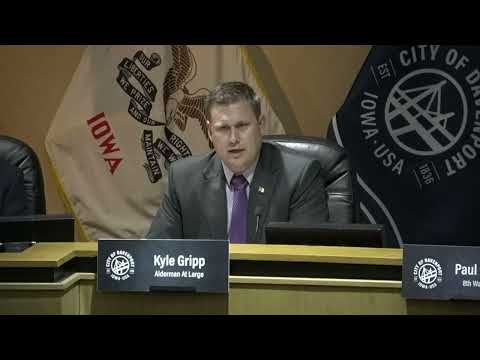
At the meeting Nov. 5, Alderman Gripp opened the public hearing on ORD25-02, described in the agenda as "a request of the City of Davenport to amend Title 17 (zoning) regarding solar farms as a principal use and freestanding solar panels as an accessory use." With no members of the public present to comment, the public hearing was closed and the item remained on the discussion list rather than moving to final consideration.
Alderman McGinnis, who said staff had worked "very diligently" to clarify language since the moratorium, expressed concern about allowing "utility scale" or standalone solar arrays in industrial (I‑1/I‑2) and agricultural (AG) zones via special use permit. "What I am not comfortable with is the utility scale, allowing with special use permit," McGinnis said, adding that floodplain and special flood hazard areas would remain ineligible but that other locations in I‑1, I‑2 and AG could be allowed.
Multiple aldermen asked staff to provide a clear, citywide visual of where those zoning districts exist. "I'm asking staff to bring us back, available for next week... a map showing these areas marked out," McGinnis said. Alderman Kelly and Alderman Rick Dunn signaled similar concerns and interest in seeing a comprehensive map before further action.
Council also discussed the procedural options for regulating these installations. One alderman summarized the choices: allow utility‑scale arrays by right in identified districts, ban them in those districts, or allow them only through a special use permit subject to Planning and Zoning and the CBA review process. Council asked staff to provide a legal opinion on whether the city may categorically prohibit utility‑scale solar in those districts or must regulate them by special use or by‑right allowances.
Separately, the council considered a resolution to extend the moratorium on new solar farms and freestanding solar panels as an accessory use until Feb. 12, 2026; Alderman Newton requested that the moratorium item remain on the discussion agenda so the council could amend the date if needed after reviewing the mapping and legal guidance.
What’s next: Staff indicated they would look into producing a large or digital map showing I‑1, I‑2 and AG parcels and identifying flood‑restricted areas for the council and public. Council members agreed the map and a written legal opinion on allowable municipal regulatory options were needed before a final vote on ORD25-02 or any change to the moratorium date.
Sources: Transcript of Davenport City Council Committee of the Whole, Nov. 5, 2025 (Alderman Gripp; Alderman McGinnis; Alderman Kelly).