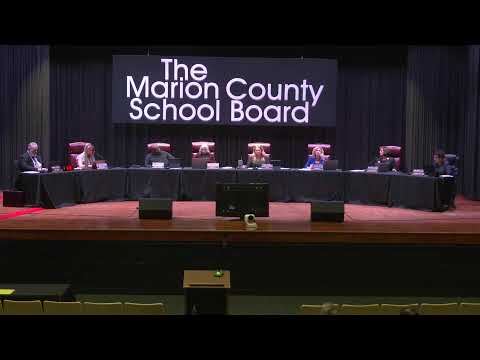
Board moves ahead with attendance-boundary advisory committee as staff outlines North End rezoning and school consolidation options
Loading...
Summary
District staff told the Marion County School Board on Nov. 6 that concentrated population growth and uneven elementary enrollment make rezoning in the North End necessary, and the board gave consensus to form an Attendance Boundary Advisory Committee to guide community input and technical recommendations.
Marion County School District staff told the school board on Nov. 6 that the district faces concentrated growth over the next decade and must consider rezoning and facility changes in the North End to maintain efficient utilization and fiscal sustainability.
Mr. Whitehouse, presenting a district analysis, said conservative projections put growth at about 600 students per year (roughly 6,000 over 10 years), concentrated in Southwest Marion County and the Shores. Staff focused a rezoning discussion on six elementary campuses—Anthony, Fessenden, Oakcrest, Ocala Springs, Reddick Collier and Sparr—finding that combined utilization across those schools is about 82 percent, a level staff judged acceptable and capable of absorbing near-term shifts if boundaries are adjusted.
To guide community engagement and technical work, staff recommended forming an Attendance Boundary Advisory Committee (ABAC) that would include board-nominated members (one per board member), a superintendent nominee, representatives from the Public Education Foundation, CEP, NAACP, the county commission, Hispanic Business Council, ESE director, and the land-development industry. A resolution to create the ABAC is on the board agenda for Nov. 11; staff asked board members to nominate committee members immediately if the board approves the resolution so meetings can start quickly.
Fiddler Springs: staff reviewed an earlier proposal to relocate the Fiddler Springs diagnostic and learning resource center into Building 10 at Reddick Collier but recommended against the move for several reasons: Building 10’s fixed bathrooms and small training spaces limit adult use; relocating Fiddler Springs would reduce training square footage and create scheduling and security burdens; and Fiddler Springs serves multiple counties and functions as a regional training site. Staff said more detailed operating-cost allocations and funding splits will be provided.
Sparr/Anthony consolidation: staff presented a financing scenario to build a combined Sparr–Anthony elementary school sooner by reallocating funds in the district’s capital program: reassigning an existing $3.8 million planning allocation, realizing roughly $13 million in cost avoidance by incorporating two newer Bellevue buildings into that project, and delaying a Dunnell Middle–High project (~$38.8 million) by one year. That approach could generate roughly $55 million for a new school, a figure comparable to recent elementary project costs the district cited. Staff emphasized alternatives, including a scaled rebuild or renovation at roughly $25–30 million, remain possible and should be part of community conversation.
Board direction and next steps: the board gave consensus to move forward with creating the ABAC and to begin ABAC meetings in November–December focused on North End boundaries. Staff will present committee recommendations at a December or January work session and hold community meetings and a rule-development and public-hearing process March–April if boundary changes are proposed. Additional items staff will address include auxiliary zones created when Evergreen closed, potential uses for vacated sites, Bridgeway relocation, and any capital reallocation proposals. Staff also committed to providing virtual tours of recently built elementary schools for community information.