Get Full Government Meeting Transcripts, Videos, & Alerts Forever!
Get email alerts on the Housing topic
No spam. Unsubscribe anytime.
Board adopts SHRA’s $341 million proposed 2026 budget amid questions about vouchers, HUD proration and shelter projects
Summary
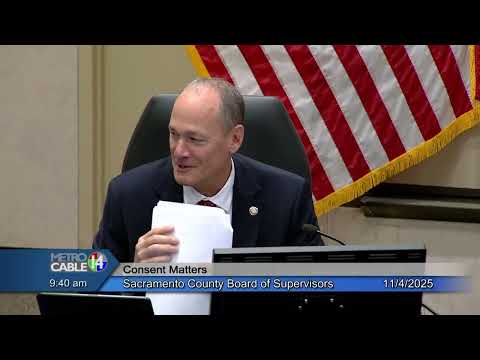
The Sacramento County Board of Supervisors on Tuesday unanimously adopted the Sacramento Housing and Redevelopment Agency’s proposed 2026 budget, a $341 million plan SHRA officials said is driven by federal housing assistance and rising rental costs.
The Sacramento County Board of Supervisors on Tuesday unanimously adopted the Sacramento Housing and Redevelopment Agency’s (SHRA) proposed 2026 budget, a $341 million plan SHRA says is driven largely by federal housing assistance dollars and rising rental costs.
SHRA Assistant Director of Finance Kaye Giunta told the Board that the agency expects about $341,000,000 in new resources in 2026, with the largest single allocation—$216,000,000—dedicated to Housing Assistance Payments for the Housing Choice Voucher (HAP) program. Capital projects were set at about $60,700,000, salary and benefits at $37,100,000 and services and supplies at $19,200,000.
“The majority of these resources is derived from federal funding,” Giunta said, adding that more than 70% of the budget is tied to U.S. Department of Housing and Urban Development (HUD) programs. “This distribution demonstrates how SHRA balances operational needs with program investments while ensuring the majority of our dollars go directly into housing assistance and community development.”
Acting Executive Director Jim Shields reviewed state and federal developments affecting the budget and programs. He highlighted California investments—an additional $1 billion for homeless housing and prevention in the governor’s plan and large allocations for Homekey, multifamily housing programs and low‑income housing tax credits—and warned of federal uncertainty caused by continuing appropriations and HUD proration.
“We received our HAP funding this month and have sent payments to landlords, and HUD has said we will receive funding for December as well,” Shields said. “But proration remains a key risk: administrative fees and subsidy proration can shift year to year, which requires us to budget conservatively.”
Board members pressed SHRA on several issues. Supervisor Serna asked for an explicit breakdown showing how much of the $341 million is targeted to county‑administered programs and how much supports city projects administered by SHRA as a joint powers authority. Giunta and Shields said staff will return with a county‑specific breakout.
Supervisor Hume asked for detail on the $60.7 million in capital spending, wanting a category‑level breakdown (new ground‑up development, conversions, loans/grants to non‑profits, and rehabilitation). Shields said that information is available and that staff will provide it in follow‑up briefings.
Several supervisors also pressed SHRA on operations and program sustainability: HUD proration’s effect on HAP, the status of emergency housing vouchers and the agency’s long‑term plan for aging public‑housing stock. Shields described efforts to place emergency vouchers at the top of waiting lists, to request HUD waivers to protect voucher status, and to modernize financial and property management systems (replacing legacy Yardi with Voyager 8) to reduce operating costs.
“We were awarded an allocation of 494 emergency vouchers intended to be 10‑year supports, but funding uncertainties mean we must seek waivers and contingency measures,” Shields said, noting HUD’s system upgrades and proration process complicate short‑term planning.
On redevelopment strategy, Shields discussed SHRA’s use of RAD (Rental Assistance Demonstration) and public‑private structures to make older public‑housing sites financially sustainable, citing Marisol Village and other repositioning projects. “These conversions preserve vouchers while generating private capital for rehabilitation,” he said, adding that SHRA owns land in multiple projects while transferring building ownership to limited‑liability entities that operate the properties with long‑term affordability covenants.
Supervisors also raised neighborhood concerns tied to some nonprofit‑operated housing. Supervisor Kennedy asked about calls for service and management accountability at the Saint Clair at Capitol Park site. Christine Weigert of SHRA said Mercy Housing is the owner/operator, that half the residents have behavioral‑health needs (No Place Like Home funding), and that the county is working with Mercy on case management and service coordination. Weigert said she would follow up to quantify police and district‑attorney workload tied to particular properties.
The board voted to approve the SHRA 2026 proposed budget after questions and the agency’s pledge to supply more county‑specific detail and project‑by‑project capital allocations.
What the Board approved: the SHRA 2026 proposed budget and the accompanying schedule for multifamily loan and mortgage revenue bond applications. Staff committed to return with additional line‑item breakouts for county‑administered projects and more detail on capital project categories.
Speakers (first reference): - Kaye Giunta, assistant director of finance, Sacramento Housing and Redevelopment Agency (first referenced 00:27:52). - Jim Shields, acting executive director, Sacramento Housing and Redevelopment Agency (first referenced 00:38:00). - Christine Weigert, SHRA (service/operations representative) (first referenced 01:02:10).
Actions (at meeting): - Approve: Sacramento Housing and Redevelopment Agency proposed budget, FY2026 (motion/second; vote: unanimous).