
Lyon County directs staff to keep developing Northline Power GID service plan amid risks and NV Energy talks
Get AI-powered insights, summaries, and transcripts
Sign Up Free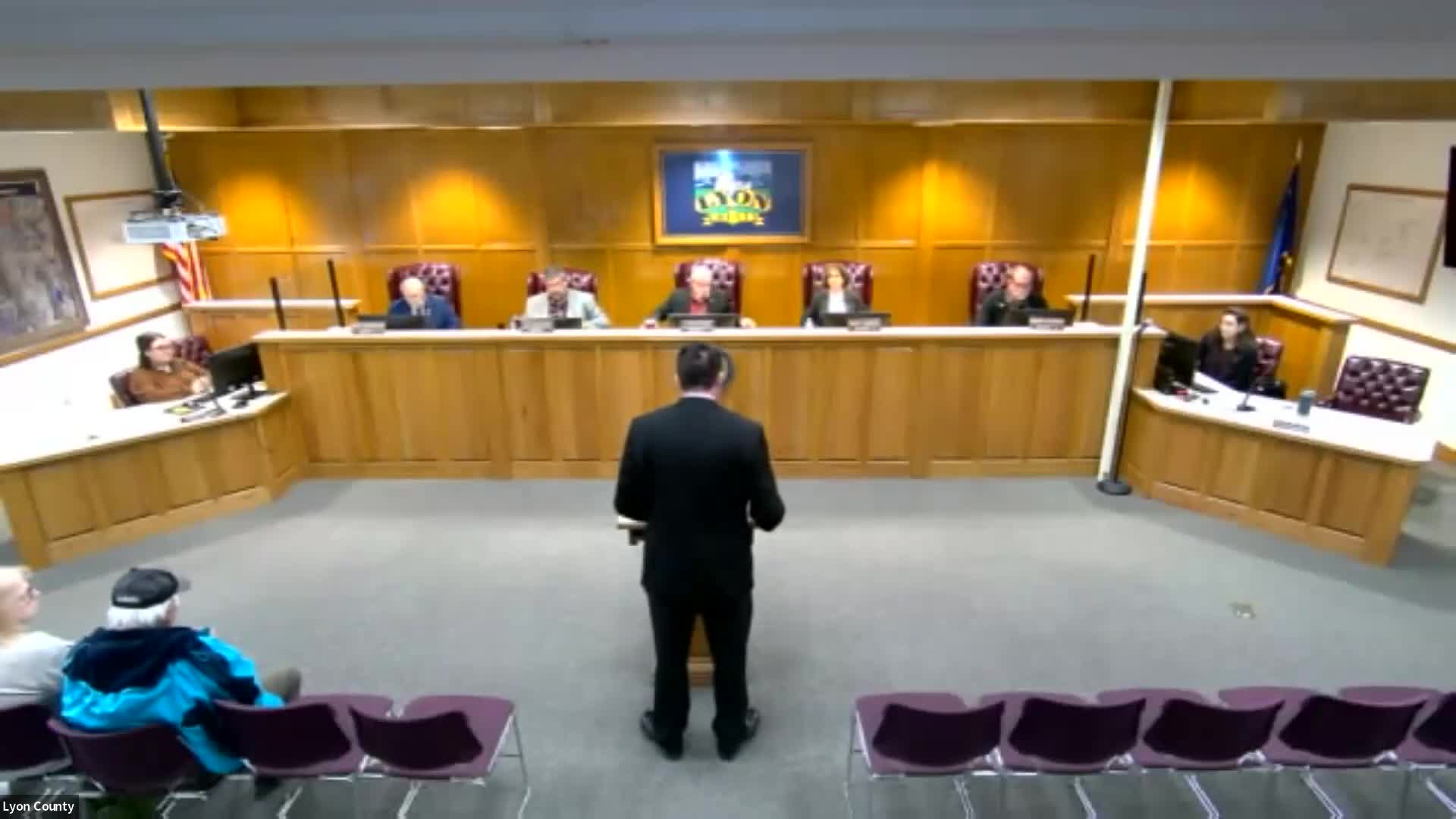
Summary
The Lyon County Board of County Commissioners on Nov. 6 directed staff to continue drafting a service plan and related ordinances for a proposed Northline Power General Improvement District intended to provide on-site generation to the Northern Nevada Industrial Center, while staff and NV Energy advisers warned of substantial regulatory and financial risks.
The Lyon County Board of County Commissioners on Nov. 6 directed county staff to continue developing a service plan and associated ordinances for a proposed Northline Power General Improvement District, a locally governed entity that developers propose would buy on-site generation and sell power to end users inside the Northern Nevada Industrial Center.
Supporters said the GID could speed power availability and help attract large industrial and data-center customers sooner than waiting for transmission upgrades controlled by NV Energy, while staff and outside counsel warned the board of substantial legal and financial risks, including regulatory complexity, stranded assets, and liability exposure if generation or operations fail.
The county manager, Andrew Haskin, summarized the proposal and the review process. He said the developer, Northern Nevada Industrial Center (NNIC), proposed a microgrid approach scalable to 2 gigawatts with an initial phase of roughly 450 megawatts supplied by reciprocating engines plus renewable resources. "NNIC27s proposal is to create a general improvement district to furnish power to the industrial center through the development of a microgrid and to attract new companies to Lyon County," Haskin said. He told the board staff had met with the Public Utilities Commission of Nevada (PUCN) and NV Energy and had retained former PUCN chair Joseph Reynolds for regulatory counsel.
County comptroller Josh Foley told commissioners that completing a service plan is a board-level due diligence step. "As part of forming a general improvement district, the board27s obligation is to figure out if this is a financially viable enterprise," Foley said, emphasizing the need for detailed financial and engineering information.
NNIC representatives said they have held talks with potential end users and plan to require 15-year, take-or-pay power purchase agreements before building generation. Dave Brown, representing NNIC, said the generator and operator teams have experience with similar projects and would include redundancy so the site would not rely on a single shaft of generation. "Before we start building generation, we will have an end user in place that commits to that generator," Brown said.
NV Energy representatives urged caution. Jeff Breger, director of business development at NV Energy, told commissioners that the utility prefers to provide retail service and that prior proposals to NV Energy had been altered or withdrawn; he said the company has made large statewide investments and that a fragmented approach could raise costs for existing customers. "NV Energy is super proud of serving about 90% of this state," Breger said. He added that NV Energy has concerns about the proposed generation types and their economic competitiveness under the utility27s rate structure.
Commissioners and staff discussed mitigation measures that would limit county exposure, including making the developer pay initial GID start-up costs, requiring take-or-pay agreements and indemnities from end users, bonding for performance, a requirement that renewable capacity be built alongside nonrenewable generation, automatic checkpoints or dissolution triggers in the organizing ordinance if milestones are not met, and requiring the generator to pursue an expedited interconnect with NV Energy where feasible.
After extended questioning on liability, regulatory authority, timing and the need for more detailed cost estimates, the board voted 5-0 to direct staff to continue preparing a detailed service plan and draft ordinances and to return with the requested financial, engineering and legal analyses. The board did not adopt any ordinance or approve the GID27s formation at the meeting.
The Board of County Commissioners' direction starts the formal service-plan process required under Nevada law; staff said the plan will be posted, noticed and reviewed by the planning commission before any organizing ordinance would be considered. The service plan will specify governance, financing, boundary, facilities and proposed operations and can be revised only through the public processes spelled out in statute.
What27s next: staff will work with the developer to deliver a complete service plan showing projected capital costs, operating costs, end-user contracts, timing for interconnection and options for limiting county liability. NV Energy, the PUCN and outside counsel participated in the discussion and may provide further input as the plan is drafted.
Commissioners said they would continue negotiations with NV Energy while staff prepares the service plan, and they emphasized that any future GID organizing ordinance would require specific mitigations and board approvals before the county took on regulatory or financial responsibility.