
St. Tammany leaders and residents urge fixes as council delays 2026 budget amid public‑safety shortfall
Get AI-powered insights, summaries, and transcripts
Sign Up Free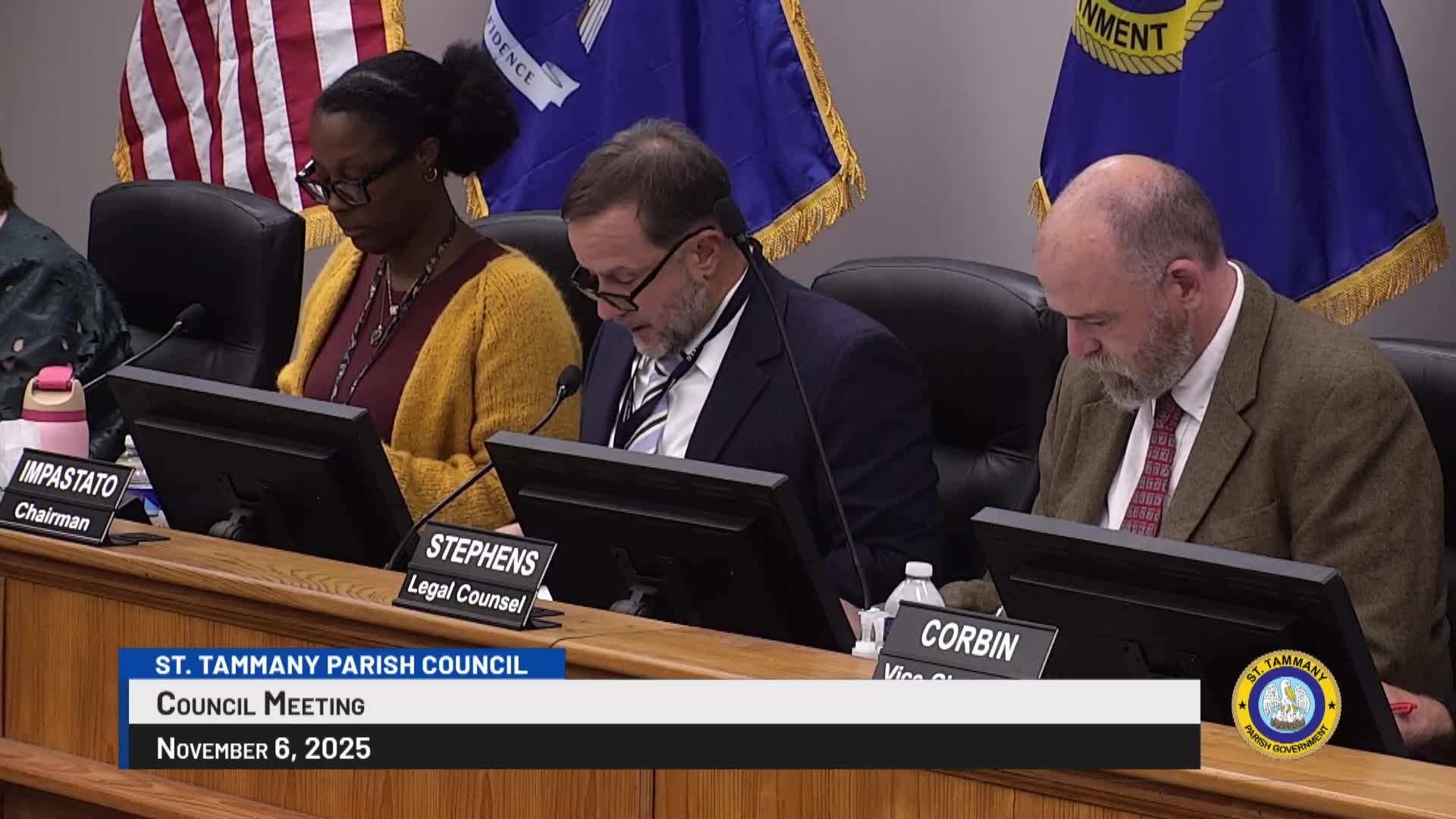
Summary
After hours of public comments from judges, the sheriff, the district attorney, and community advocates, the St. Tammany Parish Council voted unanimously to postpone action on the 2026 operating and capital budgets to give leaders more time to plan for a projected shortfall in funding for the jail, district attorney and courts.
The St. Tammany Parish Council postponed action on the 2026 operating budget and the 2026–2030 capital improvement program on Nov. 11 after a packed public hearing in which judges, prosecutors, law enforcement and social‑service advocates warned that cuts could threaten local public‑safety operations.
The council moved to delay final votes on Ordinance 7963 (the 2026 operating budget) and Ordinance 7964 (the capital plan) to the next meeting following repeated pleas to restore criminal‑justice funding. Councilmember Tanner made the motion to postpone the operating budget; the motion passed unanimously with two members absent. Tanner also moved to postpone the capital budget; the motion passed unanimously with one member absent.
Why it matters: Parish and justice officials said they face a near‑term fiscal cliff because a half‑cent sales tax that had supported the sheriff, the district attorney and judges has not been renewed. Parish President Michael B. Cooper told the council that only the parish general fund — roughly the small portion of ad valorem revenue the parish controls — is flexible, and that the administration expects to be able to fund roughly 70% of next year’s requested budgets for the courts and prosecution from non‑dedicated funds.
“Since taking office in 2020 … that half‑cent sales tax has put us in this position where we do not have sustainable funding for these agencies,” Cooper said during the hearing. “We met with the DA, the judges … and stated we would only be able to fund up to 70% of their current budgets for next year because that’s the money we have available.”
What officials said: Deputy Chief Judge Vinny Lobello said the district’s operating budget is heavily weighted toward support staff and warned that courts will exhaust their reserves without a short‑term stopgap and a long‑term funding solution. “We as a bench have decided … we are gonna exhaust our reserves so that we can continue to fund our operations,” Lobello said, adding that the bench needs both short‑term relief and a sustainable plan.
Sheriff Randy Smith said he has been able to keep the jail in compliance with state and federal standards but warned that staffing or funding cuts would undermine public‑safety outcomes. “We have to follow the DOC guidelines, the DOJ guidelines … and the Louisiana Fire Marshal guidelines, which we have done,” Smith said. “We’re never asking for additional funds. Every poll I’ve ever run … the number one priority of our citizens is public safety.”
District Attorney Colin Sims urged elected officials to show voters that the parish has reduced waste and created credibility before asking for new or restructured taxes. “Before any additional money is asked for from these taxpayers, restoration of credibility must be restored,” Sims said. He also described work by prosecutors and law‑enforcement partners on child‑abuse cases and opioid investigations and called for a collaborative effort among taxing entities to reallocate existing revenue where possible.
Public comment and community groups: The public comment period drew dozens of speakers, including Gia Baker and Thomas Mitchell from Hope House, a children’s advocacy organization, who urged the council not to cut funds that support child‑protection investigations and prosecutions. Paul Seal of the Drug Enforcement Administration described a coalition of local, state and federal partners that prosecutors credited with lowering opioid‑related deaths in recent years.
Financial context and options discussed: Multiple speakers noted that much parish revenue is restricted to special districts and that the parish receives a comparatively small share of ad‑valorem collections. Business community volunteers and taxation‑district representatives told the council there may be opportunities to reallocate or better prioritize existing millages and taxing districts but that doing so will require intergovernmental cooperation and public education. Kyle France, a Covington business leader, told the council he has been analyzing taxing districts and urged elected oversight of taxing authorities.
What the council did: Rather than vote on the 2026 budget at the meeting, Councilmember Tanner moved to refer the operating budget to the next meeting for additional consideration; the motion and a companion motion to postpone the capital budget passed unanimously (operating budget postponement: unanimous, two absent; capital budget postponement: unanimous, one absent). The postponements mean the council will reconvene debate and potential amendments before final adoption.
What’s next: The postponement gives administrators and elected officials more time to seek solutions, including: producing a short‑term funding bridge using available reserves or restricted funds where legally permitted; pursuing new or rededicated voter propositions; negotiating reallocation among taxing districts; and producing a clearer public communications plan to explain options to voters. Parish President Cooper said the administration will work with leaders across levels of government to develop a plan before the 2027 budget cycle.
Quotes attributed in this story come from the public transcript of the St. Tammany Parish Council meeting on Nov. 11, 2025, as recorded in the meeting minutes and public comments.