Get Full Government Meeting Transcripts, Videos, & Alerts Forever!
Get email alerts on the Property Valuation topic
No spam. Unsubscribe anytime.
Holyoke reports $3.26 billion in certified FY2026 property values; personal-property audit drives much of new growth
Summary
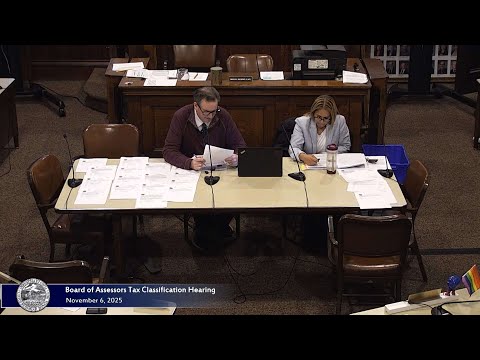
Staff member (Speaker 1) told the City of Holyoke council that the Department of Revenue, Division of Local Services certified fiscal year 2026 property values for the city and presented the breakdown by property class.
Staff member (Speaker 1) told the City of Holyoke council that the Department of Revenue, Division of Local Services has certified fiscal year 2026 property values for the city and presented the breakdown by property class.
The certified total valuation for the city was presented as $3,255,040,033. Staff read the class totals as residential $2,568,000,454, commercial $515,446,442, industrial $8,700,000,218,004 (as presented in the packet) and personal property $83,920,008.80. Speaker 1 said single-family homes increased about 8% year over year and that personal property rose 18.7% largely because a new audit found previously underreported assets.
Why it matters: certified valuations set the base for the levy limit and the tax-rate calculation. Staff included a levy-limit worksheet in the packet and said the 2026 levy was shown as $70,987,250 with a preliminary single tax-rate estimate of $21.81; staff noted the auditor27s final tax-rate recap could change that figure.
On new growth and the RRC audit: Speaker 1 said the city contracted Real Estate Research Consultants (RRC) to audit business personal property and that the audit uncovered additional accounts and underreported assets. Speaker 1 said the discovery explained much of the personal-property growth and characterized it as a significant upward adjustment that is likely to remain at the new level rather than continuing to grow by the same amount annually.
On classification: when asked to define "personal property," Speaker 1 clarified, "Business personal property. So it's anything that's, like, you say, not attached to their building. Anything they own, like their computers, their desks, their chairs, their files, their cabinets, and tangible anything. If they were moving, they would, you know, kinda go in in the moving van to their to their next spot. Machinery." The clarification distinguished business personal property from homeowner personal effects.
Tax-shift option and schedule: Speaker 1 explained that councilors may choose to shift some tax burden among classes by selecting a minimum residential or "shift" factor, up to the statutory maximum shown in the packet (1.75%). If the council does not vote on a shift factor at this meeting, the item can be continued to Nov. 18; staff noted the Division of Local Services requested the vote be taken by Dec. 1 to allow timely approval of numbers.
Questions and local impacts: a commenter asked specifically about the Holyoke Mall assessment, which staff said decreased in part because land valuation declined tied to landfill construction, sinkhole issues in the parking lot and deterioration of the parking garage, as well as lower tenancy and prior abatements. A councilor asked for current tax-rate context; Speaker 1 recited the current rates as $17.46 per $1,000 for residential and $38.55 per $1,000 for commercial/industrial and discussed how the proposed shift factor would affect those rates.
Next steps: the presentation concluded and councilors may take up the shift-factor vote at a future meeting (Nov. 18 was offered as the date for continuation). No formal vote or ordinance was recorded in the transcript of this presentation.
All figures above are reported as presented in the assessor27s packet to councilors; where packet figures were garbled or unclear in the transcript, the article uses the values as read aloud.