
Judge Boyd’s 187th District Court issues revocations, sentences and multiple resets during full docket call
Get AI-powered insights, summaries, and transcripts
Subscribe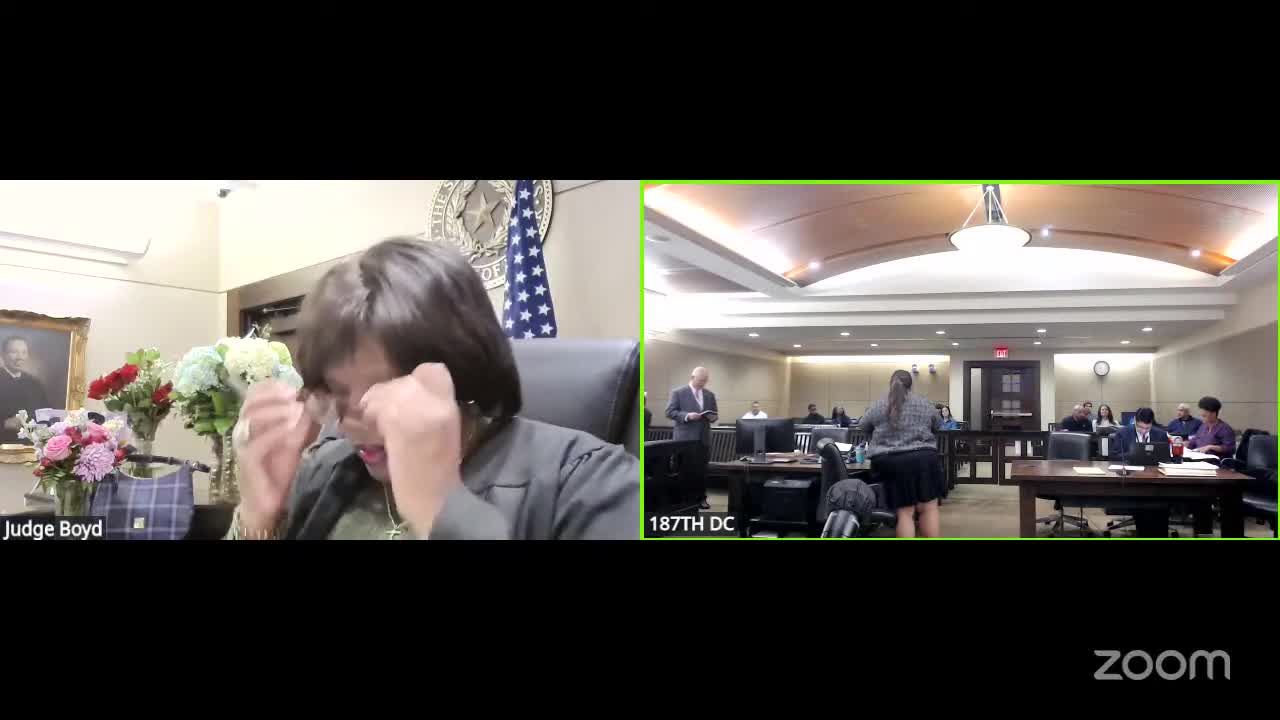
Summary
The 187th District Court handled dozens of matters, including a revocation and multi-count sentence for one defendant, a denial of a defense motion to loosen GPS/bond conditions, an alternative treatment disposition in a probation revocation case, and several contested-hearing and scheduling orders.
SAN ANTONIO — Judge Stephanie Boyd in the 187th Criminal District Court conducted a full docket call that included plea changes, probation hearings, sentencing and scheduling decisions affecting multiple defendants.
The most consequential ruling came in State v. Desmond DeBryan Gomez, where the court found violations of supervision true, revoked deferred adjudication and entered adjudication of guilt. Judge Boyd sentenced Gomez to concurrent terms — five years on counts 1 and 3 and two years on count 2 — and recommended placement in a therapeutic community. The judge told Gomez the sentence would include credit for time served and warned that the therapeutic program is intended to address substance issues rather than extend custody time.
The court also denied a defense motion to modify pretrial GPS/bond conditions in the case of Simon Alexander Garza. Officer Alicia Pryor testified about monitoring procedures and travel windows; Judge Boyd said that the monitoring will remain in place and instructed defense and the pretrial unit on overtime-notification procedures. “The motion will be denied,” Judge Boyd said after hearing testimony and argument.
In a probation revocation matter, Lupe Collin pleaded true to alleged violations. Rather than revoke supervision and impose a prison term, the court denied the state’s motion to revoke and ordered an alternative, treatment-focused disposition under SADA with conditions including participation in sober-support meetings and restrictions on unsupervised contact with minors. The judge explained treatment and reporting requirements and set timelines for employment verification and other conditions.
Antonio Eslora pleaded guilty after an amendment to the indictment and the court accepted the plea. Under the parties’ agreement, the court imposed 180 days in the Bexar County jail under Code of Criminal Procedure Sec. 12.44, a $2,000 fine, and entered the judgment satisfied.
The docket also produced multiple scheduling and procedural decisions: Bailey Alexander Corley was set for a contested hearing on Nov. 13 on a motion to enter adjudication and alleged supervision violations; Jeffrey Flores’s counsel successfully moved to withdraw a plea and the court set a contested hearing for the following Wednesday; and counsel’s motions to withdraw in three cases for Jeffrey Dollar were granted, with a 30-day recall for the defendant to obtain new counsel.
Judge Boyd repeatedly reminded attorneys to confer with the state before approaching the bench, to sign the reset forms when instructed, and to ensure contact information and discovery are up to date before hearings. On GPS and work-hour issues, the court clarified that the pretrial office allows an hour of travel time for work-related movement and that defendants must notify supervision when they will work overtime so the monitoring unit can note authorized deviations rather than treat them as violations.
Procedural follow-ups and discovery resets were set across multiple cases, with December dates commonly used for next settings. Several matters were continued for discovery, pretrial diversion orientation, or contested hearings, and the court closed the morning session with a brief recess.
The court’s actions affect defendants across Bexar County and will be revisited at the scheduled reset and contested-hearing dates. The 187th District Court’s docket included routine admonishments, repeated instruction to coordinate with pretrial services and probation, and an emphasis on treatment-based alternatives where the court found them appropriate.