Get Full Government Meeting Transcripts, Videos, & Alerts Forever!
Get email alerts on the Public Funds Investment topic
No spam. Unsubscribe anytime.
Heath staff reviews investment policy under Texas law; Hilltop outlines bond structure and February sale timeline
Summary
City finance staff briefed the Heath Finance Board on the city's investment policy under the Texas Public Funds Investment Act and the composition of the city's portfolio; Hilltop Securities presented an illustrative CO structure and a February sale timetable for roughly $40 million in capital needs.
City finance staff and an outside municipal adviser gave separate briefings to the Heath Finance Board on Nov. 6 about the city's investment policy and a potential bond sale to fund capital projects.
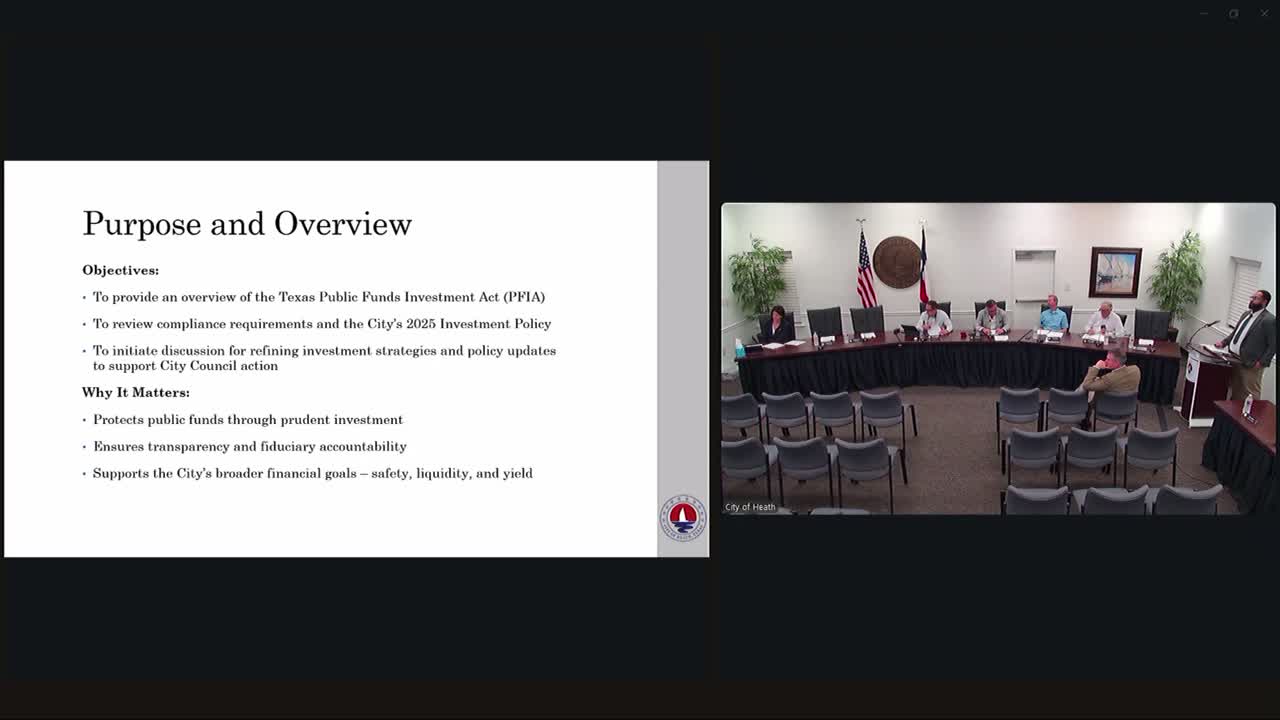
Jay, a city finance staff member, opened the investment-policy discussion by citing the Texas Public Funds Investment Act (Texas Local Government Code, Chapter 2256) and the policy goals it requires: safety, liquidity and yield. Jay said the city's current policy limits general-operating investments to maturities of two years or less (a restriction that is stricter than the state law, which permits longer maturities), requires annual training for qualified investment officers and mandates quarterly investment reporting.
Jay said that at fiscal-year end the city had about $84.2 million invested across demand accounts and local-government investment pools, and that the largest holdings were in pooled funds such as TexPool and TexSTAR. He told the board staff would provide a more detailed fund-by-fund breakout and asked staff to show the expenses associated with managing investments as well as the yields realized by individual fund accounts.
Board members urged a more active strategy in light of market expectations for lower rates in 2026, including laddering investments and locking funds into Treasury bills, agency notes or other short-term securities for money not needed in the near term. Jay said staff will take that recommendation under advisement and that the city is considering engaging an investment adviser to help with solicitations and accounting for more active management.
Separately, Jim Sebas, managing director at Hilltop Securities, briefed the board on options to finance the city's capital-improvement program. Sebas described a double-barrel pledge (combination tax and revenue certificates of obligation) as a typical structure for the proposed utility-backed borrowing and gave an illustrative example showing a 25-year amortization and an all-in borrowing cost near 4.72% under current market assumptions.
Sebas said the market is currently pricing some municipal issues at a premium and urged the board that, if council chooses to proceed, a timetable that posts the sale in February and closes in March would be typical; he offered to run amortization matrices showing 20- or 15-year alternatives and to analyze the effect of refunding older bonds alongside new-money issuance to smooth near-term debt-service impacts.
Board members asked for the bank-depository pledge report for American National Bank of Texas and for staff to provide additional detail on the composition and yields of specific funds and accounts. Jay agreed to provide the pledged-securities report in a future packet and to pursue more detailed fund-by-fund reporting for the board.
What it means: The board received the statutorily required investment-policy briefing and signaled interest in moving from a passive, pool-heavy cash strategy toward a more active, laddered approach as market conditions change. Hilltop presented a financing timetable and structure that council could consider; no financing was approved at this meeting.