Get Full Government Meeting Transcripts, Videos, & Alerts Forever!
Get email alerts on the Zoning topic
No spam. Unsubscribe anytime.
Planning commission recommends changes to downtown density-bonus rules to aid redevelopment
Summary
The commission voted unanimously to recommend a zoning-text amendment that would expand where density bonuses are available (adding DTRO and DTGC), replace percentage-based bonuses with fixed integers for clarity, increase the reward for structured parking, and lower the council-override threshold from 40 to 20 dwelling units per acre.
The Woodstock Planning Commission unanimously recommended that City Council adopt a zoning-text amendment to revise and expand the city’s downtown density-bonus system.
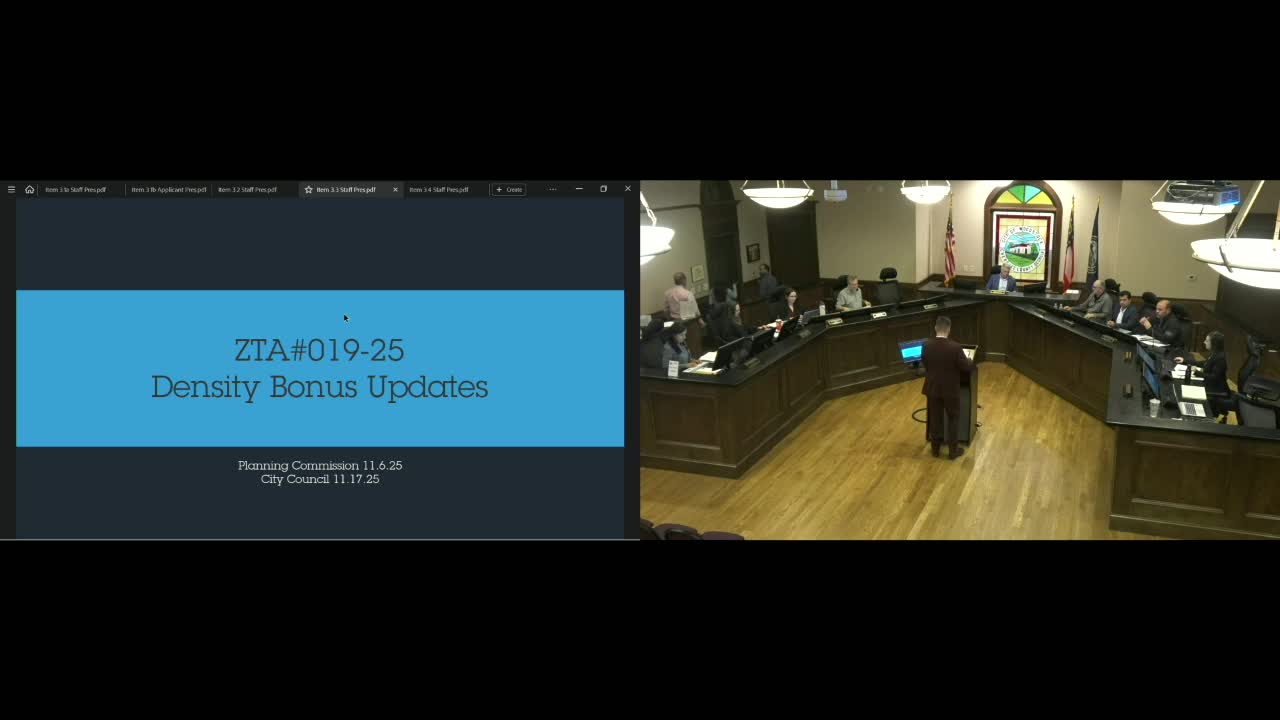
Planner Cameron Dunn said the proposal would make two principal changes: expand the districts eligible for density bonuses to include DTRO (the downtown arterial corridor) and DTGC (the regional activity center along Highway 92), and convert the current percentage-based bonus methodology into a set of fixed-integer bonuses. Staff told the commission that the percentage model was difficult to interpret and enforce (especially when applicants stack multiple bonus provisions) and that an integer-based model would be clearer for both applicants and staff.
The amendment would keep existing base-density maximums in place (for example, DTGC’s base of 8 dwelling units per acre) while giving developers a clearer, predictable set of bonuses for vertical mixed use, open space, structured parking and professional office space. Staff also proposed increasing the density reward for structured parking and lowering the threshold at which Council may approve a development above the standard maximum from 40 to 20 dwelling units per acre, a change staff said would reflect current market parcelization and encourage redevelopment along targeted corridors.
The Development Planning Committee reviewed the proposal and unanimously recommended approval. Commissioners debated balancing higher-density redevelopment with guidelines to protect lower-density neighborhoods; after discussion Greg moved to recommend the text amendment to City Council, Laney seconded, and the motion passed unanimously.
The amendment will go to City Council for a final vote and would be used to guide future downtown redevelopment and incentives for structured parking, office space and vertical mixed-use projects.