Auditors find gaps in MOED grant accounting and local‑hiring monitoring; agency says fixes underway
Loading...
Summary
City Auditor Josh Pash presented a biannual audit showing MOED did not consistently reconcile quarterly status reports to Workday prior to September 2024; MOED says it implemented reconciliations and is finalizing SOPs.
City Auditor Josh Pash presented a biannual performance audit of the Mayor’s Office of Employment Development (MOED) during the Baltimore City Board of Estimates meeting on Nov. 5, 2025, identifying a primary control weakness in grant reconciliation and reporting.
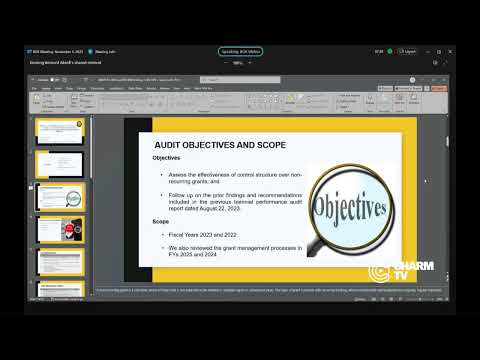
Pash said the audit’s objective was “to assess the effectiveness of the control structure over nonrecurring grants,” and that auditors reviewed grant agreements, supplier contracts, onboarding, subrecipient monitoring and closeout procedures. He told the board that prior to September 2024 MOED “did not reconcile the quarterly staff report, which is used to bill a grantor, with the operating expenditures general ledger, which is our system of record.” Auditors said the reconciliation is a critical control to ensure billable expenditures are properly charged and recorded.
MOED Director Matt Garvin acknowledged the finding and said the agency implemented a formal reconciliation process in September 2024, added job aids and began developing standard operating procedures. “We provided job aid, we trained our fiscal team,” said Garvin. Assistant Director and CFO David Hagans told the board MOED recognized a difference between the two amounts and lacked consistent documentation of follow‑up; MOED now intends to review and update SOPs to make the reconciliation process more robust.
The audit also revisited a prior finding about compliance with Baltimore’s local‑hiring law. Garvin and John Ford, special assistant who manages the city’s local‑hiring administration team, summarized the law’s scope: it applies to city contracts of $300,000 or more and to projects receiving subsidies of $5 million or more, and requires that 51% of new hires be Baltimore City residents where the law applies.
Pash told the board the audit found MOED’s process for escalating subcontractor and contractor noncompliance to the Board of Estimates had been limited by the law’s high bar for proving intentional violations, making enforcement impractical at the citywide level. Ford said MOED has increased staffing on compliance, added a compliance specialist and transitioned reporting into the city’s SMBAD/B2G tracking system. He said MOED and the Comptroller’s office recently agreed thresholds for “ad hoc” escalation of egregious noncompliance; MOED reported that the first such ad hoc report was sent after the audit period.
Comptroller Bill Henry and City Administrator Faith Leach pressed MOED on whether reconciliation had been performed and whether any unreconciled dollar amounts remained. Pash said auditors found only one immaterial reconciling item during their sample testing; MOED said it has implemented controls, but acknowledged turnover and the need to standardize procedures and documentation to ensure continuity.
Why it matters: Nonrecurring grants are one‑time awards that rely on ad hoc budgeting and monitoring. Without documented, routine reconciliations to the city’s official ledger, the audit warned, the city risks misstating grant expenditures and either under‑ or over‑billing grantors.
What’s next: MOED said it will complete SOP updates, continue trainings, and use SMBAD/B2G to improve vendor reporting and escalation. The board noted the audit; no formal corrective action vote was required.