Grayslake CCSD 46 reviews new state proficiency benchmarks and April assessment results
Summary
Grayslake Community Consolidated School District reviewed the state’s new proficiency benchmarks and its April 2025 IAR results, showing most grades near 50% literacy proficiency and lower math proficiency under the revised cut scores.
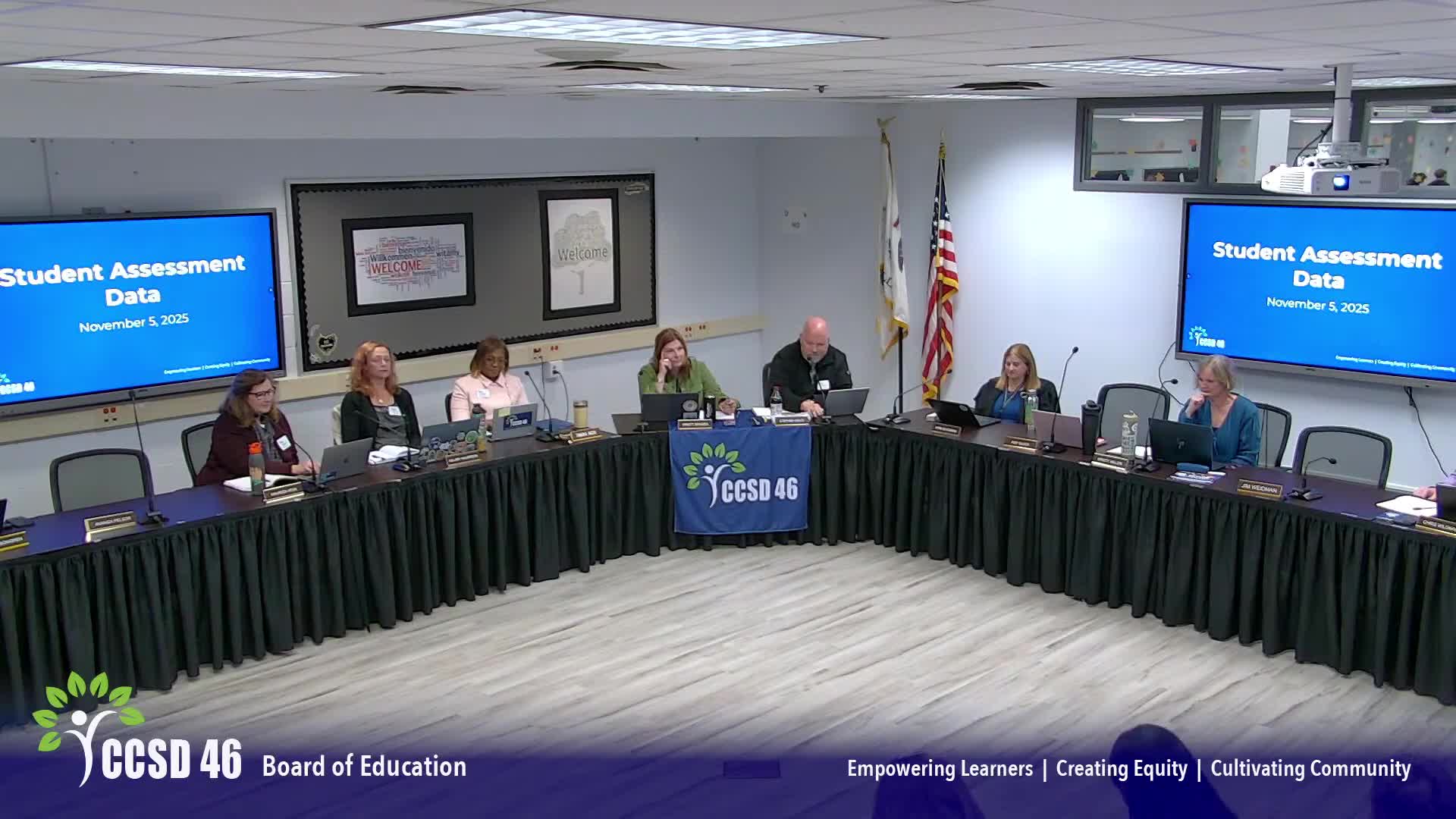
Grayslake Community Consolidated School District (Grayslake CCSD 46) administrators on Wednesday reviewed the Illinois State Board of Education’s newly established performance levels for statewide assessments and the district’s April 2025 IAR results. The presentation described how the state changed cut scores and aligned the labels and meanings across the Illinois Assessment of Readiness (IAR), the Illinois Science Assessment (ISA) and the high-school assessment so proficiency measures are comparable across tests.
District presenter Mrs. Block said the state’s work was meant to correct inconsistencies that made Illinois cut scores “the most difficult out of all of the states,” producing results that did not align with national measures such as NAEP and with classroom evidence. Under the new four-band system — below proficient, approaching, proficient and above proficient — the state now counts only those in the green (proficient and above) as proficient. Mrs. Block explained that the state described the “proficient” band as evidence that a student “deeply understand[s] the state standard for that grade level.”
The district’s slides showed that, using the new benchmarks, literacy proficiency clustered around 50% in many grade levels through grade 8; math proficiency was generally lower. District officials flagged a drop in ELA performance between sixth and seventh grades that they will monitor. Administrators said all district schools were designated either commendable or exemplary under the new state classifications; one school reached exemplary while the remainder were commendable, meaning no student groups were classified as underperforming.
Administrators emphasized the distinction between proficiency (IAR) and growth (NWEA MAP). MAP remains the district’s primary tool to measure individual and cohort growth during the school year; the district plans winter MAP administration in December and a building-level data review to identify which students need targeted interventions. Mrs. Block also noted that NWEA is still preparing a linking study to connect MAP scores to the state’s right-sized IAR cut scores; the vendor expects that study later in the school year.
Board members asked about longitudinal trend comparisons and the limits of comparing current results to prior years because the state’s cut scores changed. Administrators said historical comparisons on the public school report card are not straightforward and the district will rely on MAP growth and cohort-level analyses to track progress in the near term. The presentation closed with next steps for staff to use performance descriptors to inform instruction and to continue standards-based planning, small-group and intervention work, and upcoming MAP growth reviews.
Administration did not recommend any immediate policy changes at Wednesday’s meeting; the board held the item as informational.
The district said families received individual student reports via ParentSquare when the state released results.