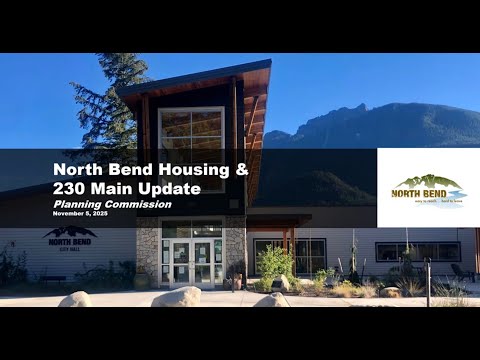
Planning Commission Recommends Approval of 40‑Unit Affordable Housing Project at 230 Main, 4–1
Loading...
Summary
The North Bend Planning Commission voted 4–1 to recommend approval of a disposition and development agreement with Related Northwest for a 40‑unit affordable housing project at 230 Main Avenue North.
The North Bend Planning Commission voted 4–1 to recommend approval of a disposition and development agreement (DDA) with Related Northwest for a proposed 40‑unit affordable housing project at 230 Main Avenue North.
City staff presented a detailed project overview and local housing context, saying North Bend’s median household income is substantially higher than King County’s and the local housing market is tight. Staff described the project as a three‑story building with 16 studios and 24 one‑bedrooms (one one‑bedroom would serve as an on‑site manager’s unit), a community room, laundry facilities and an on‑site property manager. The development is proposed to be restricted to households at 60% of King County area median income (AMI) for at least 55 years, staff said.
The presentation listed the project’s financing plan as a mix of designated affordable‑housing revenues and developer financing: Real Estate Excise Tax (REET 2) proceeds used to buy the parcel, requests for approximately $1.9 million in affordable housing sales and use tax receipts, a $500,000 REET 2 contribution for site construction/infrastructure, a Washington State Housing Trust Fund application for construction dollars, a Washington State Department of Commerce CHIP grant application for utilities/infrastructure, and an intention to pursue Low Income Housing Tax Credits (LIHTC) and permanent debt with a deferred developer fee. Staff emphasized the city would not use general‑purpose (general fund) dollars for the project.
Related Northwest and city staff said the project estimates have been sensitive to market conditions; Related Northwest presented order‑of‑magnitude costs and said it expects roughly $350 per square foot and on the order of $237,000 per unit in current estimates, with a target financing close in 2026 and an 11–12 month construction timeline once financing is secured.
The applicant is seeking multiple code departures to achieve the project economics and unit count: reductions to private open‑space and balconies, frontage/porch adjustments, a roofline deviation, and a reduced parking standard. Staff noted the departures are requested to meet the affordability targets and that the site would be conveyed to Related Northwest under a long‑term lease (described as 99+ years) to allow the developer to secure funding.
Commissioners and members of the public focused heavily on parking, traffic and scale. Residents and business owners said the downtown already faces parking shortages and argued that providing 20 or fewer on‑site spaces (the proposal’s parking counts were discussed in multiple ways during the hearing) risks overflow onto nearby streets, creating congestion and pedestrian‑safety issues. Several commenters suggested alternative sites — including a larger parcel on Southeast North Bend Way — or repurposing the lot for public parking with EV chargers. Other public speakers, including teachers and service‑industry employees, urged approval to keep local workers in the community.
Related Northwest representatives and staff responded that funders currently expect higher density for affordable projects and that roughly 40 units is often the threshold that makes state and federal affordable‑housing funding competitive. Staff also pointed to recent state policy changes: they noted that House Bill 1183 (2025) limits local jurisdictions’ authority to require off‑street parking for qualifying affordable housing, though the city has not fully implemented local code changes tied to that law.
City staff said a site‑specific traffic impact analysis and a SEPA (State Environmental Policy Act) determination would be required before any construction, and that projects cannot reduce intersection level‑of‑service below local standards without mitigation. Staff also spelled out the city’s risk exposure: because REET 2 funds were used to acquire the parcel, if the city abandons an affordable housing use it could be required to repay the REET 2 funds to the REET account.
After community comment and commissioner discussion, Commissioner Fitzgibbon moved to recommend approval of the DDA; Commissioner White seconded. The motion passed 4–1 with Commissioner Pereira recorded as opposed. Commissioners and staff stressed that this planning commission action is a recommendation: the DDA and financial requests will next be reviewed by the Community Economic Development Committee and then be subject to final action by the City Council.
Why it matters: North Bend is facing a tight for‑sale and rental market while a large share of local employment is in lower‑wage retail and service jobs. The commission’s recommendation advances a site‑based approach to workforce housing that staff and the applicant say is designed to meet funder expectations — but neighbors and business owners raised concerns about parking, traffic and downtown character that the project team and staff said they will continue to study and attempt to mitigate.
What’s next: The DDA and related funding requests will go to the Community Economic Development Committee and then to City Council. The applicant still needs to secure state and federal financing (including LIHTC) and complete required environmental and traffic analyses before a building permit or construction can proceed.