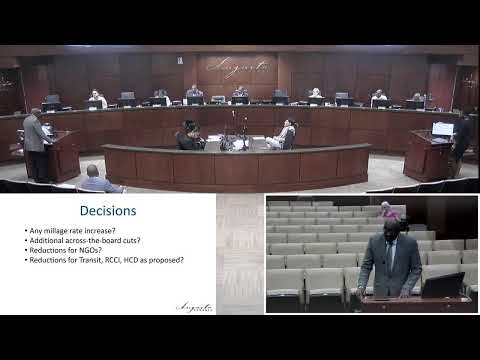
Augusta staff outline three options and $800,000 startup for vegetation and grounds maintenance
Loading...
Summary
Administrator Allen presented three restructuring options for vegetation and grounds maintenance and proposed an $800,000 2026 allocation to support contracts and start‑up costs.
Administrator Allen gave a detailed presentation of Augusta's vegetation and grounds maintenance portfolio and three restructuring options staff say would improve service delivery.
Allen said the city maintains more than 1,000 center lane miles of roadway, 168 city detention ponds, roughly 70 linear miles of ditches (the city reaches 9–15 miles annually), 49 parks, 21 non‑park facilities, and multiple cemeteries. Current responsibility is split across Central Services, Recreation & Parks, Engineering (including stormwater obligation) and supplemental RCCI crews and contractors.
To shore up service, administration proposes $800,000 for 2026: $450,000 to continue and expand engineering contracts and $350,000 as start‑up funds for program changes. Staff outlined three options:
1) Status‑quo plus: retain current departmental responsibilities but add targeted resources (contract managers, a strike‑team pilot to float resources to complaint hot spots, downtown lead) and $100,000 set aside for cemetery improvements. Allen said this would be fastest to implement but would maintain divided accountability.
2) New standalone department: combine vegetation crews from central services, recreation and engineering into a single Vegetation & Grounds department with a new director, one administrative coordinator and colocated warehouse/yard. The administration said this would centralize accountability but add overhead and implementation time.
3) Division under Central Services: transfer crews into Central Services as a new division with a deputy director; staff said this likely offers slightly lower startup costs and could be implemented faster than a new department, but raises the central services span of control.
Throughout questioning commissioners pressed several recurring issues: whether procurement should issue RFIs/RFQs to establish current market pricing for contractor alternatives; what the budget impacts would be if RCCI is phased out (staff said that is a constant variable and would require follow‑on estimates); the inventory and useful life of existing mowing and large‑equipment assets; and whether CityWorks work‑order data are being used to measure and hold departments accountable. Administrator Allen said CityWorks training has been rolled out and that staff will supply work‑order data and procurement market research.
Commissioners also asked whether ACE (a downtown nonprofit that provides maintenance services) should be treated as an NGO or as a contracted service; staff said procurement will advise and that ACE could be procured competitively if the commission directs it.
Allen asked the commission for a consensus on which path to pursue so staff can move from planning into an implementation phase; commissioners asked staff to return with detailed cost estimates, equipment inventories and alternative contractor pricing prior to any final decision.