
Kensington School Board previews 4.89% draft FY27 budget, moves teacher contract to warrant
Get AI-powered insights, summaries, and transcripts
Subscribe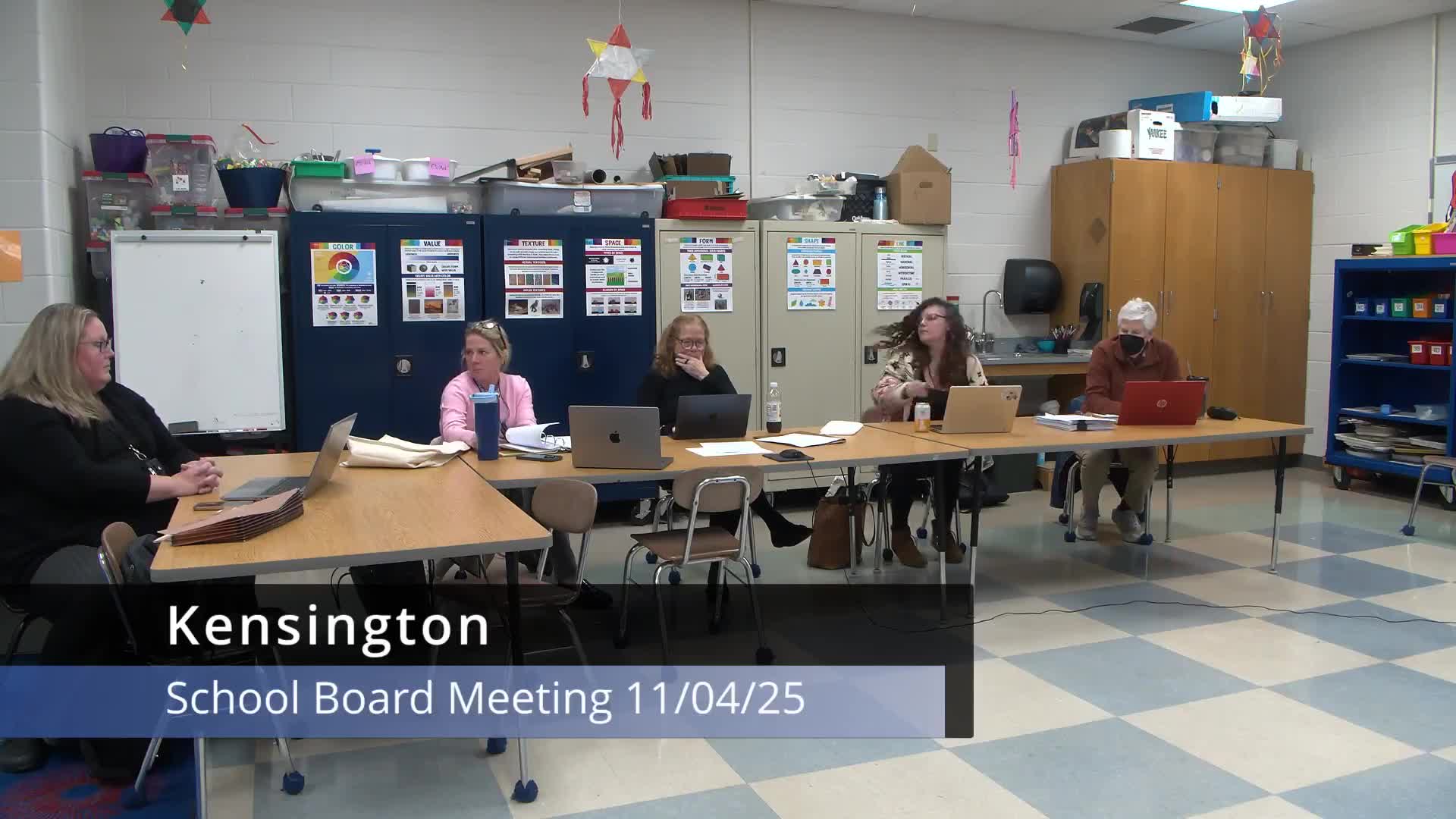
Summary
Board reviewed a draft FY27 budget showing a 4.89% increase, discussed tight funding driven by facilities and special-education costs, and voted to place the proposed collective bargaining agreement on the warrant for voter consideration.
Kensington School District officials on Wednesday reviewed a draft fiscal 2027 budget that administrators said would represent a 4.89% increase and moved the district's proposed collective bargaining agreement to the warrant for voter consideration.
Molly, the district's finance staff member, told the board the proposed FY27 budget follows the board's priorities and still requires significant investment in building systems: "we're looking at a 4.89" (proposed budget), and the district must address boiler and HVAC costs alongside routine fixed operating expenses. Molly said the budget also reflects the district's practice of encumbering known costs for the full year, including employee benefits and special-education transportation and services.
The draft budget discussion emphasized state funding shortfalls for students with individualized education programs (IEPs). Molly said the district does not recover the full costs for those students from state aid, and a staff presentation stated an average incremental cost of roughly $31,000 per special-education student in New Hampshire with about 83% of those additional costs borne through local property taxation. Molly cautioned that exact tax impacts will change when final state adequacy and special-education aid figures are available.
Board members asked for a clear explanation of tax impact. Molly explained how to estimate per-thousand tax impact using Kensington's town valuation and cautioned that the revenue side (adequacy and aid) remains unsettled: "you take whatever the budget change is divided by that 686,343,812 number times a thousand," she said, referencing the town valuation cited in staff materials.
Administrators also described recent, unplanned technology costs covered from the district's REAP grant, including an $18,000 Chromebook purchase required to meet state testing platform compatibility. Molly and Principal Becky Ruhl described REAP grant uses over several years for technology replacement, extended-school-year staffing, pilot curriculum purchases and professional development, and said the grant has been used as a limited "rainy day" fund for emergent needs.
After discussing budget details and outreach plans (including a planned public video and handouts explaining which fund components affect taxation), a board member moved to place the proposed collective bargaining agreement on the warrant as presented; the board approved the motion. The motion to place the teacher collective bargaining agreement on the warrant was recorded in the meeting as moved and seconded; outcome recorded as approved by the board.
Board staff said the full budget presentation will return in December so Principal Becky Ruhl can participate and so staff can incorporate the most up-to-date revenue estimates before presenting numbers to the public.
Votes and formal actions recorded related to budget matters included: a roll-call vote to enter a nonpublic session under the statutory authority cited in the meeting record and a motion to move the proposed collective bargaining agreement to the warrant. Specific vote tallies for those actions were not documented in the public transcript beyond board assent.