Tennessee working group presses for deeper professional learning, expanded supports for English‑learner teachers
Loading...
Summary
State and district representatives told the Tennessee Department of Education working group that professional learning must move beyond compliance to classroom‑focused coaching, and that endorsement pathways should be paired with funded coursework and mentorship to address shortages.
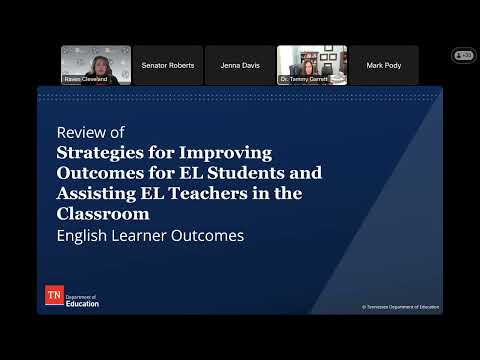
Raven Cleveland, statewide manager of English learners for the Tennessee Department of Education, told the working group that Chapter 4 19 of the Public Acts of 2025 charges the department to recommend strategies to strengthen instruction for English learners across Tennessee. “Compliance should only be the floor and not the ceiling for us,” Cleveland said, framing the meeting’s focus on measurable language proficiency and academic outcomes.
District leaders described a layered approach to professional learning that combines state supports—office hours, collaboratives and crosswalk work between ELD and ELA standards—with locally delivered coaching. Several speakers urged the department to prioritize immediately applicable, classroom‑embedded professional development rather than training that focuses mainly on compliance.
Joseph Winery, ESL program supervisor in Williamson County Schools, said content teachers are not receiving enough training to embed scaffolds in daily instruction: “Are content teachers receiving enough training? And the answer is no.” Multiple directors recommended joint training that includes both ESL and general education teachers to reduce instructional silos and model Tier 1 practices for all students.
Participants discussed endorsement pathways for ESL teachers. Cleveland noted Tennessee offers multiple pathways compared with some neighboring states, which can ease staffing shortages. But districts cautioned that a “praxis‑only” route risks diluting preparation quality. Panelists recommended incentives—tuition coverage, fee assistance and funded coursework—and stronger partnerships with educator preparation providers to sustain recruitment and grow‑your‑own programs.
Several district leaders asked the department to compile examples of state and national models showing how jurisdictions pair licensure flexibility with additional district investments (mentoring, job‑embedded coaching, cohort coursework) so that endorsement attainment produces classroom readiness. The department announced it will include comparative state models and gather additional stakeholder feedback in a follow‑up outreach and survey.