
Architect petitions California Architects Board to reduce probation after stipulated settlement
Get AI-powered insights, summaries, and transcripts
Subscribe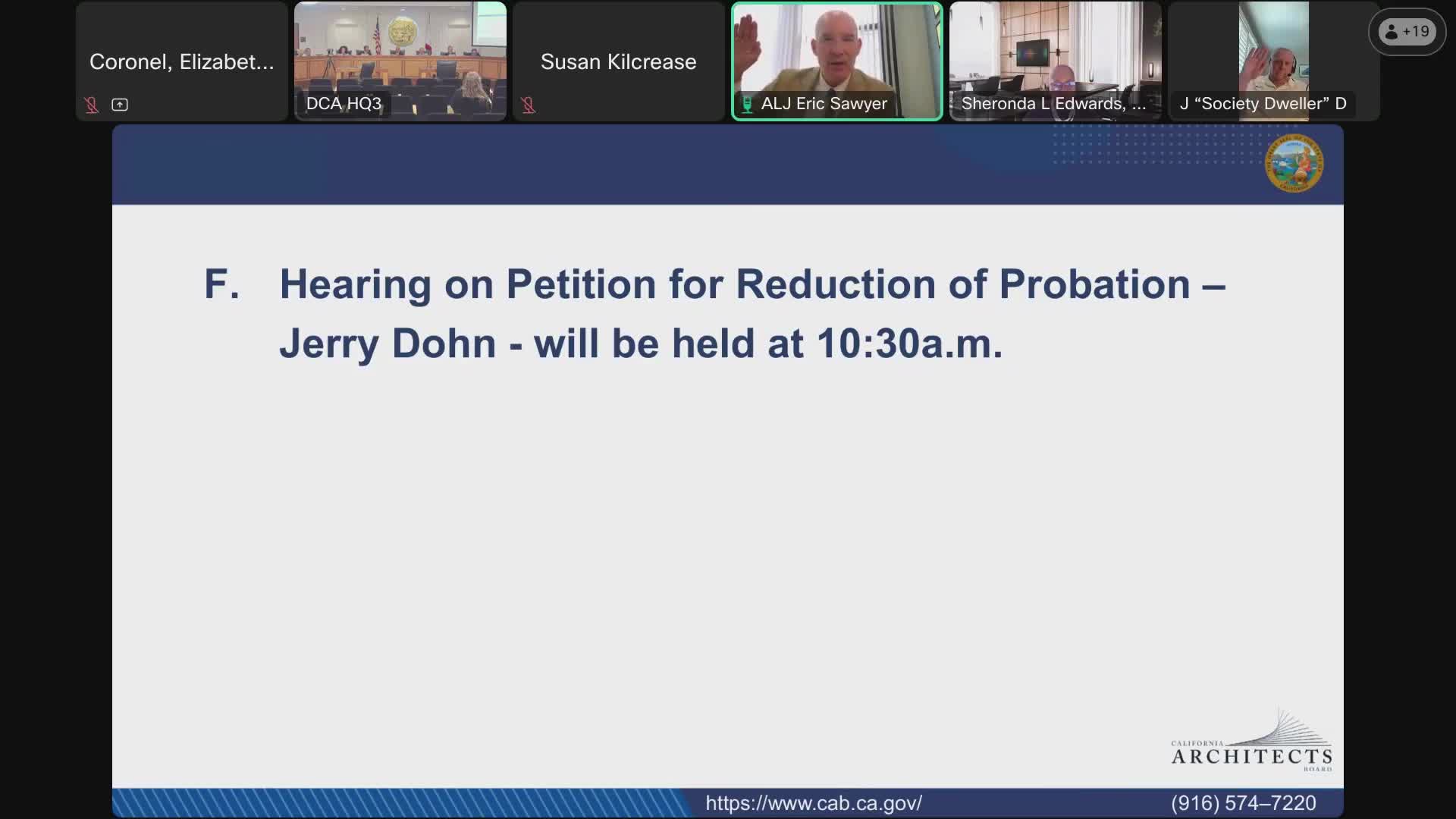
Summary
Jerry Hayes Don, a licensed California architect, asked the California Architects Board on Nov. 6, 2025, to shorten the five‑year probation imposed under a stipulated settlement and said medical treatment and health concerns led him to accept the settlement and comply with its conditions.
Jerry Hayes Don, a licensed California architect, asked the California Architects Board on Nov. 6, 2025, to shorten the five‑year probation imposed under a stipulated settlement and to recognize his compliance with the settlement’s terms.
Don told the board he first became licensed on Dec. 22, 1990, and said he had always sought to act ethically in practice. He said he accepted the stipulated settlement in 2024 during an extended period of medical treatment — including knee and hip replacements and a lengthy chemotherapy regimen — and because he was advised by physicians to avoid stress. Don said he paid the board’s required cost reimbursement in full and completed the continuing‑education and ethics training specified by the settlement. “My record is as clean as pure as the wind‑driven snow,” Don said, identifying his long career and the character‑references he supplied.
The Office of the Attorney General, represented by Deputy Attorney General Sharonda Edwards, reviewed the underlying accusation filed Feb. 22, 2024 (Accusation No. ACA‑2022‑192) and the board’s Decision and Order dated June 7, 2024, which adopted a stipulated settlement and imposed discipline. Edwards summarized five causes of discipline set out in the accusation: violations of the written‑contract provisions of the Architects Practice Act; willful misconduct; signing work prepared by others; aiding or abetting unlicensed practice; and lack of informed consent. The board adopted sanctions in 2024 that included a 30‑day actual suspension, five years’ probation, continuing education and cost reimbursement of $11,167.50.
At the hearing, Don described his role at Southwest Concepts as a salaried staff architect whose duties were to review and approve plans for permit submittal rather than to prepare design or production drawings. Don said some plans that came to the firm (including plans for a conversion to a cannabis cultivation facility in Cathedral City) were prepared by another firm; he said he participated in plan check and applied his stamp to plans that his employer processed. Don said that when he was medically unable to be physically present, the firm used a scanned electronic image of his stamp on title blocks so projects could proceed.
Edwards questioned Don about the admitted conduct and emphasized that Don made “hard admissions” to the accusation and that reproducing another firm’s plans and applying a licensee’s stamp where authorship or responsibility was absent is not permitted. She said the available record raised concerns about unauthorized access to his electronic signature and whether the firm effectively ‘‘rented’’ his stamp. “That just seems to be an element of fraud,” Edwards said.
Board members asked Don about ‘‘responsible control’’ — the professional standard by which a licensee must oversee and be accountable for the work bearing their stamp — and about the mechanics of the electronic stamp’s use during periods when Don said he was medically absent. Don told members he trusted his employer, had long experience with the firm and had paid all amounts required by the settlement. He also said he had completed an online ethics course and submitted letters of support that he said described the underlying dispute as a billing dispute between the client and his former employer.
After witness questioning and brief closing comments, Administrative Law Judge Eric Sawyer explained that the board would deliberate the petition in closed session and that it has up to 100 days from the close of the hearing to issue a written decision. No decision was announced at the meeting.
Why it matters: The hearing draws together multiple regulatory concerns — professional responsibility and “responsible control,” permissible use and protection of electronic stamps, and the boundaries between contract disputes and professional misconduct. The board’s decision will determine whether the petitioner’s performance of monitoring duties, health status, and compliance with settlement terms justify shortening the probation period.