
Juvenile services: KJCC holds older, higher‑risk youth; KDOC, providers and law enforcement debate HB 2329 changes to juvenile code
Get AI-powered insights, summaries, and transcripts
Subscribe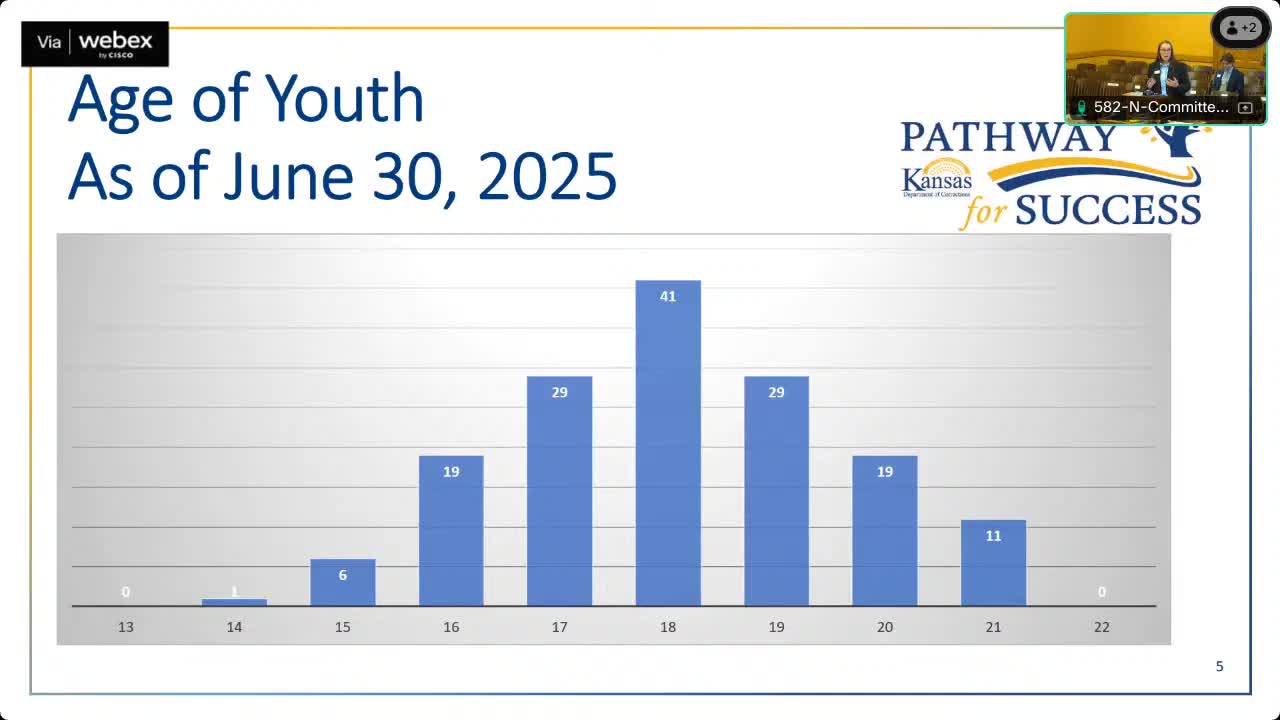
Summary
Deputy Secretary Megan Milner said the Kansas Juvenile Correctional Complex now houses largely older, higher‑risk adolescents, and multiple witnesses told the committee the state lacks sufficient in‑state capacity for short‑term crisis stabilization and secure psychiatric residential treatment for complex cases.
Kansas juvenile services officials told the Joint Committee on Corrections and Juvenile Justice that the juvenile facility population has shifted toward older teenagers and higher‑risk cases and that gaps remain in short‑term crisis and complex psychiatric residential capacity.
Who is in KJCC: KDOC Deputy Secretary Megan Milner said most youth at the Kansas Juvenile Correctional Complex (KJCC) are older adolescents: “95 percent of the youth ... are 16 years old and older,” and 64% of the KJCC population was 18 or older at the time of her presentation. She said that under 2016 reforms (Senate Bill 367), admissions are concentrated among moderate‑to‑high‑risk youth and that KJCC must focus programming for older adolescents nearing transfer to adult custody in some cases.
Behavioral health and detention screening: KDOC has rolled out GAIN screening in juvenile detention centers and used a $1.6 million FY26 grant to expand behavioral‑health services at detention centers. Early results show high needs: KDOC said approximately 84% of youth screened in detention were recommended for further mental‑health evaluation and roughly 57% for substance‑use evaluation; about one‑third received on‑site services during detention episodes.
Need for crisis stabilization and PRTF capacity: KDOC described a Stepping Up for Youth pilot and cross‑agency work with KDADS and DCF to connect youth earlier to community crisis stabilization services. Multiple witnesses, including Amber Hope (a nonprofit residential provider), urged investment in in‑state secure psychiatric residential treatment capacity for “complex cases” — youth with co‑occurring disorders, severe aggression, developmental disabilities or repeated treatment denials by conventional PRTFs. Amber Hope proposed a new secure PRTF (two build options: 32‑bed new build ~$34–36M, or 24‑bed renovation ~$21–23M) and asked the legislature to consider construction funding.
HB 2329 (juvenile code amendments): The Legislature’s reviser briefed the committee on HB 2329, which contains multiple changes: it would increase cumulative detention limits from 45 to 90 days; increase minimum/maximum juvenile detention terms where a firearm was used/possessed (proposal cited 6→12 months minimum, 18→24 months maximum in the statutory example); and require KDOC to contract for 35–45 non‑foster residential beds (no more than 15 per facility), paying costs through the Evidence Based Programs account (up to $10M/year). The bill also tasks the Juvenile Justice Oversight Committee with tracking outcomes.
Divergent reactions: Law‑enforcement witnesses said the reforms of 2016 helped reduce unnecessary juvenile confinement but left a difficult subset of violent or repeat juveniles without appropriate placement or detention authority; they supported targeted changes in HB 2329 (firearm‑related penalties, repeat offenders). Several service providers and juvenile detention directors urged care expansions — more crisis and high‑acuity beds and integrity of JJOC evidence fund use — so youth with acute behavioral needs can get therapeutic treatment rather than defaulting to foster placement or repeated community re‑arrest.
Bottom line: KDOC, vendors and county leaders described parallel needs — better short‑term crisis stabilization, more high‑acuity psychiatric beds, and clearer placement pathways for violent/repeat juveniles. HB 2329 attempts to address several of those issues through detention‑limit adjustments, firearm‑related sentencing changes and state‑funded residential bed contracts; the bill drew both support and caution from stakeholders and committee members.