
KDOC reports improved hiring but warns health care contract, rising population will push costs
Get AI-powered insights, summaries, and transcripts
Sign Up Free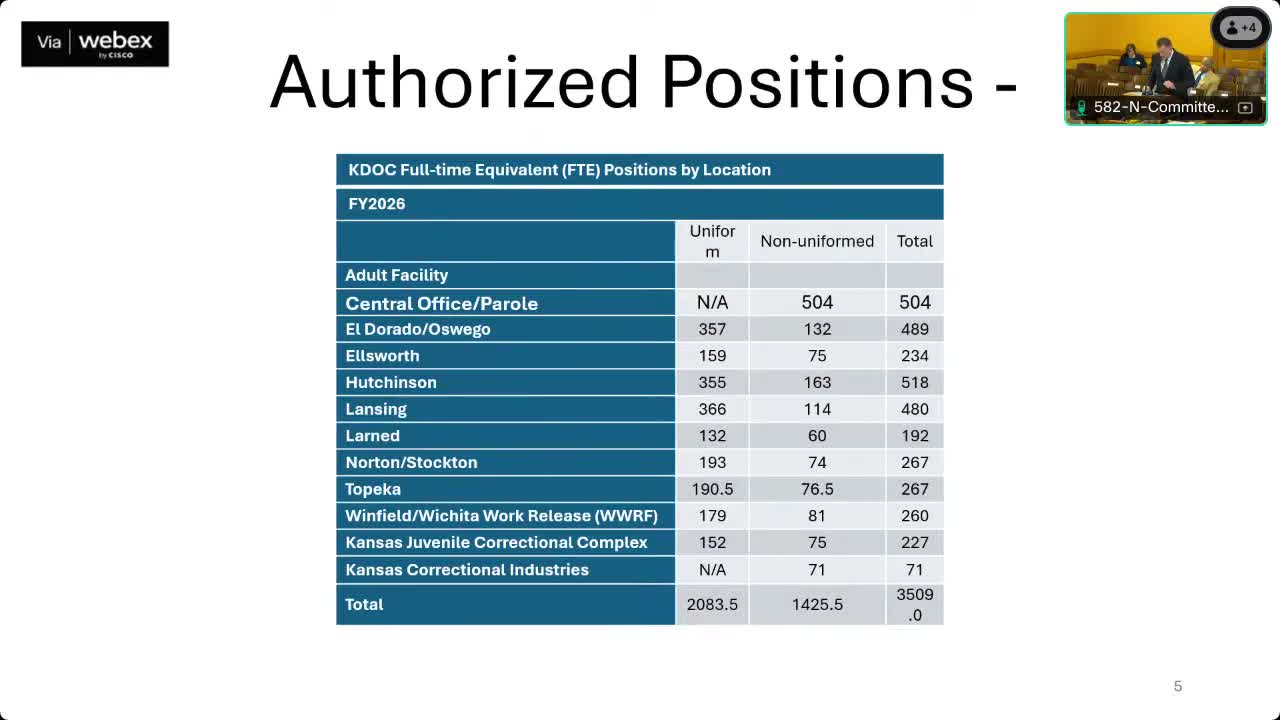
Summary
Secretary Jeff Zmuda said recruiting and pay increases have reduced correctional officer vacancies to about 11%, but KDOC warned that a $102 million health‑care line item, rising contract costs and population growth will keep pressure on state budgets.
KDOC Secretary Jeff Zmuda told the interim Joint Committee on Corrections and Juvenile Justice that pay investments and recruitment efforts have cut uniform vacancies substantially since the pandemic, but that budget pressure from health‑care and food contracts and a projected rise in inmates will require further attention by the legislature.
“We have just over 3,500 staff, and nearly 60% of them are serving in uniform positions,” Zmuda said during the department’s annual report. He showed vacancy trends that dropped from roughly 460 uniform vacancies in early 2022 to approximately 200 after recent pay enhancements; KDOC reported uniform vacancies near 11% statewide, down from a pandemic high of about 33%.
Budget picture: KDOC said roughly 95% of its operating budget is state general fund. Two of the largest single cost lines are the health‑care contract (about $102 million, ~16% of the agency’s operating budget) and contracted food services (about $23 million). The department said its current medical vendor negotiated a 5.7% price increase for the last year of the contract; KDOC has released an RFP for a new medical contract that expires 06/30/2026.
Population and projections: KDOC reported an adult population that fell in the pandemic to just under 8,300 and has risen to about 9,849 in 2025. The Kansas Sentencing Commission projects that, under current trends, the state’s bed capacity (about 10,892 combined men and women) could be exceeded in fiscal year 2029 — a point Zmuda said justifies planning for additional beds and a multiyear capital approach.
Parole and community supervision: KDOC outlined supervision responsibilities in the community, noting 17 parole offices supervising roughly 5,300 adults and a continued focus on risk‑based supervision. The department said it will expand data and metrics to guide parole work and pursue grant funding to improve parole‑facility coordination and reentry supports.
What the department is doing: KDOC said it is rolling out RFPs and investments — not only for the medical contract but also for tablets, body and package scanners at high‑custody facilities, and improved offender management technology (the Athena OMS). Zmuda listed education, private‑industry work programs (Zephyr, Polo, Russell Stover partnerships) and newly expanded industry buildings funded by Kansas Correctional Industries as priorities to reduce recidivism by improving job skills.
Bottom line: KDOC told legislators that workforce investments have noticeably improved vacancy levels and that targeted capital and contracting decisions (health care RFP, scanners, Athena stabilization) are intended to limit future operating risk. But the department cautioned that demographic and sentencing trends — coupled with contract inflation for health care — are likely to keep corrections among major budgetary demands in coming years.