
Boone County planners review draft Energy Overlay to regulate large solar, wind and battery projects
Get AI-powered insights, summaries, and transcripts
Sign Up Free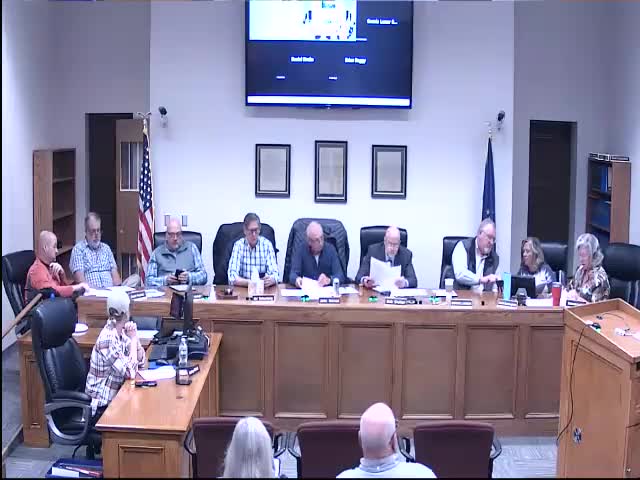
Summary
Boone County planning staff presented an outline for an Energy Overlay District intended to regulate large commercial solar, wind and battery storage projects, prompting a lengthy discussion of siting, groundwater and farmland protections.
Boone County planning staff presented an outline for an Energy Overlay District intended to regulate large commercial solar, wind and battery storage projects, prompting a lengthy discussion of siting, groundwater and farmland protections.
"The Energy Overlay District ... would require rezoning to the overlay while preserving the underlying zoning," Deborah Lazier, Boone County planning director, said as she walked the commission through the draft. "It would go through the plan commission for recommendation, and then the county commissioners would have to formally vote to put that overlay in place."
Why the draft matters: The outline sets a new multi-step approval path for utility-scale renewable energy — rezoning to a county-managed overlay, BZA review for a special exception, and a later development-plan review tied to permits. The draft divides solar into medium and large commercial categories, prohibits concentrated solar thermal power, limits overlays to agriculture (AG) zoning, establishes a 5-acre minimum and 400-acre maximum for overlay rezonings, and sets a 30-year maximum special-exception term.
Commissioners pressed staff and the consultant on numerous details. Several members questioned limiting the overlay to AG zoning and noted that the county’s existing industrial or commercial parcels might be better suited to rooftop or parking-structure solar. "If you're going to build a commercial building, it has to be set up for that," Jay Schonberg said, asking why existing commercial construction would be excluded by AG-only language. Lazier said the draft would be fleshed out in the forthcoming ordinance text.
Groundwater and farmland protections emerged as a recurring concern. The draft prohibits projects in specified unconsolidated aquifer systems (including the Wabash River Outwash) and contains a prime-farmland siting limit; commissioners warned that, as written, the aquifer and farmland exclusions could remove most county land from consideration. "Which just this alone would preclude any of this in our whole county," a commissioner said of the aquifer restriction; staff noted state DNR and Department of Natural Resources mapping would be used to identify constrained areas.
The draft also calls for a 5-mile pre-application notice radius (current public notice is 660 feet), minimum separation distances (three miles between projects), setbacks from nonparticipating landowners, fencing and wildlife-passage standards, and a requirement for testing wells within one mile of a site. Commissioners asked for clearer definitions and mapping to show what the restrictions would actually prohibit.
Other outstanding policy points included how to measure and guarantee property-value impacts, whether batteries should be allowed at non-substation locations (the draft restricts battery energy storage to utility substations), construction hour restrictions, and decommissioning surety. "The guarantee there needs to be some specific language," Deborah Lazier said about property-value guarantees and appraisal timing.
What comes next: Staff said HWC expects to provide a draft ordinance for review on Nov. 10; the commission asked the consultant to clarify thresholds (acreage and wattage for medium vs. large projects), define "prime farmland," and provide maps showing aquifer and farmland constraints. Commissioners directed staff to return with a full draft ordinance so they can identify specific edits before a public hearing cycle.
The discussion did not result in any binding approvals; the commission asked staff and HWC to flesh out the text and technical exhibits for future meetings.