Committee weighs adding Campus Corner to Center City TIF and using increment to back a public parking garage
Loading...
Summary
Planning staff told the committee Campus Corner was left out of the 2017 form‑based code footprint though included in the Center City TIF boundary; members discussed major amendment procedures, funding options including a parking trust and TIF‑backed debt, and rough garage cost estimates.
Planning staff (Miss Walker) briefed the Business & Community Affairs Committee Nov. 6 on Campus Corner’s exclusion from the 2017 form‑based code, the design of the Center City TIF project plan and options to bring Campus Corner under the form‑based code or to amend the TIF project plan to fund public parking.
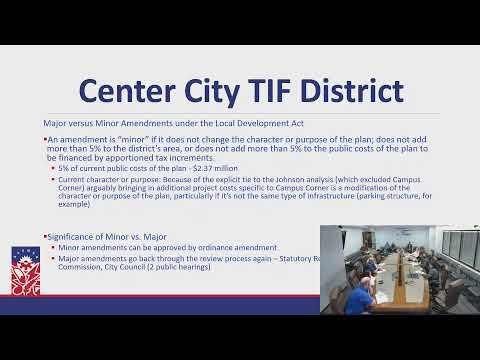
"The form based code was adopted in 2017 and the campus corner area was not included," Miss Walker told the committee, explaining that the Center City TIF boundary already includes Campus Corner but the project plan and the Johnson & Associates infrastructure study that underpins it do not allocate project dollars to parking structures. "The total for this particular TIF is $47,400,000," she said, and added that those dollars were tightly tied to public infrastructure upgrades identified in the original analysis (sewer, water, storm lines and street improvements).
Staff laid out two primary pathways to change how Campus Corner is treated: (1) a major amendment to the existing TIF/project plan (required if proposed changes alter the character or add more than 5% to public costs) or (2) creation of a distinct financing approach such as a parking trust or developer assistance combined with TIF as a backstop. Staff noted a minor amendment is only appropriate when changes do not materially change the plan’s character or cost (the 5% cap on project cost changes was cited as $2,370,000 under the current cap).
On parking economics, staff and council members offered only high‑level estimates: construction cost ranges of roughly $25,000–$35,000 per space were cited, and staff said an 87‑space surface lot could be replaced with a 4‑ to 5‑story structure yielding roughly 500 spaces on the same footprint if parcels could be acquired to expand the footprint. Staff estimated the conceptual design and cost‑estimate work could take several months; land acquisition timelines would depend on willing sellers.
Council discussion touched on the policy tradeoffs. Supporters said consolidating parking into a multi‑story garage would free small parcels for housing and ground‑floor retail and would enable transformation of Campus Corner toward a more urban form under a form‑based code. Others warned that previous negotiations tied unlimited height rights to parking commitments and that imposing new height limits in exchange for parking assistance would be contentious. Staff said the council could opt to amend the form‑based code to incorporate Campus Corner (and set new form standards) or pursue a new TIF to restart the tax‑increment clock if council preferred a longer financing horizon.
No formal action was taken. Staff told the committee they will present a draft parking‑trust document to the council in November, pursue more precise cost estimates and consider formation of an ad‑hoc committee or consultant engagement to draft form‑based code amendments if council directs that path.