
Laredo planning panel sends proposed gas-station buffer ordinance back to staff after extensive public hearing
Get AI-powered insights, summaries, and transcripts
Sign Up Free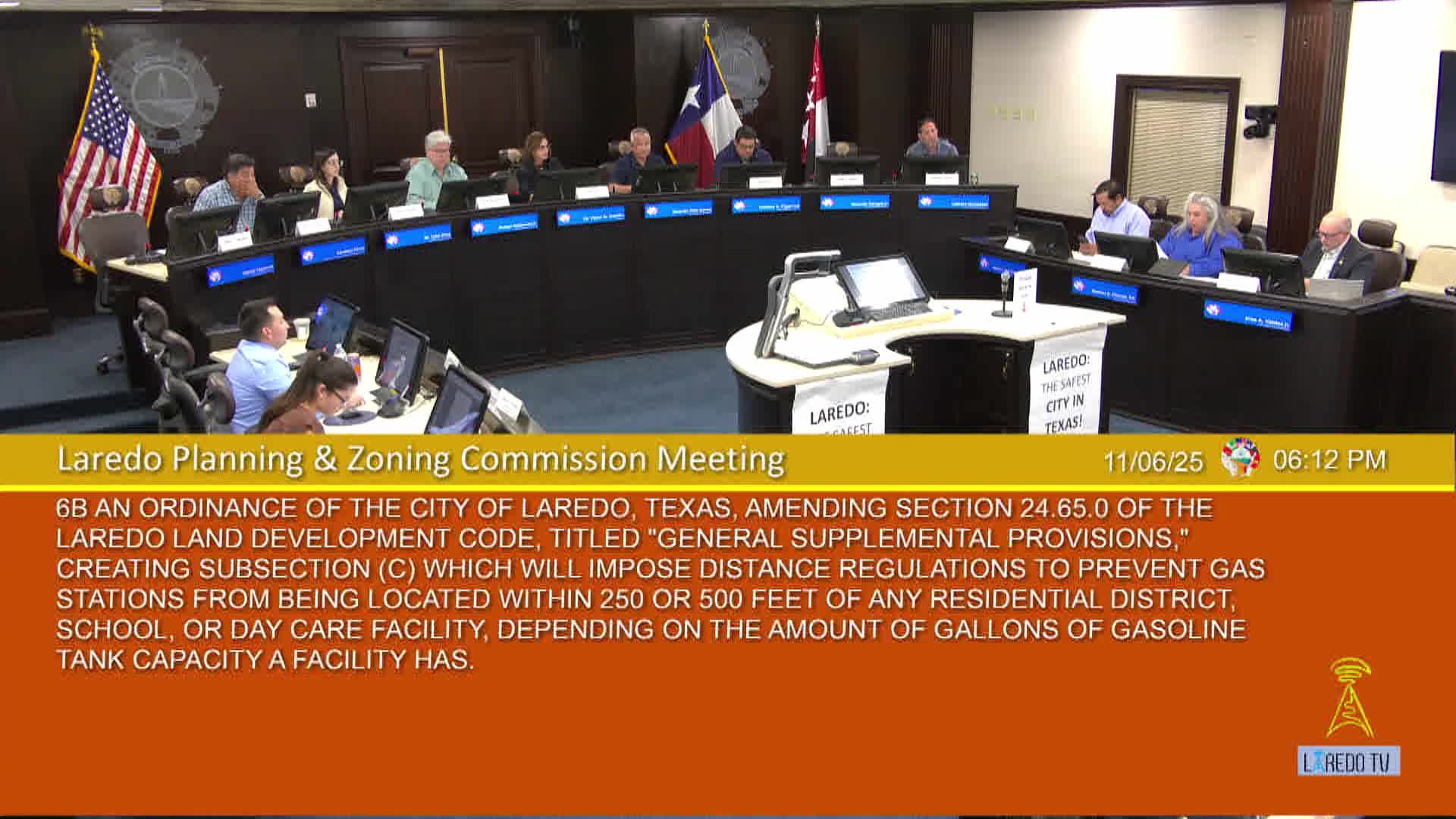
Summary
The City of Laredo Planning & Zoning Commission voted to send a proposed ordinance requiring distance buffers between gasoline stations and residential areas back to staff for more study after extended public comment and technical questions.
The City of Laredo Planning & Zoning Commission voted to send a proposed ordinance that would impose distance limits between gasoline stations and residential districts, schools and day-care facilities back to staff for additional study.
The ordinance, which staff said was drafted following a City Council directive and modeled in part on language other Texas cities use, would create a graduated buffer (different distances tied to underground storage tank capacity) intended to prevent certain gasoline facilities from locating near sensitive uses. Staff told the commission the draft measures distances from property line to property line and offered distance bands of roughly 100–500 feet depending on tank capacity. Commissioners and members of the public repeatedly asked staff to clarify which measuring method would apply and whether existing developments would be grandfathered.
The commission’s decision followed more than an hour of public comment and technical testimony. Alfonso Arguindi, representing ARG Petro and local retailers, told the commission the fuel industry is highly regulated — citing federal (EPA) and state (TCEQ) requirements for tank construction, secondary containment, monitoring and leak detection — and urged the body to clarify objectives and measurement details before forwarding a recommendation. Developers and planners, including Orlando Navarro and Judd Gilpin, said the ordinance as drafted could conflict with the city’s walkability goals and master plans, reduce the economics of high-value corner sites and complicate master-planned development unless distances and measurement points are specified.
Staff acknowledged the council directive and said the draft attempted to balance the council’s request with models used elsewhere; staff also said the draft adjusted a strict 500-foot directive to permit lesser buffers in some tiers. Commissioners pressed staff on several technical points: whether distances are measured from property line to property line versus pump or tank locations; how large-capacity tanks (for example, 50,000-gallon systems) are counted; whether the rules apply to convenience-store fuel operations at supermarkets; and how the ordinance would treat already-submitted plans. Staff said developments with plans submitted before ordinance adoption would not be affected, whereas future permit applications would be subject to any new rules.
After procedural discussion and motions, commissioners approved a motion directing staff to return with a revised draft that includes: a comparison table showing distance rules used by other Texas cities and how those cities measure buffers; specification of the measurement point (property line vs. pump or tank); counts or estimates of local tank capacities and how many existing sites would fall into each buffer tier; documentation of incident history or leak frequency relevant to buffer distances; and an outreach plan that includes industry, planning and engineering stakeholders. The motion passed on a voice vote.
The action is advisory. The commission’s recommendation and the staff’s revised draft will be returned to City Council for consideration. The commission did not adopt the draft ordinance as written and took no final regulatory action at this meeting.
Speakers quoted or paraphrased above are identified from the public record of the hearing. Where testimony described technical regulatory frameworks, speakers cited federal EPA and Texas Commission on Environmental Quality (TCEQ) standards for underground storage tank systems and vapor recovery.
The commission’s request for additional comparative data and clearer measurement language frames the next step in the city’s consideration of limits on fuel retail siting.