Seattle public commenters urge council to restore tenant services, add rental aid in 2026 budget
Loading...
Summary
At a Select Budget Committee public hearing, dozens of Seattle residents and nonprofit leaders asked the council to restore tenant services funding to 2024 levels, add at least $4 million for rental assistance, and protect meal and food-bank programs as federal SNAP cuts take effect.
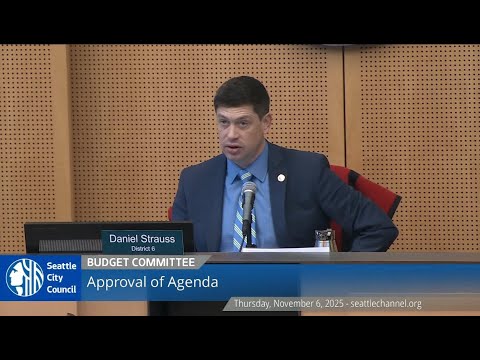
Dozens of residents, service providers and neighborhood leaders told the Seattle City Council Select Budget Committee on Nov. 8 that restoring tenant services and expanding rental assistance must be priorities in the 2026 budget.
"I urge the council to fully reinstate all of the funding for tenant services by adding at least 500,000 to what is proposed in the chair's balancing package," said Mackenzie Liu, elected legal assistant with the Housing Justice Project, during the virtual public hearing. Liu said eviction filings have doubled this year and that tenant services are the "strongest prevention" against displacement.
The testimony came during an extended virtual public-comment segment after the committee opened the 2026 budget hearing. Commenters argued that cuts to city-funded tenant services last year have left legal and counseling providers with less capacity to prevent evictions, and that restoring funding would be more cost‑effective than responding after households lose housing.
"As a result of the cuts to tenant services, our contract was reduced by 43%, and we had to reduce our staffing," said Celestine Barry Smith, tenant services manager at Solid Ground. She said the organization served about 125 fewer renters this year and that callers face longer callback times.
Attorneys and frontline advocates offered concrete examples of outcomes when legal help is available. "A 91‑year‑old woman facing eviction... No other city-funded organization could have sent an attorney to that hearing, but we did, and we kept her housed," said Sarah White of Catholic Community Services' Tenant Law Center. White asked the council to restore $1,000,000 to return tenant services to 2024 levels.
Many callers also urged the council to include a $4 million allocation for rental assistance proposed in the chair's package and to strengthen the mayor's reserve to blunt service disruptions if federal funding streams are reduced. "Families coming to the food bank right now are scared and confused" following SNAP cuts, said Max Wimbaka, pantry coordinator at the University District Food Bank, who urged protecting investments in food banks and meal programs.
Other frequently repeated requests included:
- Sustaining and expanding funding for meal programs for older adults and community dining (testimony came from the Meals Partnership Coalition and community dining providers). - Protecting Seattle Public Library operations and preparing for a robust levy renewal after a one‑time capital transfer. - Funding neighborhood and small-business supports (incubator, cleaning services, business technical assistance), with speakers from Lake City, Georgetown and the Lake City Collective describing local needs. - Maintaining survivor services and supporting HSC/HST amendments 061–064 to fund gender-based violence and survivor programs, urged by KCARC and survivor-service legal providers.
Service providers repeatedly framed their requests as cost‑effective investments that prevent homelessness, stabilize families, and reduce downstream emergency costs. Several speakers urged the council to prioritize maintaining existing housing and social services before creating new programs that could risk disrupting current care.
Where commenters named specific amounts, they typically requested an additional $500,000 to $1,000,000 for tenant services and $4,000,000 for rental assistance; other neighborhood or program requests varied by speaker and were often smaller, targeted allocations. Many organizations also urged the council to preserve proposed investments in workforce and small-business programs that they said yield economic returns.
The committee completed the virtual signups at 3:00 p.m., recessed until 5:00 p.m. and planned to alternate between in-person and any remaining remote commenters. The budget hearing remains a deliberative process; no council votes occurred during the public hearing segment.