
Volusia County details near-term sand placements, inlet and offshore sand resources
Get AI-powered insights, summaries, and transcripts
Subscribe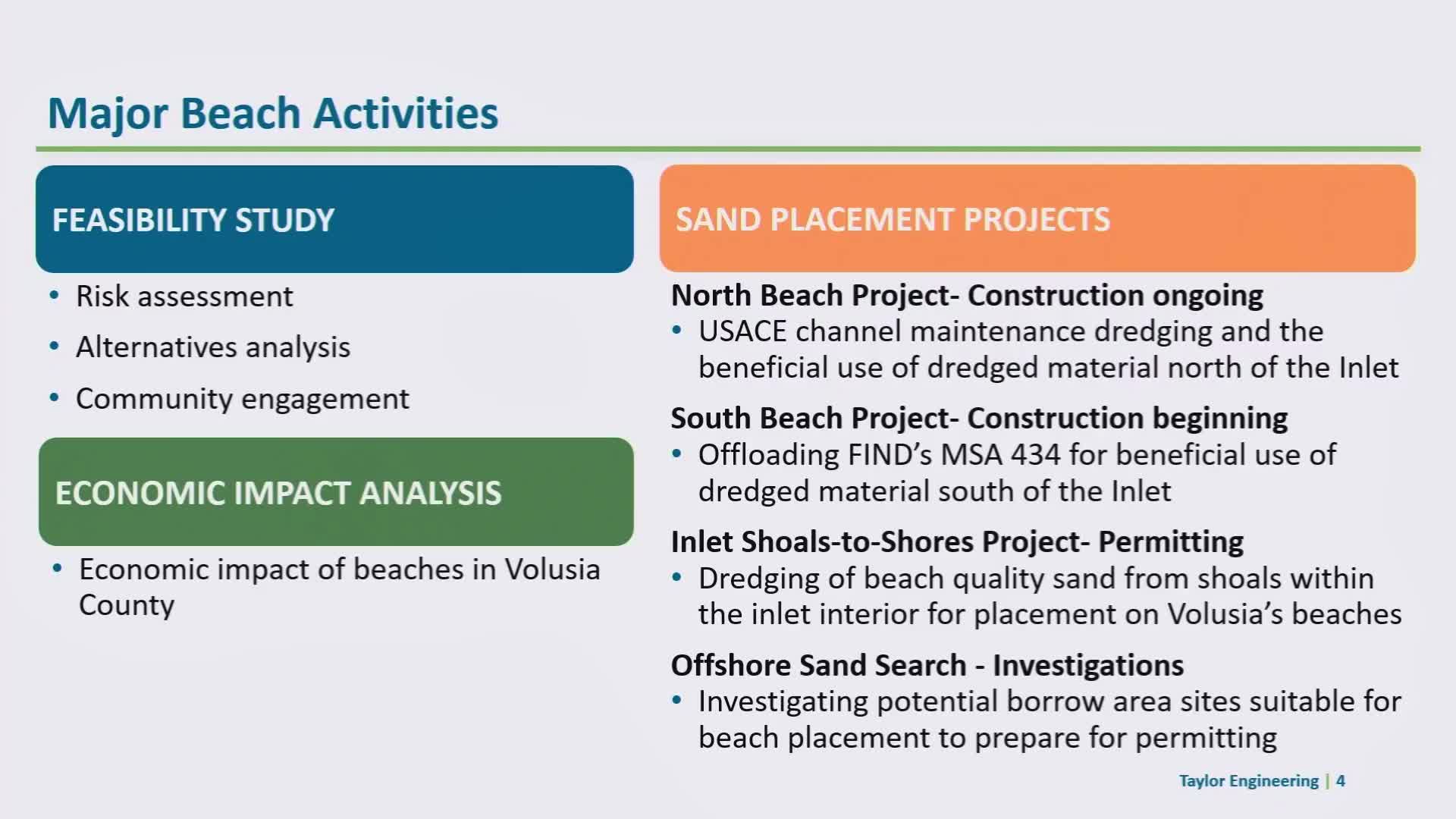
Summary
County staff described ongoing sand placement actions, recent emergency fills, and substantial additional sand resources inside the inlet and offshore that could be mobilized for future nourishment projects.
Volusia County staff described current sand placement activity and the county's approach to identifying additional sand resources for future nourishment projects. Jessica Fentress, the county's coastal director, said the North Beach sand placement project placed material south of Sunglobe in Daytona Beach Shores down to Ponce Inlet and characterized that placement as "sacrificial" material following the 2022 hurricanes.
"Following the 2022 hurricanes, we lost over 6,000,000 cubic yards of sand," Jessica Fentress said, and she described the recent placement rate as approximately 18 cubic yards per linear foot — "about 1 dump truck load per foot of shoreline" — compared with a design nourishment magnitude of about 100 cubic yards per linear foot.
Fentress outlined a planned South New Smyrna Beach project that would place about 550,000 cubic yards of beach-quality sand taken from Rattlesnake Island, a dredge material management area near Ponce de Leon Inlet. She also said Army Corps dredging is limited to navigational channels, leaving approximately 1,750,000 cubic yards of sand in inlet shoals outside the platted channels that Volusia staff plan to recover and place on the beach.
Looking further offshore, the presentation noted roughly 40,000,000 cubic yards of sand in a 3–5 mile band along the continental shelf from Flagler County to Canaveral, with varying grain sizes that would need to be matched to local beach conditions. "Whatever sand we put on the beach has to match the existing sand in that community," Fentress said, warning that a mismatch could change driving access or wave dynamics on beaches such as Bethune Beach.
The team said they are performing large-diameter core sampling to 30 feet below seabed to test grain size and suitability, and staff will tailor borrow-source selection to each community's sediment characteristics. County staff and consultants noted that emergency sand placements are smaller and more temporary than engineered nourishment projects and that long-term planning and permitting will drive larger-scale renourishment intervals and design.