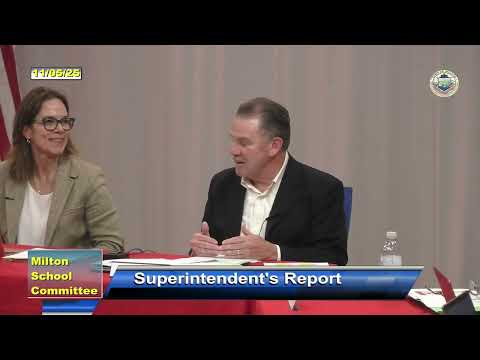
Milton presentation shows overall MCAS strength, persistent gaps for selected student groups
Loading...
Summary
Milton — At its Nov. 5 meeting, Milton School Committee members heard a district presentation showing that Milton Public Schools outperformed statewide averages on MCAS overall in 2025, while also revealing persistent achievement gaps for several student groups and a clear plan of instructional work intended to raise outcomes.
Milton — At its Nov. 5 meeting, Milton School Committee members heard a district presentation showing that Milton Public Schools outperformed statewide averages on MCAS overall in 2025, while also revealing persistent achievement gaps for several student groups and a clear plan of instructional work intended to raise outcomes.
The presentation, led by the district’s data specialist (Vee) and the superintendent, reviewed DESE’s accountability framework and emphasized three central findings: Milton’s aggregate MCAS results remain above state averages across tested grades; science results showed substantial improvement in 2025; and selected populations — students with disabilities, English learners (ELs), low‑income students and Black and Hispanic students — continue to lag substantially behind the district average.
"It's important to remember that the standardized assessment, which is MCAS, is a useful measure for what students have learned," the superintendent said, adding that "MCAS really lets us know what we need to work on as adults." Vee illustrated subgroup differences: in grades 3–8 ELA, 33% of English learners in Milton were meeting or exceeding expectations compared with 19% of ELs statewide, a gap Vee described as a data point the district will target.
Why it matters: MCAS results inform the state accountability rating and local planning, influence where the district targets professional development and instructional resources, and shape the narratives parents and town officials use when reviewing budget priorities.
What the data showed - Science: The district reported a strong year in science testing in 2025 across tested grade spans; presenters called it a "good news story" tied to intentional instructional work and staffing in science. - Growth and SGP: Presenters stressed student growth percentiles (SGP) and the DESE progress measures as central to measuring how much students are advancing year over year; committee members urged a sharper focus on SGPs as a leading indicator of longer‑term score changes. - Subgroups: Vee and district leaders repeatedly flagged historical differences among groups and said the district will focus targeted supports on students with disabilities, ELs, low‑income students and Black and Hispanic students. - Attendance: The district noted chronic absenteeism is down and currently among the state’s lower rates, a factor the district sees as complementary to instructional improvements.
Budget context and local comparisons Superintendent John framed part of the discussion in resource terms, noting Milton’s per‑pupil spending is lower than some DESE 'comparable' communities and that funding differences limit but do not fully explain performance differences. In his remarks he calculated that the three higher‑spending comparable districts average about $23,000 per pupil and that difference equated to roughly $4,000 per Milton student — "about $12 million" when applied to Milton’s enrollment; another committee member later calculated a $4,900 gap (roughly $21 million) using a different comparator and emphasized how funding gaps shape options. The committee did not change policy or budget at the meeting; those numbers were presented as context for the instructional and resource decisions the district is pursuing.
District response and next steps District leaders tied the MCAS and related data directly to an instructional plan anchored in five district priorities. Actions the superintendent and staff described include: - Aligning professional development and school‑level professional learning with the five priorities; the district reported a full‑day PD on Nov. 4 that offered roughly 45 sessions for staff. - Continuing grade‑ and item‑level analysis in schools to pinpoint standards and concepts that need more instructional time. - Piloting targeted, modest investments at Tucker School to increase teacher leadership time and a portion‑time position to improve supports for special education students; the superintendent said the package totals about $14,000 and will be treated as a pilot if the finance subcommittee supports it. - Using the Performance Matters platform to give teachers near‑term access to assessment results for regrouping and interventions.
What committee members asked and urged Members praised the clarity of the presentation and pressed district leaders for speed and specificity on interventions. Several members said Milton should aim for higher student growth percentiles and for more coherent, district‑wide instructional systems so effective practices can scale from strong classrooms to all schools.
The meeting closed with the district committing to return with deeper, grade‑by‑grade analyses and updates on early‑literacy pilots, curriculum work and the realignment of staff resources tied to the five priorities.