
Staff outlines certification and leadership pipelines: ESOL cohorts, teacher-to-AP pathway, EdTech supports and Chapter 115 portfolio plan
Get AI-powered insights, summaries, and transcripts
Subscribe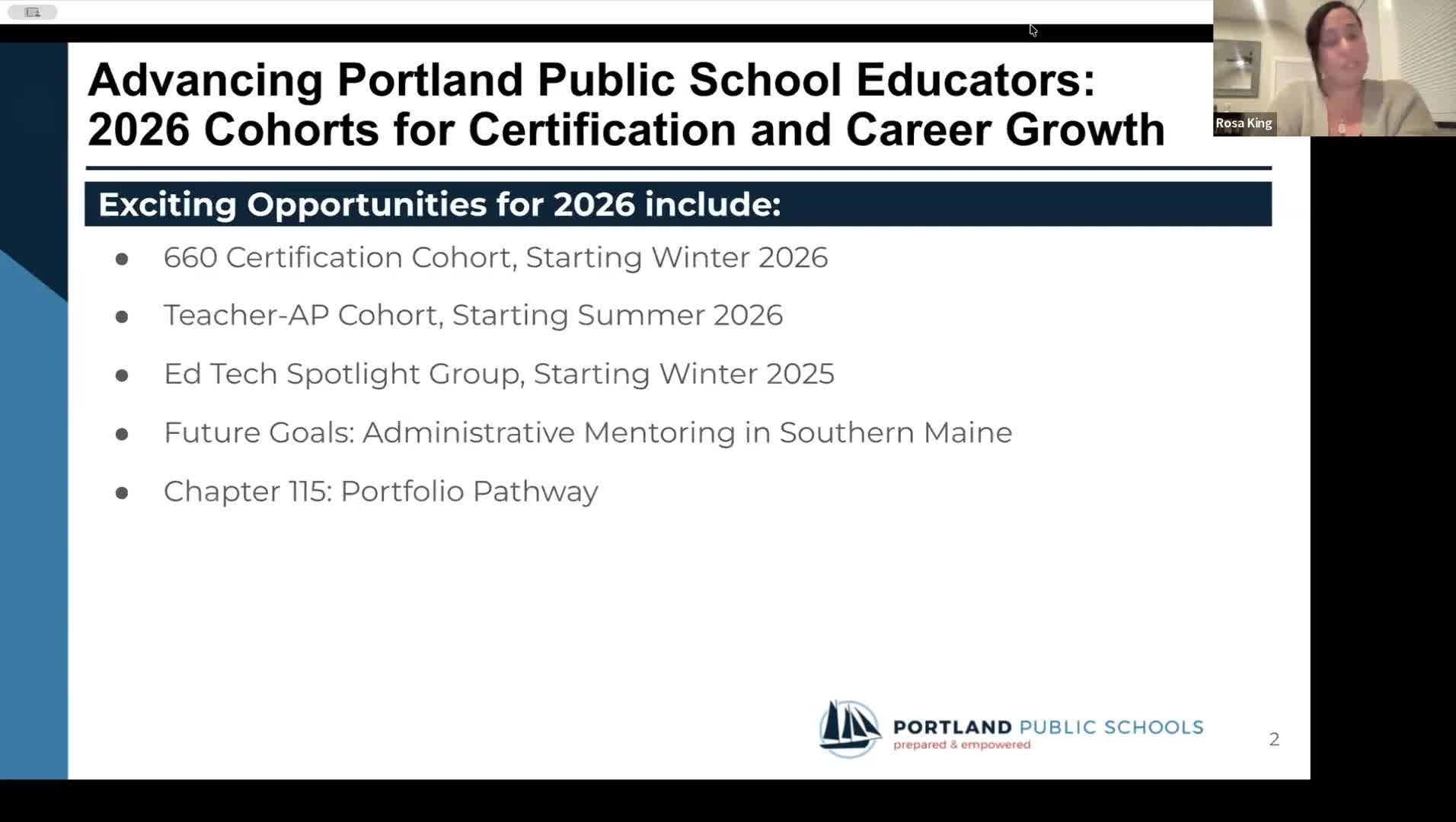
Summary
Rosa King, a district staff member, presented a package of workforce-development initiatives including a January 6-60 ESOL cohort, a summer 2026 teacher-to-AP leadership pathway, an EdTech peer group and a proposed Chapter 115 portfolio certification route.
Rosa King, a district staff member, presented a package of workforce-development initiatives intended to increase certification and internal pipelines for hard-to-fill roles.
King said the district will launch an accelerated 6-60 ESOL certification cohort in January in partnership with the University of Maine at Farmington (UMF). “We have about, over 30 teachers who are interested in the cohort,” King said; she noted the program has been live for fewer than two weeks and the district expects the number to rise. The cohort will be five graduate-level courses, each roughly eight weeks long; cohorts are capped at about 25 per section and the district will use grant funds to fully cover teachers’ costs.
King also described a teacher-to-assistant-principal (AP) leadership pathway that will begin in summer 2026 through UMF and the University of Southern Maine (USM). About 11 teachers have been nominated for the first cohort, and the district intends to use funds from an apprenticeship grant to seed the work. King told the committee the district currently has $127,000 available from its main apprenticeship grant to support the 6-60 cohort, the leadership pathway and mentoring work, and staff are exploring other funding to continue the programs after the grant ends.
The district plans an EdTech spotlight group that will meet quarterly during professional-development time to share practice, resources and peer learning; the group is optional and run by EdTechs themselves. King said principals had nominated potential candidates for the leadership pathway and that future mentoring plans include partnering with southern Maine districts and existing principal networks to provide cross-district mentoring for new administrators.
King closed with a discussion of a proposed revision to Department of Education Chapter 115 that would allow a portfolio-based conditional certification and a three-year induction plan. If passed, the change would let the district support career changers and classroom staff through an in-district portfolio and mentoring process that the district would submit to the Maine DOE for final certification. The proposal has not passed; King said it likely would not be in effect until 2026 and public buy-in remains necessary.
Board members asked clarifying questions about cohort size and eligibility. Board member Offerman confirmed that candidates in the proposed Chapter 115 pathway must hold a bachelor’s degree; King confirmed that prerequisite. Committee members asked staff to provide further context on current baseline certification rates and the district’s capacity to use available grant funds.