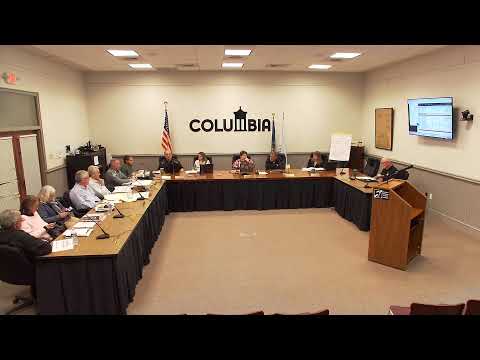
Columbia council workshop grapples with capital accounting, fire truck funding and community donations
Loading...
Summary
Columbia Borough Council spent its Nov. 6 workshop weighing capital budgeting choices, including whether to return bond debt service to the capital fund and how to fund a ladder truck the borough—s volunteer fire company ordered.
Councilmembers spent the majority of a Nov. 6 workshop poring over the 2026 general and capital budgets and debating how to fund near-term capital needs, including a ladder truck the Columbia Fire Company has ordered.
Staff told council the borough moved bond debt-service payments from the capital fund into the general fund in recent years because capital balances were depleted and there were no dedicated transfers back into capital. Councilmembers and staff discussed two approaches: restore debt service to the capital fund and make a recurring transfer from the general fund into capital, or leave debt service in the general fund and plan transfers when and if capital receipts (property sale proceeds, grants) materialize. Staff cautioned that treating projected property-sale proceeds as current capital cash can be misleading and urged clearer presentation of projected vs. realized revenue in future budgets.
Council reviewed several capital projects and grants. Staff said a $1 million LSA grant is available for Ridge Avenue work and that RACP funds tied to the public works facility (phase 2) and sale proceeds from wastewater-plant property are planned to be used for the transition. Council members asked staff to prioritize which components to complete with currently available grants and recommended clearer, multi-year capital planning.
The Columbia Fire Company appeared to press council for support for a ladder truck the company says is already ordered. Fire department representatives described a long-term decline in volunteer availability and rising operating costs; they asked for an additional recurring revenue source to help pay for the truck. Fire representatives said financing earlier could secure a manufacturer—s financing discount, while council members noted the borough has limited uncommitted capital and must weigh competing priorities. Several council members agreed to form a committee of council and staff to explore financing, grant, and fund-balance options before finalizing a funding decision.
Council also discussed nonoperational community funding. Members questioned annual contributions to a local management organization for the Market House (referenced in discussion as "Susskind National Heritage") and recommended that future donations or reimbursements be approved only after organizations submit budgets and invoices to create an audit trail. On animal-control funding, council members preferred paying direct invoices submitted by a recognized humane society or shelter rather than making unrestricted donations to informal volunteer groups; they asked staff to add specific line items and require budgets or monthly invoices for reimbursement.
Two formal procedural motions were recorded: a motion to approve the workshop agenda (moved by Councilperson Kaufman, second by Councilperson Giese; approved) and a motion to adjourn (moved by Councilperson Giese, second by Councilperson Kaufman; approved). No final vote or appropriation for the ladder truck or other capital projects was taken at the workshop.
Council scheduled its next regular meeting for 7 p.m. on Thursday, Nov. 13 and agreed to form a committee to develop options for funding the ladder truck and to return to capital budget presentation that clearly separates projected and realized revenue.