Get Full Government Meeting Transcripts, Videos, & Alerts Forever!
State Water Board hears competing views on Tuolumne HRL after staff’s scientific‑basis supplement
Summary
The State Water Resources Control Board on Nov. 5 reviewed a draft Scientific Basis Report supplement that compares the Tuolumne River Healthy Rivers and Landscapes proposal (HRL) — a locally funded, 8‑year voluntary agreement by Modesto Irrigation District, Turlock Irrigation District and the San Francisco Public Utilities Commission — against existing operations and 30–50% unimpaired flow scenarios. Staff found temperature, spring flow and floodplain area most strongly correlated with juvenile Chinook productivity; the HRL projects some habitat gains and lower spring temperatures versus existing conditions but, according to NGOs and some technical reviewers, likely would not provide sufficient protected flows, temperature improvements or Delta outflow guarantees to meet the board’s biological goals.
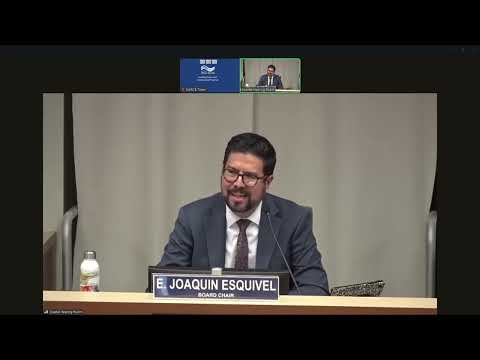
The State Water Resources Control Board on Nov. 5 held a workshop to review a draft Scientific Basis Report (SBR) supplement that staff said will inform whether the Tuolumne River Healthy Rivers and Landscapes proposal (HRL) can be incorporated into the Bay‑Delta Water Quality Control Plan. The HRL, advanced by Modesto Irrigation District, Turlock Irrigation District and the San Francisco Public Utilities Commission (SFPUC), would combine schedule‑based flow commitments (base flows, a spring out‑migration pulse and a floodplain‑activation pulse) with non‑flow actions such as spawning gravel augmentation, constructed rearing habitat and predator management backed by roughly $80 million in local funding.
Staff summarized the SBR’s technical analyses — stock‑recruit modeling, two hydrology tools (the State Water Board’s monthly WSE model and a Tuolumne parties’ daily accounting spreadsheet), HEC‑5Q temperature modeling, and weighted‑usable‑area habitat estimates — and described how they compared the HRL against existing conditions and 30%, 40% and 50% unimpaired‑flow scenarios adopted in the board’s 2018 Bay‑Delta plan update. Staff said the SBR will be revised after public comment and will be submitted for independent scientific peer review in 2026.
Why this matters: board members and members of the public framed the discussion as a choice between two ways to pursue the board’s co‑equal goals — the 2018 unimpaired‑flow approach (30–50% unimpaired flow, with 40%…
Already have an account? Log in
Subscribe to keep reading
Unlock the rest of this article — and every article on Citizen Portal.
- Unlimited articles
- AI-powered breakdowns of topics, speakers, decisions, and budgets
- Instant alerts when your location has a new meeting
- Follow topics and more locations
- 1,000 AI Insights / month, plus AI Chat