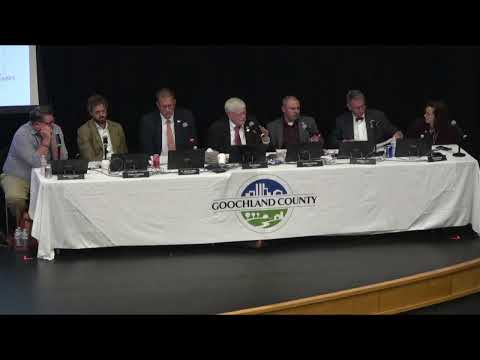
Goochland County adopts technology overlay district and technology zone amid heavy public opposition
Loading...
Summary
The Goochland County Board of Supervisors on Nov. 6 approved a Technology Overlay District and a companion Technology Zone incentive ordinance, voting 4–1 to adopt the measures with staff‑recommended changes plus additional generator‑noise mitigation measures.
The Goochland County Board of Supervisors on Nov. 6 approved a Technology Overlay District and a matching Technology Zone incentive ordinance, voting 4–1 to adopt the measures with staff‑recommended changes and additional generator‑noise mitigation requirements. The board adopted the overlay after an extended public hearing in which more than 80 speakers — mainly neighbors of the proposed overlay — urged delay, tighter noise and emissions standards, and removal of a contested 900‑acre area labeled "TOD West."
County staff described the two measures as a paired tool set: the overlay (a zoning amendment and a companion comprehensive‑plan update) would set new local controls for technology uses such as data centers and advanced manufacturing, and the technology zone would allow the county and its Economic Development Authority to offer financial incentives (for example, reimbursing permit or water/sewer connection fees under an ROI review). Sarah Worley, deputy county administrator for economic and community development, told the board the measures aim to diversify the tax base while protecting rural character.
The proposal approved by the board contains several substantive limits and new requirements staff highlighted during their presentation: it bars any by‑right energy generation (including small modular reactors and gas peaker plants) and requires a conditional use permit (CUP) for specified high‑impact uses; it lowers the noise standard to 55 dBA measured at the property line and adds a 65 dBC limit to address low‑frequency noise; it requires a pre‑ and post‑construction environmental noise impact assessment prepared by a qualified third party using industry standard modeling; it narrows generator testing to limited times, requires operators to post testing schedules publicly, and mandates that generators minimize noise by using acoustic walls, enclosed enclosures, locating generators away from residences, berms/screening, or other methods. Staff also proposed larger setbacks and buffers — including setbacks up to 500 feet for data centers adjacent to A‑2 (agriculture) zoning — and stepped height rules (e.g., buildings 61–80 feet would face greater setbacks and structures over 80 feet would require CUP).
Worley also described operational and site standards such as dark‑sky lighting, architectural treatments, interior fencing, a minimum open‑space requirement in TOD projects, a prohibition on routing road access through local residential streets, and a requirement that commercial facilities use public water rather than wells for commercial flows. She said battery storage would remain a by‑right use but would be limited in location (e.g., 1,500 feet from residential and within quarter‑mile of major highways), battery type would be restricted, and siting agreements could require operator training and financial contributions. The Technology Zone language staff presented leaves incentive decisions to ROI analysis and board/EDA approval; Worley noted connection fee reimbursements could be sizable in high‑water‑use projects and gave a worked example where facility connection fees might be reduced from $2,000,000 to $1,000,000 based on projected tax revenue.
The public hearing drew extensive, largely negative public comment. Speakers representing Mosaic at West Creek, Reader’s Branch, Creekmore and other neighborhoods asked the board to remove the 900‑acre "TOD West" area from the overlay and to defer adopting the ordinance for 180 days to allow additional analysis and negotiation. Common concerns raised by residents and technical witnesses included: the cumulative noise impact of large facilities and diesel backup generators, health impacts from diesel emissions and particulates, large water withdrawals and closed‑loop cooling, the risk of clustering multiple data centers in the same region, limited enforcement mechanisms, potential impacts on property values and the county’s character, and a perceived lack of transparency earlier in the process. Several public‑health and environmental witnesses urged stricter standards for emissions, continuous monitoring and bonding to guarantee compliance. The Southern Environmental Law Center advised the board to require CUPs for high‑impact facilities so conditions can be tailored to site‑specific impacts.
Board action and amendments: After public comment the board deliberated and adopted the overlay (and the companion comprehensive plan amendment) with the staff‑proposed wording plus further amendments moved by Supervisor Waters that tightened generator mitigation. Waters’ additions directed that the listed mitigation measures be required (acoustic walls, enclosed generators, location away from residences, berms/screening and similar measures), required berms/fencing to provide screening and be installed before structures, and required use of low‑emission Tier‑4 diesel generators where diesel backup is used. A separate vote adopting the Technology Zone (the incentive ordinance) also passed 4–1.
Votes at a glance: The TOD ordinance and the Technology Zone were each adopted on 4–1 votes, with Supervisor Jonathan Lyle the lone dissenting vote on both measures. The board earlier approved a separate conditional use permit (CUP‑2025‑3) for an accessory family dwelling (831 Broad Street Road) unanimously.
Why it matters: The TOD/TZ package is intended to make Goochland more competitive for high‑revenue technology investment while creating local tools (setbacks, buffers, noise limits, CUP review) to reduce potential impacts on adjacent neighborhoods. Opponents warned that permitted and by‑right allowances plus incentives could accelerate clustering of data centers and related infrastructure and urged a countywide pause, stronger enforceable emissions and noise limits, or outright exclusion of certain uses near neighborhoods. Supporters — including some board members — argued the revised package balances growth and protections and will help the county pay down capital debt and fund public services without shifting tax burdens to homeowners.
What to watch next: The County will publish the final adopted ordinances and the comprehensive plan amendment. Conditional use permits and performance agreements for individual projects are likely to return to the planning commission and board with site‑specific plans, permits and conditions. Residents and county boards also flagged enforcement mechanisms and monitoring details (e.g., third‑party noise testing and potential air‑quality monitoring) as next steps for county staff and the board to operationalize.