Get Full Government Meeting Transcripts, Videos, & Alerts Forever!
Get email alerts on the Drought Policy topic
No spam. Unsubscribe anytime.
Ecology outlines drought thresholds, relief and grants as Dungeness team weighs local impacts
Summary
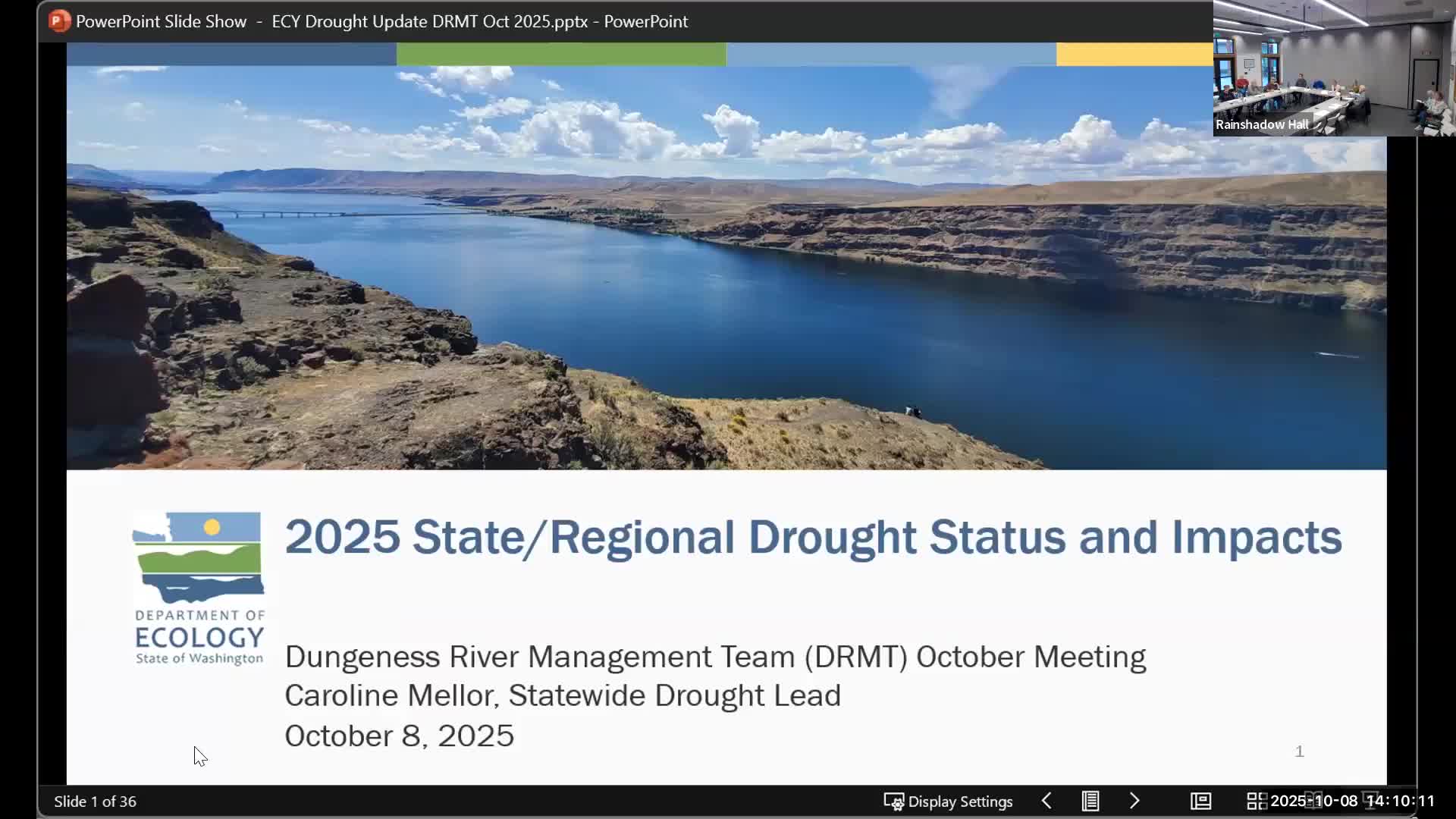
The Washington Department of Ecology’s statewide drought lead, Caroline Mellor, told the Dungeness River Management Team on Oct. 8 that the agency uses a two‑part test—a hydrologic threshold and a hardship threshold—before issuing a state drought declaration, and that a declaration opens expedited temporary water transfers and limited emergency response funding.
The Washington Department of Ecology’s statewide drought lead, Caroline Mellor, told the Dungeness River Management Team on Oct. 8 that the agency uses a two-part test before issuing a state drought declaration: a hydrologic threshold and a hardship threshold. “First is a hydrologic threshold that an area is receiving or is projected to receive less than 75% of normal water supply,” Mellor said, adding that “by normal, we’re referring to the most recent 30 year period” (1991–2020).
Mellor said the second required factor is a demonstrable “hardship threshold” meaning water users or the environment “are or clearly expected to experience undue hardship based on those hydrologic conditions.” She repeated that a state declaration does two key things: it allows Ecology to expedite temporary emergency applications for water transfers or drought permits and it opens limited drought emergency response funding to eligible public entities and tribes.
That funding, Mellor said, is emergency‑response money and “is limited to emergency response.” She noted that the eligible‑entity list in statute does not include nonprofit organizations and that Ecology can use interagency agreements to support the Washington Department of Fish and Wildlife and the Conservation Commission in response actions.
Team members raised technical and policy questions about how the state defines “normal.” One attendee observed that a fixed 30‑year normal can obscure more recent climate patterns; Mellor replied that the 30‑year normal is established federally and updated every decade. “That’s specifically the comparison of normals,” she said, and acknowledged the broader debate about whether other statistical measures might better reflect recent variability.
Mellor contrasted the state process with the federal drought designation, saying federal criteria are tied to the U.S. Drought Monitor (for example, D2 for eight weeks or D3/D4 for immediate designation) and that federal designation triggers different relief—such as low‑interest loans for farmers—and can extend to contiguous counties once a county is included.
Local context drew repeated attention: DRMT Chair Hansi House and others noted recent Dungeness River flow readings and the role of soil moisture, snowpack and early melt in determining local water supply. Mellor pointed members to tools Ecology uses—snowpack, runoff forecasts, soil moisture and the state Water Supply Availability Committee—and encouraged early outreach under an “advisory” designation that the Legislature added in 2020 to allow preparedness conversations before a declaration.
Mellor also cited grant and program timelines. She said Ecology’s drought‑related relief is separate from the competitive Streamflow Restoration Grant program, which will open a new round in January with updated guidance that emphasizes climate and drought preparedness. “There might be even more sort of examples of how that can fit into the streamflow restoration grant,” she said.
Why it matters: a state declaration can fast‑track temporary permits and unlock emergency funding for public agencies and tribes; it does not automatically provide federal farm loans or expand nonprofit eligibility. Local utilities and small districts told the team they face capacity barriers when applying for limited emergency funding, and attendees discussed using the advisory period for planning and partnership-building.
Ecology encouraged local partners to contact staff early to explore eligible projects and to watch the Streamflow Restoration Grant guidance and application window in January.