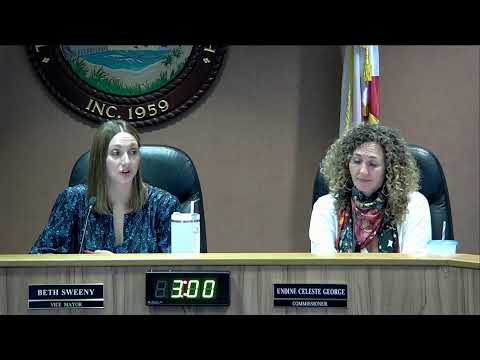
St. Augustine Beach commission approves perpetual easement for federal renourishment after lengthy debate
Loading...
Summary
The City Commission of St. Augustine Beach voted Nov. 4 to sign a perpetual beach easement that the U.S. Army Corps of Engineers requires for federal beach renourishment work.
The City Commission of St. Augustine Beach voted Nov. 4 to sign a perpetual beach easement that the U.S. Army Corps of Engineers requires for federal beach renourishment work.
The commission debated the draft easement at length, focusing on three substantive differences between the new document and an earlier agreement from 2000: the new easement is perpetual (rather than 50 years), it explicitly places responsibility on the grantee for removal of damaged structures in some cases, and it lacks an automatic reverter clause tied to project funding or activity. After discussion, commissioners approved the perpetual easement with a clerical correction to Exhibit A (changing the wording to reflect "parcels"), and a motion to approve was made and seconded "under protest." The vote passed on a voice vote and was recorded as adopted.
City and county staff told the commission the Army Corps has generally declined to negotiate the perpetual-easement language, and that while the commission could submit edits the Corps is unlikely to accept them. County and city staff described local practice in prior renourishment cycles: when a private beachfront structure is so damaged that a contractor will not work near it, property owners have historically been responsible for removal costs; otherwise, contractors and project work have typically included replacement or repair during renourishment activity.
Staff reported outreach to private property owners in the project area and said about 41 percent of property owners had returned signed easement documents at the time of the meeting; several commissioners said many holdouts are unreachable by mail and typically sign after in-person contact.
Commissioners and staff also discussed the project funding and recurring costs for renourishment. Staff described the Corps’ emergency renourishment mechanism (FCCE), which would restore beach material at federal expense after a qualifying storm event; that emergency coverage, staff said, is treated as a perpetual insurance policy separate from the project’s scheduled renourishment intervals. Commissioners noted uncertainty about funding at project end-of-life but said they were advised by Corps/court staff that many Florida projects have been reauthorized or extended after their initial term.
The commission’s approval included the clerical correction requested by council and an explicit record that at least one commissioner supported the motion "under protest," citing concerns about the lack of local negotiating room with federal partners. The commission did not direct staff to withhold signatures from private owners who decline to sign; county staff noted the county has pursued eminent domain in other projects where necessary to reach 100% participation.
What the commission approved: the motion recorded in the minutes authorizes the city to sign a Perpetual Beach Storm Damage Reduction Easement for the city-owned shoreline parcels described in the exhibit, with the exhibit language corrected to pluralize "parcels." The easement is intended to enable inclusion of the city’s shoreline in Corps-managed renourishment projects.
Next steps: Staff will record the corrected exhibit language and proceed with signature collection for city parcels; county staff will continue outreach to private property owners. The record of the vote and the adopted amendment will be included in the filed easement documentation.