Get Full Government Meeting Transcripts, Videos, & Alerts Forever!
Get email alerts on the Downtown Branding topic
No spam. Unsubscribe anytime.
Richfield reviews placemaking playbook and three branding options for central commercial area
Summary
Richfield City staff and the Economic Development Authority on Tuesday reviewed a "placemaking playbook" and three branding concepts aimed at creating a more cohesive, walkable destination in the city's central commercial area.
Richfield City staff and the Economic Development Authority on Tuesday reviewed a "placemaking playbook" and three branding concepts aimed at creating a more cohesive, walkable destination in the city's central commercial area.
Economic Development Manager Jen Youngquist told councilmembers and EDA members that outreach for the project included pop-up engagement, an online survey, focus groups, one-on-one interviews and small-group sessions with the EDA and city council. "All in total, well over 1,100 people did provide comments and feedback on the downtown area," she said.
Civic Brand cofounder Ryan Short presented the placemaking approach and said it is intentionally different from a traditional downtown "master plan." "This what we're doing is definitely not like a downtown master plan," Short said; he described the deliverable as ‘‘a playbook of ideas’’ that can be tested at small scales and scaled up if successful. "This would be a great project. We now have the funds to do this," Short added in reference to available grant funding and the rationale for quick, low-cost pilots.
Why it matters: city officials said the engagement surfaced consistent strengths and gaps. Residents and stakeholders rated the area's central location, parks and nature (particularly Woodlake Nature Center) and multicultural dining as top assets. Common concerns were a weak sense of identity, large expanses of parking that discourage walking, and limited evening activity; staff said typical visits last less than an hour.
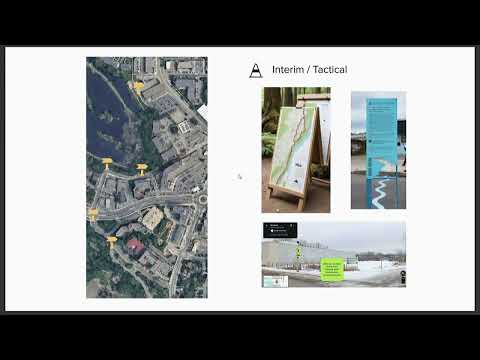
What was proposed: the placemaking playbook pairs tactical, low-cost tries (painted asphalt paths, pop-up seating, bike repair stations, temporary markets, coffee carts and food trucks) with longer-term investments (gateway signage, murals, improved lighting and permanent public spaces). Specific suggestions included a mural or gateway artwork near the amphitheater, improved wayfinding and lighting to make the lake and trails more visible, branding and signage for the city's bicycle spine along 66th, and seasonal activations in underused parking at the hub.
Short illustrated the parking-activation concept with case studies (including a conversion labeled Hillcrest Village) and recommended testing with paint, benches and string lights before permanent redevelopment. He also recommended issuing an RFP for mobile coffee vendors to prove retail demand in front of identified spots.
Branding options: Civic Brand presented three visual directions. "Shapes" uses bright colors and various forms to highlight diversity and seasonality; "Patchwork" centers patterned graphics on roundabouts and banners; and "Line" is a more minimalist approach that emphasizes linear connections between nodes. All three mock-ups used "Richfield" prominently while avoiding a day-one rollout of the label "Downtown Richfield," a deliberate choice presenters said would allow the identity to be "earned" through physical changes and consistent application.
Council and EDA reaction: most members expressed support for tactical pilots and stronger wayfinding and lighting. Multiple councilmembers favored the more colorful concepts (Shapes and Patchwork) for their vibrancy; others urged a tighter, simpler system to limit inconsistent implementation. Council member Coleman Woods (Ward 3) said "the hub has seemed to have stuck with us a long, long time" and supported rebranding activity. Several members and staff cautioned against siting social seating directly in front of the municipally owned liquor store; one councilmember suggested designing that stop to feel integrated with the street and bus stop rather than a place to "hang out in front of the liquor store."
Funding and next steps: staff said the consultant work to date was funded about 90% by an external grant or partner and that the EDA contributed $5,000. Short and staff asked the council and EDA to pick a direction to refine; staff will combine the chosen branding direction with the placemaking concepts, test tactical pilots, and pursue grant or budget options to fund installations. Staff closed by offering residents a chance to speak at the council's open forum if they wanted more time.
What was not decided: there were no formal votes or ordinance actions at the work session. Members did not adopt a final brand, nor did the council designate definitive geographic boundaries for a "downtown"; several members said an internal planning name and consistent design standards will be needed if the city pursues streetscape or regulatory changes.
Looking ahead: staff will collect feedback from the meeting, refine selected concepts and return with updated mock-ups and a recommended sequencing of tactical pilots and funding options.