Get Full Government Meeting Transcripts, Videos, & Alerts Forever!
Get email alerts on the Caregiving topic
No spam. Unsubscribe anytime.
Pierce County proclaims November 2025 Family Caregiver Month and highlights county caregiver support services
Summary
The Pierce County Council and Executive proclaimed November 2025 as Family Caregiver Month and highlighted the Pierce County Family Caregiver Support Program, which provides respite services, counseling and other assistance to unpaid family caregivers. County staff gave a program overview and a caregiver offered a personal testimonial.
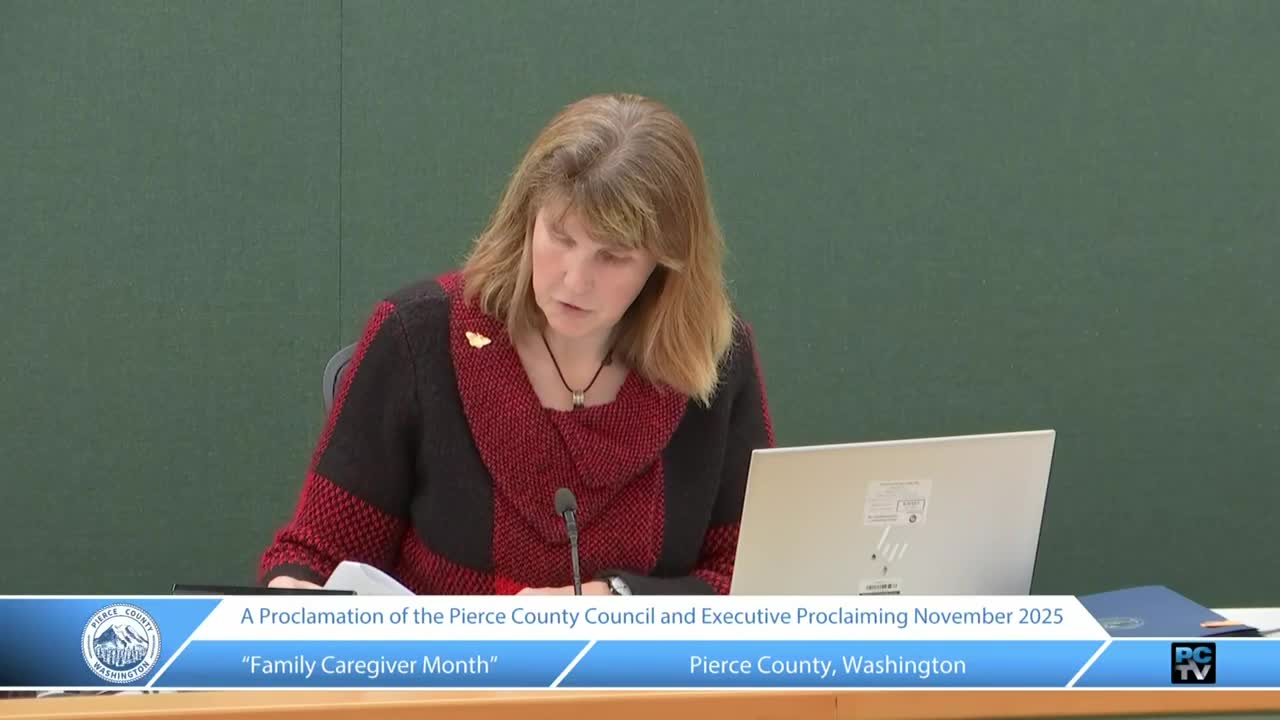
The Pierce County Council and Executive on Oct. 28 proclaimed November 2025 as Family Caregiver Month and used the occasion to describe county programs that support unpaid family caregivers.
Councilmember Yambe read the proclamation into the record, noting Pierce County’s demographic trends and the role of family caregivers. Matt Santelli, education and outreach specialist with Pierce County Aging and Disability Resource Services (ADRS), summarized the Family Caregiver Support Program and local outreach activities. Santelli said the county estimates about 87,000 family caregivers of adults live in Pierce County and that they provide an estimated 82,000,000 hours and nearly $2,000,000,000 worth of unpaid care each year.
Santelli described services available through the program: consultation, caregiver counseling, training, support groups, limited respite (examples cited included in‑home relief for up to 24 hours per month), light household assistance and provision of certain medical equipment. He said the county’s program is fully subsidized for eligible couples up to $6,000 monthly household income and that Pierce County staff authorize services directly. He gave the program contact as (253) 798-4600 and the website www.pierceadrc.org for more information.
A caregiver, Sharon Tupa, described how county-coordinated respite services and a Catholic Community Services provider delivered several hours a week of in‑home support that allowed her time for medical appointments and short breaks, and she urged others to become program advocates.
Councilmembers from across the chamber praised the proclamation and commended ADRS staff, noting the mental‑health and isolation risks caregivers face and the increasing local demand as the county’s population ages. Councilmembers encouraged public awareness of the program and cited prior county action—Resolution R2021-201—that recognized family caregivers and participating veterans’ families.
The proclamation does not change program eligibility or funding; it serves to raise awareness and encourage use of existing ADRS services. Councilmembers said further staff work on caregiver needs and budgets may be discussed in future meetings.