Get Full Government Meeting Transcripts, Videos, & Alerts Forever!
Get email alerts on the Boards Commissions topic
No spam. Unsubscribe anytime.
Pierce County updates boards, per diems and expands Planning Commission over objections
Summary
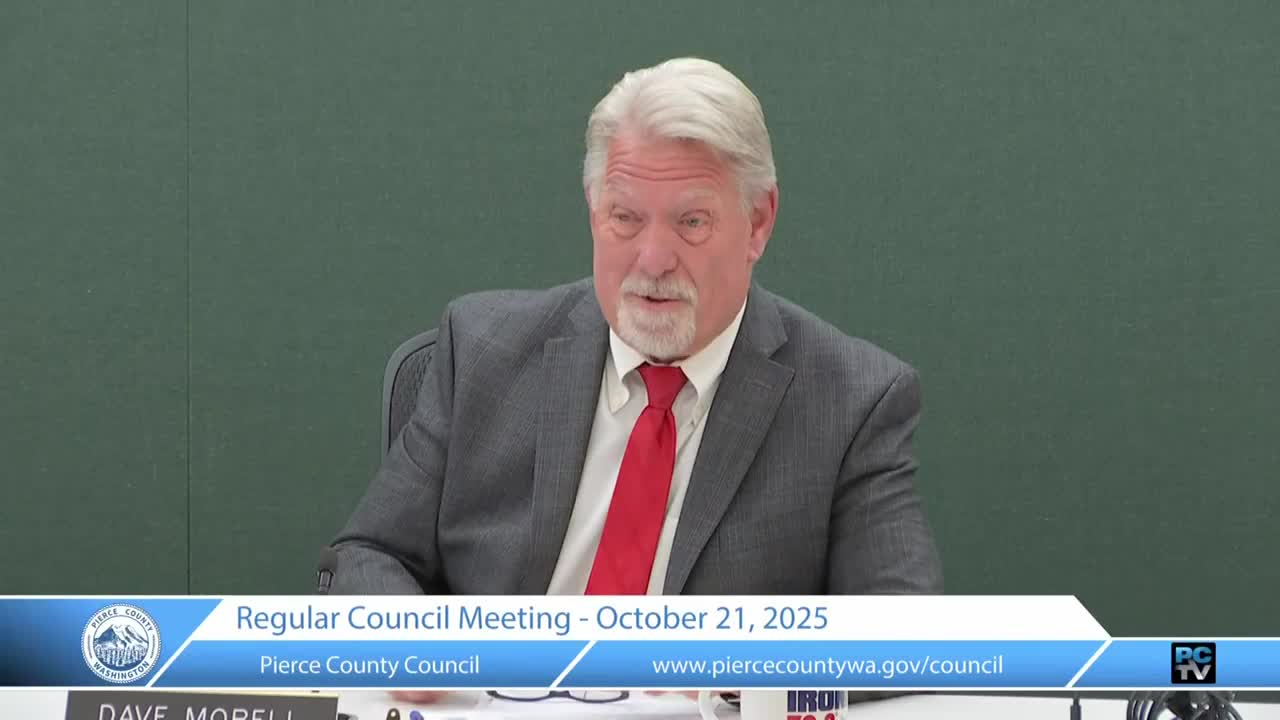
Pierce County’s Council on Oct. 21 adopted an ordinance authorizing compensation/reimbursement for selected boards and commissions, boosting some per diems and expanding the Planning Commission with two at‑large technical seats.
Pierce County’s Council adopted ordinance O2025‑538S on Oct. 21, changing code language to authorize compensation and reimbursements for identified county boards, committees and commissions under the county’s community engagement financial support chapter. The ordinance also increases per‑diems for the Board of Equalization and the Planning Commission and adds two at‑large seats to the Planning Commission with specified technical qualifications and residency requirements.
Under the ordinance as adopted, certain codified and non‑codified advisory bodies are eligible to receive per diem or reimbursement consistent with the community engagement financial support chapter; that chapter (adopted earlier in 2025) provides a framework for paying members to reduce economic barriers to participation. The Planning Commission membership increases from seven to nine to add two at‑large members described in the ordinance as possessing technical expertise (biology, horticulture or environmental sciences) to help analyze land‑use and environmental impacts; the two at‑large members must be registered voters of Pierce County and reside in different council districts, and the ordinance adjusts the quorum requirement to reflect the new membership.
Council debate included repeated concerns about (1) whether compensating volunteer members would change motivations for service and weaken the volunteer ethic; (2) whether adding at‑large, technically expert positions risks diluting district representation and producing governance by experts rather than elected accountability; and (3) fiscal impacts. Supporters argued the adjustments remove economic barriers for younger people, people with lived experience, and others who otherwise cannot afford to serve; they said per diems and reimbursements make boards more representative and increase the diversity of voices the county hears.
Several floor amendments were offered: some sought to make the at‑large seats nonvoting or limit the stipend differences; others sought two‑year terms for ad‑hoc seats and to remove age‑based differences for a developmental‑disability advisory board stipend. Multiple amendments failed or were withdrawn; the council ultimately adopted the ordinance on a roll call vote (4 ayes, 3 nays). Supporters emphasized equity and outreach benefits; opponents warned about long‑term governance consequences.
The ordinance includes a fiscal note: staff said the Board of Equalization will need an added budget adjustment (estimated at roughly $23,800 annually) to cover the increased per diems; other items were spread across existing departmental budgets or will require future budget adjustments. The ordinance will require departments to implement per‑diem and reimbursement processes and the council indicated staff will return with administrative details and fiscal adjustments as necessary.