
Pierce County Council approves submittal of two state clean-energy grant applications for county buildings
Get AI-powered insights, summaries, and transcripts
Subscribe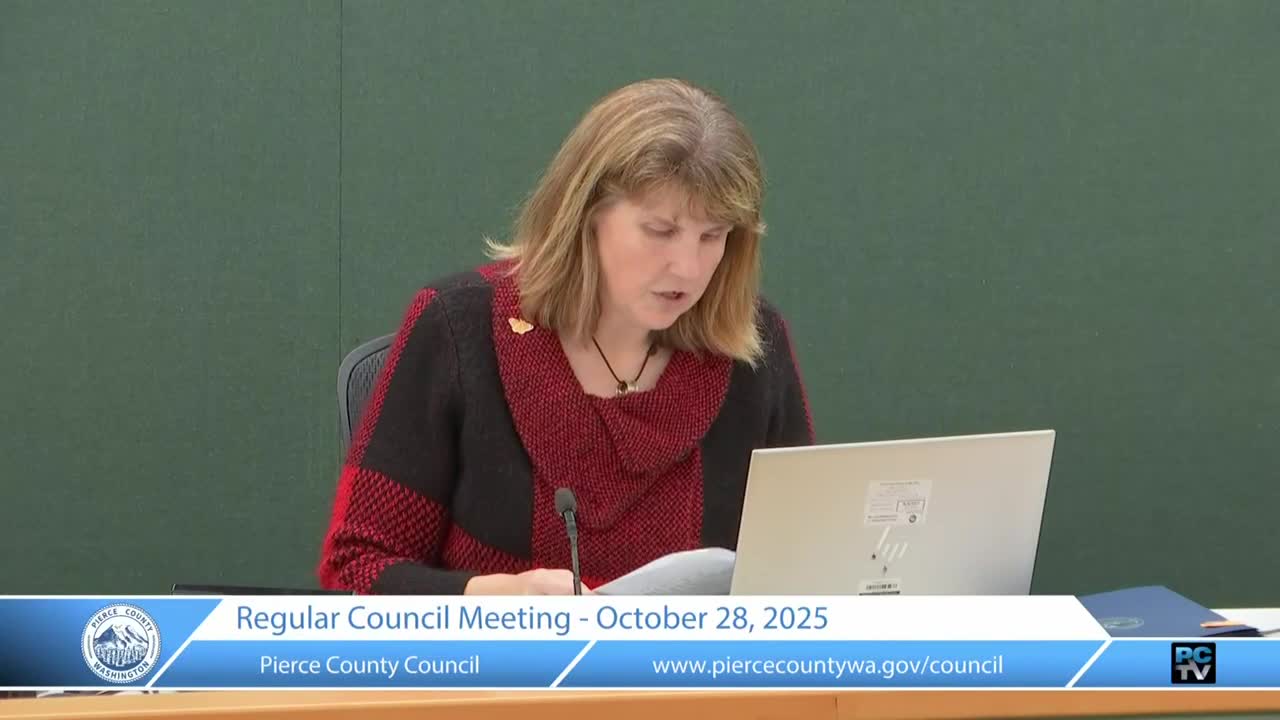
Summary
The Pierce County Council voted to approve submittal of two competitive clean-energy grant applications to the Washington State Department of Commerce for solar installations on county facilities. Council discussion focused on site feasibility, long‑term maintenance and how on‑site generation helps meet state clean‑building energy targets.
The Pierce County Council on Oct. 28 approved the submittal of two grant applications to the Washington State Department of Commerce to install rooftop solar arrays on county buildings.
Councilmember Denson moved to approve submitting both applications; the measure was carried by voice vote after staff answered council questions and no members of the public addressed the submission. Council did not record a roll-call tally; the motion passed by voice vote.
The grant opportunities are part of a competitive Commerce program with roughly $32 million available statewide, staff said. County facilities management staff and an electrical engineering consultant previously completed a solar-feasibility study that identified priority buildings. The two target sites discussed at the meeting were 1501 Market Street and Sprinker Recreation; staff told the council the study calculated about 95% and 96% annual solar access for those sites, respectively, and estimated expected annual kilowatt‑hour production using local weather data.
Councilmembers raised questions about long‑term costs and risks. Councilmember Krueger said she was concerned about lifecycle issues—maintenance, replacement parts, disposal of panels at end of life, and the potential fiscal exposure if manufacturers leave the market. Councilmember Gruber and others asked whether the county already had solar on other buildings (staff said they were 99% sure the county did not) and whether utilities or private partners might lease rooftop space. Staff said Commerce encouraged multiple applications from the same entity as long as application quality did not suffer, and that permit costs and site‑specific regulatory considerations had been reviewed as part of the feasibility work.
Councilmember Denson and staff framed the applications in the context of state clean‑building requirements for large facilities. Staff noted that on‑site solar generation can be counted against a building’s energy use in calculating compliance with state energy‑use intensity targets for large ("tier 1") buildings.
Staff said the grants are all‑or‑nothing awards: if Commerce funds a project it would cover design, materials and installation costs identified in the application; if not awarded, the county would not receive partial funding. The council voted to proceed with submitting both applications.
The council did not set final project scopes or appropriations at the meeting; if funded, installation and ongoing operations would be subject to future procurement, permitting and budget approvals.