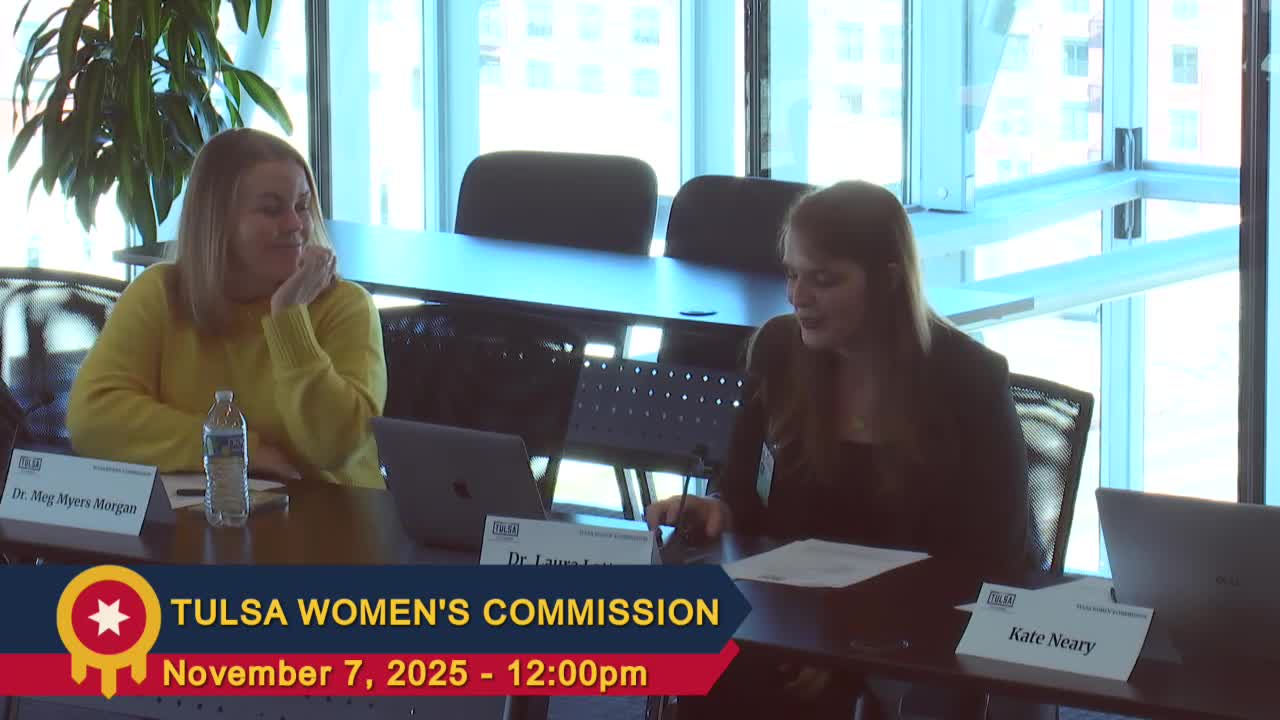
OU Professor Urges Tulsa Women's Commission to Center Safety, Pick One Action
Loading...
Summary
Dr. Meg Myers Morgan told the Tulsa Women's Commission that empowerment depends on addressing racism and misogyny, and urged commissioners to "pick one thing" in their sphere to pursue. Commissioners agreed to condense a year of inquiry into a short packet and to pick a focused initiative at their January meeting.
Dr. Meg Myers Morgan, a professor at the University of Oklahoma and author, told the Tulsa Women's Commission on a final installment of its yearlong inquiry that "women's empowerment cannot exist if we first don't eliminate racism," framing empowerment as inseparable from intersectional systems.
Morgan walked commissioners through a three-part approach to empowerment'self, career and society'and emphasized safety as a foundational concern. She cited national statistics on intimate-partner violence and maternal health disparities, saying that "36 percent of women in the U.S. have experienced intimate partner violence" and that Native American women experience domestic violence at a far higher rate. Morgan also highlighted health-system gaps, including late testing of menstrual products and higher maternal mortality among Black women.
The presentation moved from home safety and health inequities to education and workforce issues. Morgan noted that women now graduate college at higher rates than men but face occupational steering and gendered expectations that constrain choices. She said workplace harassment and assault remain problems, and argued that as fields become female-dominated their pay and perceived value can decline. "There's actually something called gender-based evaluation," she said, pointing to veterinarians and other professions as examples.
Morgan also addressed the economic burden of gendered marketing, saying women often pay more for similar goods (the so-called "pink tax") and described childcare shortages as a driver of female labor-force exits, a problem that deepened during the COVID-19 pandemic. On reproductive health, she cited teen-pregnancy statistics and the role of older fathers in many cases, framing predatory relationships as a public-health concern.
In closing, Morgan urged commissioners to "pick one thing and one space you're in and go all in," arguing that focused efforts are more likely to produce sustained change than broad, principle-only demands. She added two operational suggestions: prioritize safety-related actions and avoid pursuing symbolic principles without market or research-based negotiation strategies.
Commissioners responded with a broad discussion about intersectional beauty standards, workplace aging and menopause, cultural expectations around domestic labor and the limits some women face based on immigration or cultural context. Several commissioners praised the presentation's intersectional lens and identified safety and access as recurring themes from the year's inquiry.
Following the discussion, the commission agreed to synthesize the year's findings into a concise packet (the chair suggested "three pages max") and to reconvene in January to select a single initiative to champion going forward. The commission set its next meeting for Jan. 9 and asked staff to curate and prioritize the inquiry findings for that meeting.