
BFRW committee orders staff opinion to clarify child-care occupant-load and sprinkler triggers
Get AI-powered insights, summaries, and transcripts
Subscribe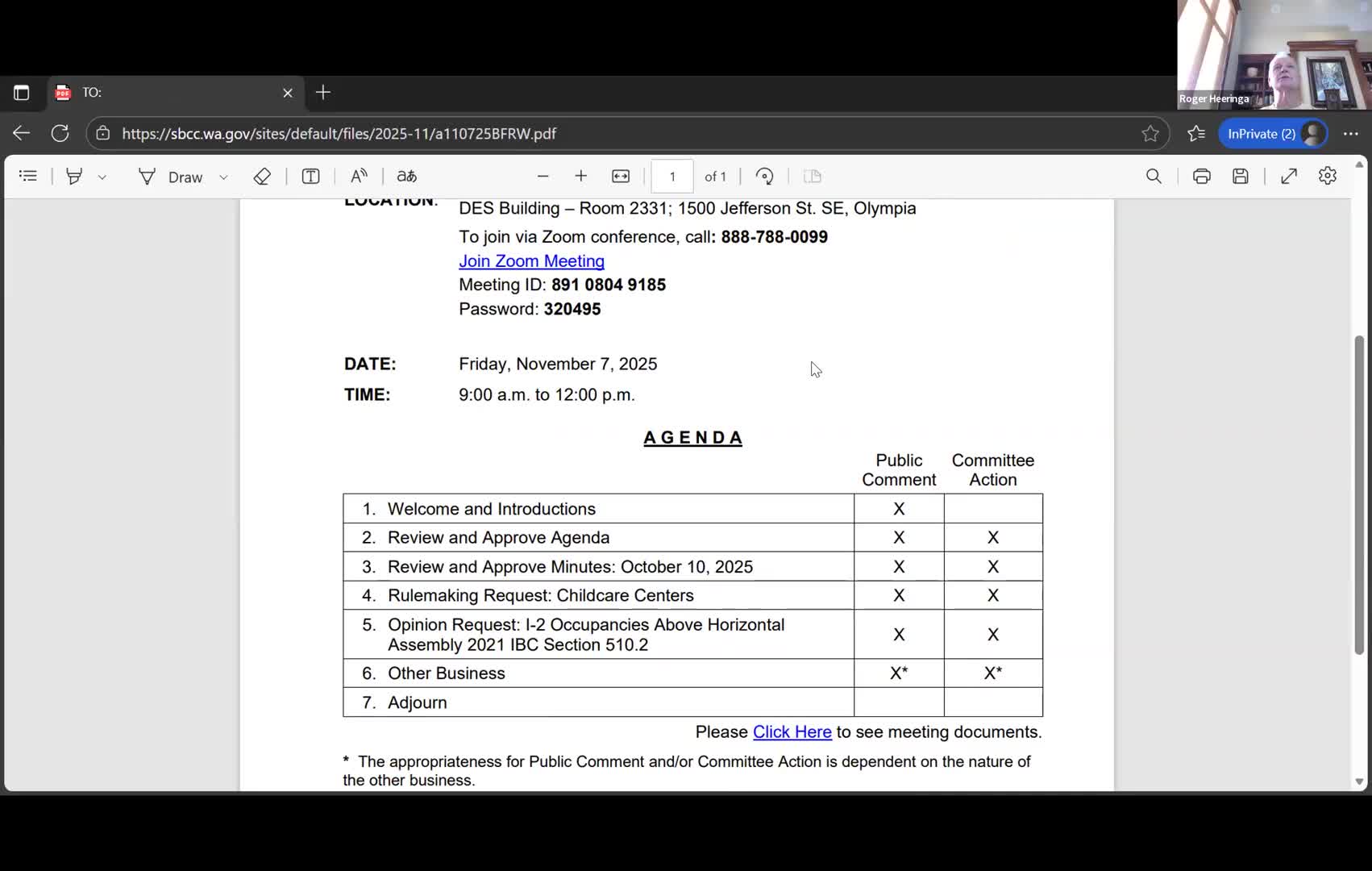
Summary
The BFRW committee of the State Building Code Council on Nov. 7 moved to clarify how occupant load and "fire area" calculations apply to child-care centers placed inside existing buildings, directing staff to draft an opinion interpreting the 2021 International Building Code (IBC) and to pursue 2024 code language for existing buildings.
The BFRW committee of the State Building Code Council on Nov. 7 moved to clarify how occupant load and "fire area" calculations apply to child-care centers placed inside existing buildings, directing staff to draft an opinion interpreting the 2021 International Building Code (IBC) and to pursue 2024 code language for existing buildings.
The action followed a petition from Ken Broulette asking whether, under the statute that authorized more child-care centers in existing buildings, local officials should calculate occupant load and sprinkler triggers based only on the space used for child care or based on the full fire area of the building. "I just thought that maybe we need to maybe come up with some rulemaking to clarify, regarding, you know, is there a fire barrier required or not?" Broulette said.
Why it matters: if officials apply the occupant-load calculation to the entire fire area rather than only the dedicated child-care spaces, many existing church or multiuse spaces could be deemed to exceed occupant thresholds that require whole-building sprinklers. Committee members cited the bill (identified in the meeting as Senate Bill 5655) and the RCW findings that the Legislature intended to make it easier to use existing buildings for child care.
Committee members debated three options presented by the petitioner and staff: (1) a narrow clarification that simply restates table-based occupant-load calculations; (2) a specific exemption for dedicated childcare spaces in certain building types; and (3) a clarification that affirms the code's existing approach that occupant load for sprinkler triggers is based on the defined fire area unless the daycare area is separated by rated construction. Several members said option 3 most clearly preserves the current code approach and reduces future interpretation differences.
Several members argued relief should focus on existing buildings. "If we can drill down on relief in the existing building code rather than the building code, maybe that's a path forward where we can try to provide some relief for what the legislature is trying to do," a committee member said. Staff and committee members discussed placing any targeted relief in the International Existing Building Code (IEBC) (for example, in the change-of-occupancy sections) rather than altering new-construction IBC rules.
The committee voted to direct staff to draft an opinion clarifying the interpretation of the 2021 IBC consistent with the committee's preferred clarification (recorded as "option 3" during the meeting). The motion passed by voice vote. The committee also approved a motion directing staff to develop language for the 2024 IEBC (or the existing-building provisions) and to submit that language to the IEBC tag for consideration in the 2024 code cycle; that motion also passed by voice vote.
In follow-up steps, petitioner Ken Broulette agreed to withdraw his petition so staff and the tag could handle drafting and public review. Staff said they will prepare an opinion for the council and work with the IEBC tag on proposed permanent language for the 2024 cycle.
Details and context: presenters and committee members discussed specific code references including the fire-area definition and fire barrier requirements (table cited in the meeting as table 707.3.10 and chapter 9 references). Committee members emphasized differences between churches or community centers (where daytime use can substitute for occasional congregation use) and commercial strip-mall tenant scenarios (where adjacent tenant occupant loads can be simultaneous), noting that the latter typically requires rated separations or sprinklers under current code practice.
What happens next: staff will draft the formal opinion interpreting the 2021 IBC and will prepare proposed 2024/IEBC rule language for the tag to consider. The committee recorded the actions as its formal direction and will report the draft opinion and proposed language to the full council for adoption processes and public comment.
Ending note: the committee's action clarifies immediate enforcement guidance (via an opinion) while pursuing a longer-term code amendment for existing buildings to reflect the legislative intent cited in the petition.