
HCDC tells staff to prioritize 1–3 year actions, funding and measurable targets in 'Housing for All' update
Get AI-powered insights, summaries, and transcripts
Sign Up Free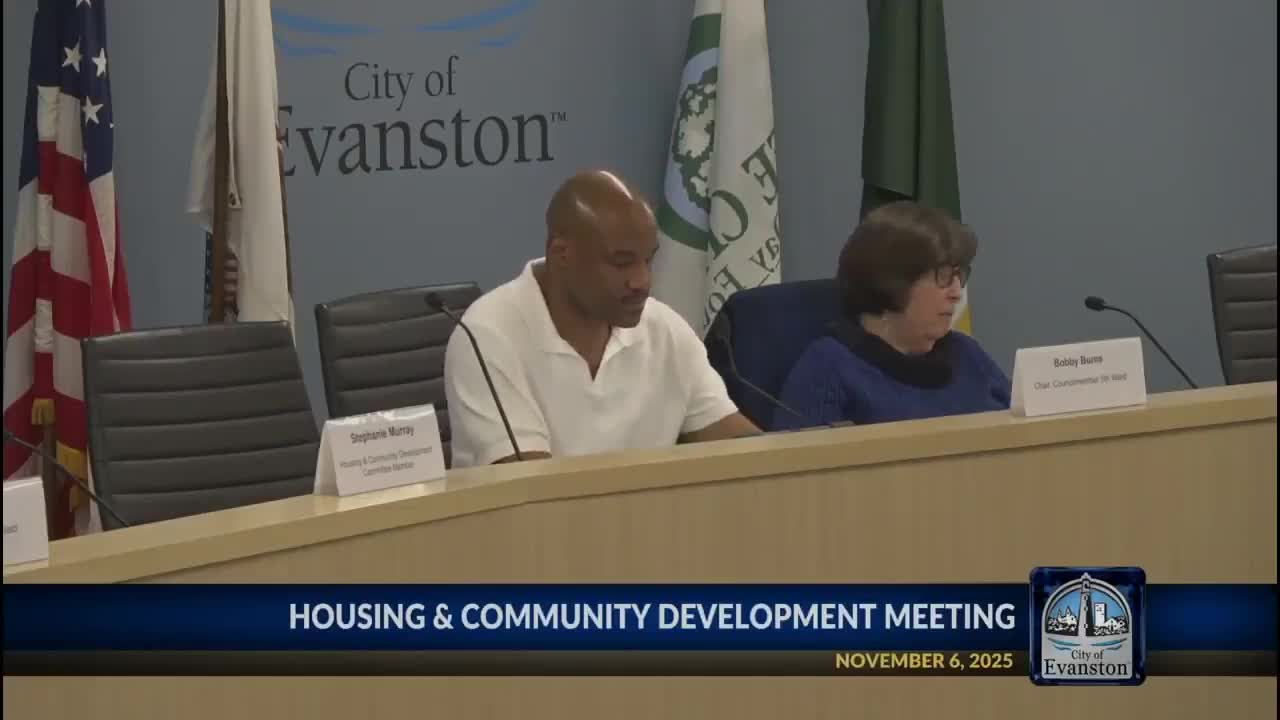
Summary
Committee members asked staff to rework the Housing for All draft to (1) identify near-term priorities to prevent displacement, (2) tie strategies to funding and implementation leads, (3) add measurable annual benchmarks and phased timelines, and (4) return with a more detailed, phased version for the committee and council (target: January).
The Housing and Community Development Committee spent the second half of its Nov. 6 special meeting pressing staff to convert the Housing for All draft into a phased, measurable implementation plan. Uri Pachter, senior housing planner, presented 14 staff recommendations that include consolidating strategies, adding funding/cost context, assigning implementation leads, and incorporating metrics and case studies.
Pachter said staff plans to add maps and charts, clarify which income brackets each initiative would serve, connect funding sources to strategies where possible, and identify departmental leads for each initiative. He also said staff would aim to better align goals and initiatives so the plan shows which strategies support multiple objectives and where efforts produce the greatest return on investment.
Committee members urged staff to produce a clear phase 1 (one- to three-year) set of priorities to prevent imminent displacement. Council member Rogers said he wanted staff to identify the likely groups to be displaced in the near term and then map strategies that most effectively keep those households in place. "Who are the people in the next 1 to 3 years who are gonna have to leave Evanston because they can't afford it?" Rogers asked; members suggested focusing on lower-income, larger households in high-cost-burden census tracts (committee discussion repeatedly cited the 5th Ward area as at-risk).
Members asked for concrete connections between the plan's 3,000–5,000 unit goal and annual benchmarks, and for staff to compare the pipeline of projects with the plan's income-targeting needs. Council member King asked staff to prioritize ‘‘fundamentals’’ and identify which strategies will be transformational versus incremental. Members also discussed leveraging inclusionary housing tools (including the ordinance's weighted-average option) and examining strategies to preserve naturally occurring affordable housing and properties whose affordability restrictions will expire.
Funding context and existing resources were discussed at length. Staff and members noted a roughly $4 million balance in the affordable housing fund (with portions already committed) and referenced a signed $7 million federal pro-housing grant that requires an action plan with HUD before funds are fully available. Members emphasized that the committee must identify how limited local funds should be prioritized and whether to target preservation, rental assistance, ADU development, or deeper affordability through subsidized developments.
Other implementation suggestions from the committee included:
- Prioritizing preservation of small multi-family and scattered-site units (NSP2 acquisitions and other units whose affordability is expiring). - Identifying phase 1 target populations (e.g., low-income families with children, seniors at risk of displacement) and mapping interventions to those groups. - Including both short-term actions (rental assistance, rehab programs, ADU technical assistance) and long-term zoning and missing-middle work that require more time. - Adding clearer oversight and reporting cadence (which committee or body will regularly review progress and at what frequency).
Outcome and next steps: Staff heard direction to draft a revised, phased Housing for All update that: clarifies priorities and near-term actions (1–3 years), ties strategies to likely funding sources and implementation leads, and includes measurable benchmarks and reporting milestones. Staff said it will aim to circulate a revised draft well in advance of the committee's next meeting and return in January with a more detailed implementation-oriented version.