Get Full Government Meeting Transcripts, Videos, & Alerts Forever!
Get email alerts on the Electricity Rates topic
No spam. Unsubscribe anytime.
Northwest Ohio aggregation leader: data centers, grid upgrades driving recent electricity bill spikes
Summary
Mark Frey, consultant to the Northwest Ohio Electric Aggregation Coalition and CEO of Palmer Energy, told Lucas County commissioners that a confluence of surging data-center demand, transmission constraints and the end of a three-year fixed-price contract explain recent steep increases in local electricity bills.
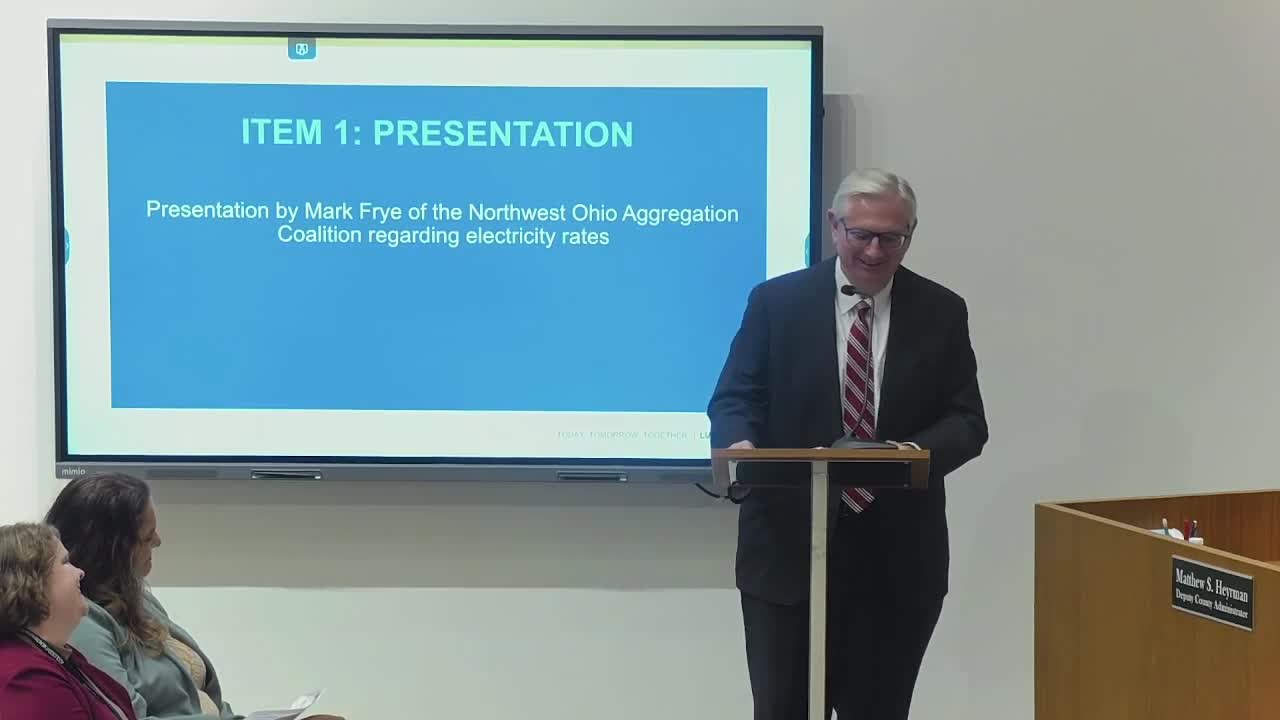
Mark Frey, CEO of Palmer Energy and a consultant to the Northwest Ohio Electric Aggregation Coalition (NOAC), told Lucas County commissioners on Oct. 7 that a ‘‘perfect storm’’ of demand and infrastructure changes—not the county’s aggregation program—has driven recent spikes in electricity costs.
Frey, who also serves as mayor of Sylvania, said NOAC had a three-year fixed-price supply contract that expired in May 2025. ‘‘We fixed our price at an opportune time,’’ he told commissioners, and as wholesale prices rose the protection lapsed. The coalition now ‘‘reverts to market conditions,’’ Frey said, and he cautioned residents there is likely no relief in the immediate term.
Why it matters: NOAC aggregates electric purchasing for multiple communities on an opt-out basis to lower rates through pooled buying power. Frey said the coalition has returned substantial savings to the region over decades but that the recent market shock exceeded what the aggregation could shield customers from.
Frey described several drivers of the price surge. He said overall U.S. electricity consumption grew only modestly over an 18-year span, but from 2023 to 2024 a roughly 3% increase in consumption was driven largely by large-scale data centers. ‘‘An individual large hyperscale data center will use more electricity on an annualized basis than the entire Lucas County will use,’’ Frey said, characterizing the demand as far larger and faster than markets anticipated.
He said the transmission operator PJM and utilities are planning substantial transmission upgrades to move the added load; Frey cited an industry figure in the hundreds of billions for regional transmission investment needs. He also said some data-center operators are addressing the problem by contracting directly with generation sources — citing Microsoft’s reported $1.5 billion arrangement with Constellation Energy related to 3 Mile Island — and that natural gas generation currently fills much of the near-term gap left by retiring coal plants and intermittent renewable output.
Frey warned that renewables’ intermittency and current battery storage limits complicate matching 24/7 data-center loads with wind and solar. He said NOAC had not yet signed a new long-term supply contract and was waiting to see how markets develop; ‘‘I'm not sure you can expect another three-year deal,’’ he said.
Commissioners and Frey agreed to schedule a broader public presentation so residents could better understand causes and options. Commissioner Gerken said the briefing should ‘‘be the springboard of more conversations’’ and asked staff to post materials online.
Provenance: The presentation and question-and-answer appear throughout the transcript beginning when Frey took the podium and concluding before the proclamation at 00:37:32. Topic excerpts: "Thank you, Commissioner Gerken... I am the... consultant for the Northwest Ohio Electric Aggregation Coalition" (transcript 00:06:21) and "Thank you. Yep. Okay. Next on our agenda is, proclaiming October 9 is children's environmental health day" (transcript 00:37:32).