Get Full Government Meeting Transcripts, Videos, & Alerts Forever!
Get email alerts on the Electrical Code topic
No spam. Unsubscribe anytime.
Lawrence board narrows NEC GFCI amendments for commercial code, moves residential items to IRC; amendments pass 8–0
Summary
The Lawrence Building Codes Board voted unanimously to adopt edited revisions to NEC Article 7, agreeing to move residential GFCI exceptions to the IRC, retain a commercial refrigeration exception, and remove sump pumps from a commercial appliance exemption list.
The Lawrence Building Codes Board voted unanimously to adopt revisions to the National Electrical Code (NEC) Article 7 that the board edited during its Nov. 3 meeting.
Board discussion centered on whether proposed GFCI (ground-fault circuit interrupter) amendments should apply to commercial construction or only to 1- and 2-family dwellings. Staff and multiple board members said prior debate on the topic was focused on residential settings and that carrying residential changes into the IRC would reduce conflicting requirements for apartment and single-family work. The board decided not to amend AFCI (arc-fault circuit interrupter) requirements in the NEC.
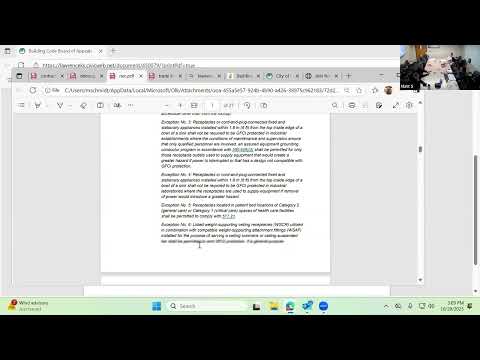
On the commercial side the board agreed to keep exception 7 — which retains GFCI protection for refrigeration and appliances in commercial kitchens and similar spaces — and to remove exception 5 from the NEC commercial section and treat it within the IRC (residential code). The board also struck sump pumps from the list in subsection d for commercial appliances. Staff said those edits will be circulated to the board after the meeting for record-keeping.
A motion to approve the NEC amendments as revised during the meeting was made, seconded and approved by an 8–0 vote. The motion covered the changes the board made on the floor: moving exception 5 to the residential code (IRC), keeping exception 7 for commercial kitchens/refrigeration, and removing sump pumps from the commercial appliance exemption list. The board did not alter AFCI language.
Staff will distribute the revised NEC text to board members for their records and to support any future cross-references in the IRC.
Why it matters: The edits limit changes to commercial electrical provisions to items the board agreed affect commercial safety and operations, while deferring residential GFCI changes to the IRC where the code structure already handles 1- and 2-family dwelling requirements.
Speakers quoted or cited in discussion included code staff and contractors who reviewed the draft language and provided site- and equipment-specific context.